Key takeaways
- Odor control: Look for activated carbon or another sorbent filter; HEPA is excellent for dust and dander but does not remove gaseous smells on its own.
- Particle filtration: A true HEPA or H13 HEPA stage helps capture litter dust, hair, and airborne allergens, especially in rooms where cats spend time.
- Placement: Choose a compact unit for a box alcove or a higher-capacity model for an open room. Keep the intake and exhaust clear of walls, curtains, and litter debris.
- Maintenance: Washable pre-filters are useful in cat homes because they catch hair before it loads the finer filter. Check replacement-filter availability before buying.
- Pet safety: Avoid products that intentionally generate ozone around cats. If a purifier uses ionization, look for clear emissions information and consider switching that feature off.
What's inside
Cat litter smell is rarely just a matter of a dirty box. Fine dust, tracked particles, ammonia-like odors, and airborne dander can settle into rugs, upholstery, and the furniture around a litter station. A purifier can help, but only if it is placed close enough to capture the problem and equipped for both particles and odors.
This guide takes a practical, hands-on look at compact litter-area deodorizers and full-size HEPA cleaners. I’m focusing on filter design, room coverage, noise, maintenance, and pet-safety considerations so you can match the machine to your actual setup rather than simply choosing the biggest advertised number.
As an Amazon Associate we earn from qualifying purchases.


🛒 Best Price Today on Amazon
Prime members get fast, free shipping on everything above, plus member-only deals. New members get a 30-day free trial — cancel anytime.
How to Choose an Air Purifier For Cat Litter Smells (2026)
- Odor control: Look for activated carbon or another sorbent filter; HEPA is excellent for dust and dander but does not remove gaseous smells on its own.
- Particle filtration: A true HEPA or H13 HEPA stage helps capture litter dust, hair, and airborne allergens, especially in rooms where cats spend time.
- Placement: Choose a compact unit for a box alcove or a higher-capacity model for an open room. Keep the intake and exhaust clear of walls, curtains, and litter debris.
- Maintenance: Washable pre-filters are useful in cat homes because they catch hair before it loads the finer filter. Check replacement-filter availability before buying.
- Pet safety: Avoid products that intentionally generate ozone around cats. If a purifier uses ionization, look for clear emissions information and consider switching that feature off.
The Best Air Purifier For Cat Litter Smells (2026)s Reviewed
Cat Litter Deodorizer, Odor Eliminator (3 Pack)
This three-pack of plug-in ionizers is designed for small spaces, making it a convenient option for a litter closet, bathroom, or utility room where a conventional purifier may be awkward. Its compact, filterless format keeps upkeep simple, although buyers should verify the unit’s emissions information and remember that a small plug-in device is not a substitute for ventilation or regular litter-box cleaning.
Cat Litter Odor Deodorizer with Sensor Monitor
This model combines a sensor monitor with ozone and negative-ion functions, aiming to react to odor conditions rather than run at one fixed setting. The monitoring concept is useful for a multi-purpose pet area, but the ozone feature deserves particular caution: I would not operate an ozone-generating mode in an occupied room with cats, people, or other animals.
LEVOIT Vital 100S-P
The LEVOIT Vital 100S-P is the most versatile choice here for a larger room shared by people and pets. Its washable pre-filter is a practical advantage for catching hair and litter dust, while the HEPA system, sleep mode, smart monitoring, and stated coverage of up to 1,073 square feet make it a strong living-room or bedroom candidate. For stubborn litter odor, confirm that the replacement filter includes a substantial carbon layer.
AIRROMI A2005
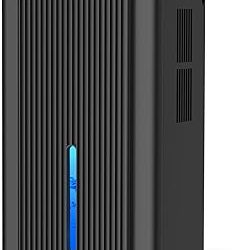
The AIRROMI A2005 is a compact 360-degree purifier aimed at bedrooms and smaller home spaces. Its pet-focused positioning, HEPA filtration, quiet operation, and scent option give it flexible appeal, but scented output should be treated as optional rather than a true odor-removal solution—particularly in homes where cats are sensitive to fragrances.
Cat Litter Deodorizer (2 Pack)
This two-pack of plug-in negative-ion deodorizers is a budget-friendly way to cover two small areas, such as a litter station and nearby hallway. The filterless design avoids recurring filter purchases, but it offers less robust particle capture than a HEPA purifier, so it works best as a supplementary odor-control tool alongside scooping, source ventilation, and occasional deep cleaning.
Frequently Asked Questions
Will an air purifier remove cat litter smell completely?
No purifier can compensate for an unclean box, damp litter, or poor airflow. A cleaner can reduce airborne odor and particles, but the best results come from frequent scooping, a properly sized box, fresh litter, and placing the purifier near—not inside—the litter area.
Is HEPA enough for litter-box odors?
HEPA is designed primarily for particles such as dust, dander, and hair. For odor molecules, choose a purifier with activated carbon or another gas-adsorbing media, and check how much carbon is included because very thin carbon sheets have limited capacity.
Where should I put the purifier?
Set it a few feet from the litter box with a clear intake path, ideally in the same room where odor accumulates. Avoid placing it directly on the floor beside a dusty box; a stable low table or stand can reduce the amount of litter grit pulled into the machine.
Are ionizers and ozone purifiers safe for cats?
Ozone-generating products should not be used around occupied spaces, pets, or people. Ionizers may also produce trace emissions depending on their design, so review the manufacturer’s documentation and select a purifier with a switchable ionizer—or use a conventional HEPA-and-carbon model instead.
Final Thoughts
For whole-room coverage and everyday pet debris, the LEVOIT Vital 100S-P is the strongest all-around pick. The AIRROMI A2005 suits a smaller bedroom, while the compact plug-in deodorizers are best considered supplemental tools for targeted spaces rather than replacements for HEPA filtration and good litter-box hygiene.