Key takeaways
- Polycarbonate: Highly impact-resistant and a sensible choice for children or rough outdoor use. Rebound can sound and feel less like a gymnasium backboard.
- Acrylic: Clear, attractive, and usually less expensive than glass. It provides a livelier rebound than basic molded plastic but may scratch or cloud over time.
- Tempered glass: Provides the most consistent rebound and a professional feel. It is heavier and needs a stronger pole and base to perform well.
- Molded plastic: Lightweight and budget-friendly, but rebound is generally softer and less predictable.
The best basketball hoops for driveway use are usually portable systems for renters and families who need flexibility, while in-ground hoops are the better choice for serious play, windy locations, and maximum stability.
Our top picks


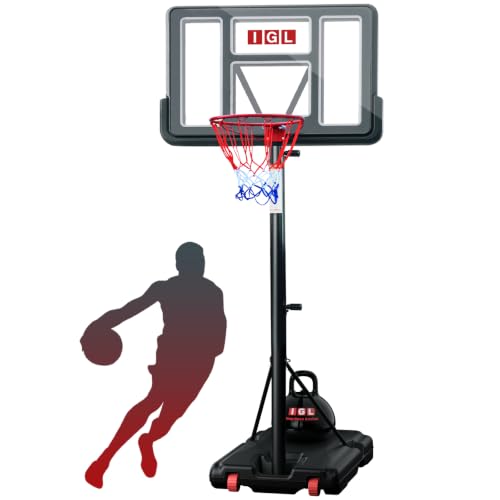

As an Amazon Associate we earn from qualifying purchases at no extra cost to you. Ratings are shown as listed on Amazon.
Portable vs. in-ground basketball hoops: the short answer
A portable hoop has a weighted base, wheels, and an adjustable pole, so you can reposition it or store it between games. An in-ground hoop is anchored in concrete and normally offers less movement, a cleaner playing area, and better resistance to aggressive shots. The trade-off is permanent installation and a larger commitment to your driveway layout.
| Decision factor | Portable hoop | In-ground hoop | Best choice |
|---|---|---|---|
| Base stability | Usually a 27–50 gallon base filled with water or sand; can rock during hard rebounds | Steel pole set in a concrete footing; substantially less movement | In-ground for dunking, competitive practice, or windy areas |
| Backboard material | Acrylic or polycarbonate is common; tempered glass is available on premium models | Tempered glass, acrylic, polycarbonate, or molded plastic | Tempered glass for the most authentic rebound |
| Height adjustment | Often adjustable from about 7.5 to 10 feet | Commonly 7.5 to 10 feet, with some systems offering a wider range | Either, depending on the adjustment mechanism |
| Driveway footprint | Base commonly extends about 3.5–5 feet behind the pole and may need side clearance | Smaller equipment footprint, but the footing and pole are permanent | Portable for temporary use; in-ground for a tidy permanent court |
| Weather durability | Good when covered and drained; water-filled bases can crack when frozen | Generally better, though exposed steel and backboard hardware still need maintenance | In-ground in harsh weather, or a well-protected portable model |
Choose a portable hoop if flexibility matters most
Portable systems are the practical choice for renters, shared driveways, young children, and households that want to clear the driveway for vehicles. A base filled with water is easier to empty and move, while sand adds weight but makes the system harder to relocate. A 50-gallon base filled with water weighs roughly 417 pounds, although the actual system weight varies. Sand is heavier per volume and does not freeze or slosh, but it can be difficult to remove once inside the base.
Look for two or more wheels, a broad base, and a pole that connects securely to the frame. A narrow or lightly weighted base may be acceptable for free throws and casual shooting, but it can shift when a ball hits the rim at an angle. Portable hoops also need room behind the baseline: measure the base, wheel path, and the space required to tilt the system before buying.
Portable hoop backboards
- Polycarbonate: Highly impact-resistant and a sensible choice for children or rough outdoor use. Rebound can sound and feel less like a gymnasium backboard.
- Acrylic: Clear, attractive, and usually less expensive than glass. It provides a livelier rebound than basic molded plastic but may scratch or cloud over time.
- Tempered glass: Provides the most consistent rebound and a professional feel. It is heavier and needs a stronger pole and base to perform well.
- Molded plastic: Lightweight and budget-friendly, but rebound is generally softer and less predictable.
Choose an in-ground hoop for stability and serious practice
In-ground hoops are the best basketball hoops for driveway play when stability is the priority. The pole is installed in a concrete footing, eliminating the rolling base and greatly reducing vibration. This matters for bank shots, repeated rim contact, and players who intend to practice at game speed.
Installation is more demanding than assembling a portable system. You may need to excavate, pour concrete, wait for it to cure, and assemble the pole and backboard with help from another adult. Check local utility-marking requirements before digging. A typical pole footing may require a hole roughly 16–24 inches across and around 24–48 inches deep, but the manufacturer’s installation specifications must take priority.
In-ground systems also require careful placement. The backboard should not obstruct garage doors, walking routes, or parked vehicles. Leave enough room for the pole, rebound area, and maintenance access. If you might move homes within a few years, the installation cost and permanent footing may outweigh the stability benefit.
One-piece and multi-piece poles
A one-piece steel pole usually offers the least movement because it has fewer joints. It is the preferred design for serious players, but it can be difficult to transport and install. Multi-piece poles are easier to handle and often less expensive, though each connection can introduce some vibration. For family shooting, a well-engineered multi-piece pole can be adequate; for repeated dunking or competitive practice, favor a one-piece pole or a premium reinforced design.
Height adjustment is more important than it looks
A regulation rim is 10 feet high, but children often develop better form when the hoop is lowered. For younger players, a system that adjusts to 7.5 or 8 feet can make the ball easier to control without encouraging them to throw from below their chin. Teenagers and adults can gradually move the rim toward 10 feet.
Telescoping poles are convenient, but the adjustment mechanism is a wear point. Pin-based systems are simple and dependable but may offer fewer height settings. Crank systems allow more precise changes and can be easier for one person to operate, although the handle, cable, or gears may need maintenance. Avoid choosing a hoop solely because it advertises a wide adjustment range; confirm that the lowest setting still leaves the backboard and rim safely above the driveway.
Measure the driveway before buying
Do not measure only the space between the garage and the street. Include the base or concrete footing, the backboard’s overhang, the player’s approach, and the path of a missed shot.
| Space to measure | Useful planning allowance | Why it matters |
|---|---|---|
| Behind a portable base | 3.5–5 feet, plus room to roll and tilt it | Prevents the base from blocking a garage or walkway |
| Side clearance from walls or vehicles | At least 3 feet; more for active play | Reduces collisions and protects cars and siding |
| Clearance above the backboard | At least 1–2 feet from gutters, branches, and roof edges | Allows adjustment and avoids repeated impacts |
| Playing depth in front of the hoop | About 20 feet for casual shooting; 30 feet or more for broader drills | Determines whether players can practice beyond the key |
| Vehicle and pedestrian route | Keep a clear path of roughly 8–10 feet where cars or people pass | Maintains safe access when the hoop is in use |
A portable hoop may fit physically while still being inconvenient if its base occupies the best parking position. An in-ground model frees the ground around the pole, but the rim and backboard remain permanent overhead obstacles. Mark the proposed location with painter’s tape and test the space with a ball before installing anything.
Best type by household situation
| Your situation | Recommended design | Reason |
|---|---|---|
| Renter or frequent mover | Portable, polycarbonate or acrylic backboard | No concrete work and easier relocation |
| Young children learning fundamentals | Portable hoop with a low adjustment range | Height can follow the child’s development |
| Serious high-school or adult player | In-ground hoop with tempered glass and a rigid pole | More authentic rebound and minimal movement |
| Windy property | In-ground system, or a portable base filled with dry sand and secured as directed | Reduces tipping and unwanted movement |
| Small driveway shared with vehicles | Portable system with large wheels, or no permanent hoop | Can be moved when parking or access is needed |
| Families concerned about storage | Portable hoop that can be covered and rolled to a protected location | Protects the base and backboard during severe weather |
Weather durability and maintenance realities
Outdoor hoops wear out from exposure as much as from basketball. UV light can fade graphics and weaken some plastics, while rain promotes rust around bolts, welds, and pole seams. Inspect fasteners at least a few times each season, tighten loose hardware, and replace visibly corroded parts before they fail.
Never leave a water-filled portable base exposed where temperatures regularly fall below freezing. Expanding ice can split the base. Drain it before winter or use the manufacturer’s approved antifreeze approach. Do not move a portable hoop by pulling on the rim or backboard. Use its wheels, keep the backboard controlled, and have a second person help on slopes.
For the longest service life, use a weather cover when the hoop is not in use, avoid hanging from the rim unless the system is specifically designed for it, and keep tree branches from rubbing the backboard. The components most likely to wear first are base seams, wheel brackets, adjustment cables, pole joints, rim springs, and exposed bolts.
How much should you spend?
Basic portable hoops usually cost about $150–$300, while more stable adjustable portables commonly fall around $300–$700. Premium portable systems with tempered-glass backboards can cost $700–$1,500 or more. Entry-level in-ground systems often begin around $400–$900 before installation, while rigid, glass-backboard systems can reach $1,000–$2,500 or more. Concrete, delivery, tools, and professional installation may add several hundred dollars.
For most households, spend first on a stable pole and correctly sized base or footing, then on the backboard material. A large glass backboard cannot compensate for a portable base that shifts with every shot. If the driveway is shared or the hoop must move, choose a dependable portable system with a lower adjustment range. If the location is permanent and players care about realistic rebound, an in-ground tempered-glass hoop is the stronger long-term choice.