Key takeaways
- Battery capacity vs. real runtime: A 20,000mAh pack typically delivers 6–10 hours on low and closer to 3–4 on high with the light on. If you want all-evening airflow at full tilt, step up to a 40,000mAh unit rather than hoping the marketing math works out.
- Blade span matters more than motor watts: A 20″ fan cools a bistro table and two chairs. A 31.5″ span pushes a genuine column of air across a full gazebo. Measure your seating footprint before you buy small and regret it.
- Hanging hardware and headroom: Check for an included extension hook or S-hook. Canopy crossbars, umbrella poles, and tent ridge loops all need different reach, and a fan hung flush to fabric will recirculate hot air instead of moving it.
- Solar panel realism: Panels are a great top-off for sheds, coops, and porches with sun exposure, but a fan hanging under a canopy sits in shade by definition. Plan to run the panel on a lead into daylight, or treat USB-C charging as your primary source.
- Light quality and controls: Look for dimmable output and adjustable color temperature (3000K–6500K) so the same fixture works for dinner and for a late-night card game. A remote is non-negotiable when the unit is eight feet overhead.
What's inside
Running romex to a gazebo ceiling means a trench, a GFCI circuit, an inspection, and a weekend you’d rather spend grilling. Most covered patios, pop-up canopies, and RV awnings simply have no junction box overhead, and the ones that do often sit too far from the panel to justify the copper. That’s why rechargeable overhead fans have quietly become the practical answer: a hook, a battery pack, and airflow where you actually sit.
I’ve hung, charged, drained, and re-hung a stack of these units across a screened porch, a 10×10 pop-up, and a travel trailer awning. Below I’ve sorted out which ones genuinely move air versus which ones just spin, plus what the spec sheets leave out about hanging hardware, blade span, and how solar panels behave under a shade structure. Here are the picks worth your money in 2026.
As an Amazon Associate we earn from qualifying purchases.



🛒 Best Price Today on Amazon
Prime members get fast, free shipping on everything above, plus member-only deals. New members get a 30-day free trial — cancel anytime.
How to Choose a Battery Powered Ceiling Fan No Wiring (2026)
- Battery capacity vs. real runtime: A 20,000mAh pack typically delivers 6–10 hours on low and closer to 3–4 on high with the light on. If you want all-evening airflow at full tilt, step up to a 40,000mAh unit rather than hoping the marketing math works out.
- Blade span matters more than motor watts: A 20″ fan cools a bistro table and two chairs. A 31.5″ span pushes a genuine column of air across a full gazebo. Measure your seating footprint before you buy small and regret it.
- Hanging hardware and headroom: Check for an included extension hook or S-hook. Canopy crossbars, umbrella poles, and tent ridge loops all need different reach, and a fan hung flush to fabric will recirculate hot air instead of moving it.
- Solar panel realism: Panels are a great top-off for sheds, coops, and porches with sun exposure, but a fan hanging under a canopy sits in shade by definition. Plan to run the panel on a lead into daylight, or treat USB-C charging as your primary source.
- Light quality and controls: Look for dimmable output and adjustable color temperature (3000K–6500K) so the same fixture works for dinner and for a late-night card game. A remote is non-negotiable when the unit is eight feet overhead.
The Best Battery Powered Ceiling Fan No Wiring (2026)s Reviewed
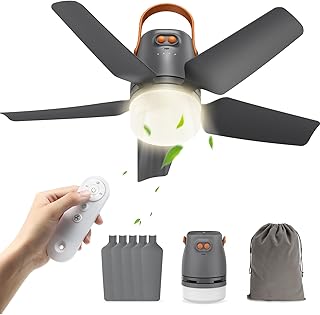
31.5″ Gazebo Outdoor Ceiling Fan with 40000mAh Battery
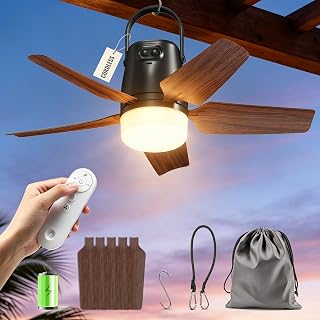
This is the one I reach for when the whole family is under the canopy — the wide blade span and 40,000mAh pack combine for genuine all-evening performance across four speeds. The 3000K–6500K dimmable light is the most versatile of the group, though the larger diameter needs a proper crossbar rather than a flimsy umbrella clip.
21″ Portable Ceiling Fan with 20400mAh Battery
A smart middle ground: the extra inch of blade over the standard 20″ models is noticeable, and the hangable design packs down cleanly for camping trips. Runtime on medium is where this one shines, making it my pick for weekend tent use.
20″ Outdoor Patio Ceiling Fan with Light and Remote
Straightforward, well-balanced, and quiet enough that conversation isn’t a shouting match — the farmhouse-style housing looks intentional on a covered porch rather than like camping gear. Best suited to smaller patios, gazebos, and RV awnings where a compact footprint is the point.
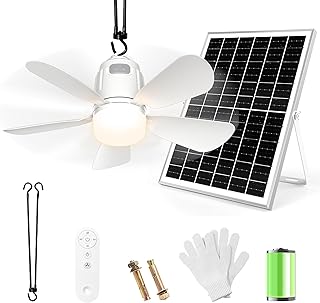
Gliztech Solar Ceiling Fan with 30W Panel
The 30W panel is the largest here, and it genuinely keeps up if you can position it in direct sun on its lead cable. I’ve found it especially useful for permanent installs like sheds and chicken coops, where you set it once and stop thinking about charging.
20″ Canopy Fan with Extension Hook
The included extension hook solves a real problem: getting the fan far enough below tent fabric to actually circulate air. Controls are refreshingly simple, which makes it a good pick if you’d rather not decode a five-button remote in the dark.
Frequently Asked Questions
How long do these fans actually run on one charge?
Expect 6–12 hours on the lowest speed with the light off, and roughly 3–5 hours on high with lighting engaged. Capacity scales predictably, so a 40,000mAh unit roughly doubles a 20,000mAh one under identical settings.
Can I leave one hanging outside permanently?
Under a covered structure, yes. These are outdoor-rated for humidity and splash, not for standing rain or snow load — bring them in for winter and the battery will last considerably longer.
Do the solar panels charge fast enough to skip the wall outlet?
For light-duty use in full sun, often yes. For daily multi-hour runtime, treat solar as supplemental and top off via USB-C between sessions.
Will one of these cool an enclosed room?
They move air rather than lower temperature, so they work best where you feel the breeze directly. In a sealed garage or shed, pair one with cross-ventilation for meaningful relief.
Final Thoughts
For most covered patios and gazebos, the 31.5″ 40000mAh gazebo fan is the clear performance leader and worth the extra bulk. Campers and RV owners will be better served by the 21″ portable model for its packability, while the Gliztech solar unit is the smart choice for sheds, coops, and any setup you’d rather install once and forget.