Key takeaways
- Load rating per bunk, not total: Look for a stated per-bunk capacity around 250 lb or higher. A single “total weight” number tells you almost nothing about what the upper frame and its four welds are actually carrying.
- Steel gauge and joint type: Thicker square tubing with welded corner assemblies resists racking far better than round tube joined by a single bolt. If a frame relies on bolts alone, plan on re-torquing everything at the three-month mark.
- Slat deck coverage: Count the slats and measure the gaps. Spacing under about 3 inches supports a foam or hybrid mattress without sag, and a full metal deck means you can skip a bunkie board entirely.
- Guardrail height versus mattress loft: A tall mattress eats guardrail. Aim for at least 5 inches of rail standing proud of the sleeping surface, and check the maximum mattress thickness in the manual before you buy the bed.
- Stairs, storage, and access: Angled stairs with drawers underneath are far easier on a groggy teenager than a vertical ladder, but they add roughly a foot of footprint. Measure that overhang against your door swing and baseboard before committing.
What's inside
A bunk bed that worked fine for a seven-year-old turns into a liability at fifteen. Teenagers arrive with longer legs, heavier frames, and a habit of climbing into bed at odd angles, and the cheap tubular steel that once felt sturdy starts telegraphing every movement through the joints. If you have ever laid on the floor with a wrench, chasing a squeak that came back three nights later, you already know the real problem: most bunk beds are sold on footprint and photos, not on how the hardware behaves after a year of load cycling.
This guide comes from the assembly side of things. I have put together enough flat-pack frames to know which design decisions actually hold up: welded versus bolted corners, slat spacing, whether the ladder is bolted through the upright or hooked over it, and how much room the top bunk leaves once a mattress goes in. Below are six bunk beds worth considering for a teen room in 2026, plus the checks I run before the last bolt gets torqued down.
As an Amazon Associate we earn from qualifying purchases.




How to Choose a/an Bunk Bed For Teenager (2026)
- Load rating per bunk, not total: Look for a stated per-bunk capacity around 250 lb or higher. A single “total weight” number tells you almost nothing about what the upper frame and its four welds are actually carrying.
- Steel gauge and joint type: Thicker square tubing with welded corner assemblies resists racking far better than round tube joined by a single bolt. If a frame relies on bolts alone, plan on re-torquing everything at the three-month mark.
- Slat deck coverage: Count the slats and measure the gaps. Spacing under about 3 inches supports a foam or hybrid mattress without sag, and a full metal deck means you can skip a bunkie board entirely.
- Guardrail height versus mattress loft: A tall mattress eats guardrail. Aim for at least 5 inches of rail standing proud of the sleeping surface, and check the maximum mattress thickness in the manual before you buy the bed.
- Stairs, storage, and access: Angled stairs with drawers underneath are far easier on a groggy teenager than a vertical ladder, but they add roughly a foot of footprint. Measure that overhang against your door swing and baseboard before committing.
The Best Bunk Bed For Teenager (2026)s Reviewed
Twin Over Twin Bunk Bed with Stairs, 8 Drawers and LED Lights
Eight drawers plus a hanging area makes this the pick for rooms with no closet, and the staircase entry is genuinely more usable than a rung ladder. Budget a solid afternoon for assembly and pre-sort the hardware by bag number, because the drawer boxes are where most of the build time goes.
DICTAC Twin XL Over Twin with L-Shaped Desk
The twin XL upper bunk is the detail that matters here, giving a tall teen five extra inches of length that a standard twin simply cannot. The L-shaped desk and integrated charging station turn the lower footprint into a real workstation instead of a dead corner.
DICTAC Full Over Twin with Desk and Charging Station
A full-size upper bunk is the right call for an older teen who sprawls or a room that doubles as a guest space. The stair access, shelving, and drawer bank are all bolted into the same frame, which keeps the structure feeling tight once you torque the corner brackets properly.
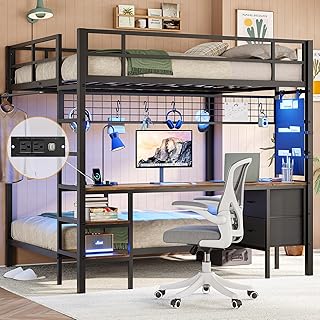
Twin Over Twin with Hall Tree and L-Shaped Desk
The hall tree is an underrated addition, giving backpacks and jackets somewhere to land other than the floor. Five drawers and a desk in one black steel package makes this a strong single-purchase solution for a small bedroom.
Jocoevol Metal Bunk Bed Twin Over Twin
Stripped back and heavy duty, this is the frame to buy when you want steel and nothing else, with a vintage brown finish that reads more industrial than institutional. Assembly is straightforward and the simpler joint count means fewer places for a rattle to develop.
Frequently Asked Questions
Is a bunk bed safe for a teenager?
Yes, provided the per-bunk weight rating covers them and the guardrail clears the mattress by several inches. Re-torque all fasteners every few months, since steel frames loosen under repeated load.
What mattress thickness works on the top bunk?
Most manufacturers cap it at 6 to 8 inches. A thicker mattress raises the sleeping surface and effectively shortens the guardrail, which is the single most common safety mistake I see.
Do I need a box spring?
No. These metal frames use slat or mesh decks designed to support a mattress directly, and adding a box spring would push the upper sleeper dangerously high.
How long does assembly take?
Plan on two to four hours for a storage or desk model with two people, and less for a plain frame. Leave every bolt finger-tight until the whole structure is standing, then tighten in a cross pattern.
Final Thoughts
For most teen rooms, the DICTAC Twin XL Over Twin with L-Shaped Desk is the smartest all-round buy thanks to that extra mattress length and a genuinely usable work surface. If storage is the bottleneck, the Twin Over Twin with Stairs and 8 Drawers replaces a dresser outright, while the Jocoevol Twin Over Twin remains the honest, no-frills steel frame for anyone who would rather spend the money on better mattresses.