Key takeaways
- Most cats meet their carrier only on the worst days of the year: the vet visit, the move across town, the flight to a relative's house.
Most cats meet their carrier only on the worst days of the year: the vet visit, the move across town, the flight to a relative’s house. That single fact shapes the whole buying decision. A carrier has to be roomy enough that a nervous cat can turn around, easy enough to load that nobody gets scratched at the door, and sturdy enough to survive a car seat, a shoulder strap, or an overhead bin. Soft-sided and hard-sided designs solve those problems in different ways, and the right pick depends on the cat in front of you.
This guide is for owners shopping for a first carrier, replacing a cracked or smelly one, or trying to find something that works for a larger cat in 2026. The picks below are compared on listed dimensions, weight limits, entry style, and construction, based on the spec text in each product title. Fit always depends on your own pet’s measurements, so measure length, height, and weight before you buy, and ask your vet about any health or sedation questions. Use the table for a fast comparison, then read the buying advice to match entry style and size to your cat before choosing.
Quick Picks
Our top picks


As an Amazon Associate we earn from qualifying purchases at no extra cost to you.
| Product | Best for | Key spec from the title |
|---|---|---|
| Vceoa fabric carrier | Small cats and compact storage | 17.5″ x 11″ x 11″ fabric body |
| LEHNI soft-sided carrier | Walking trips with a bigger cat | Shoulder strap, removable mat, mesh |
| Basics hard-sided carrier | Vet runs and car travel | 2-door top-load, front and top entry, 22.8″ L |
| Morpilot soft carrier | Larger cats that like cushioning | Up to 20 lbs, dual-sided cushion, foldable bowl |
| Henkelion soft carrier | Small to medium cats on flights | Up to 15 lbs, listed as TSA airline approved |
| GAPZER soft carrier | Shy cats that want privacy | Up to 20 lbs, privacy protection design |
| SportPet foldable carrier | Budget hard-shell with a front door | Collapsible plastic, medium size |
How to Choose
Match the interior to your cat, not the label
Measure your cat standing from nose to base of tail and from floor to top of head, then add a few inches in each direction. A cat should be able to stand, turn, and lie down without folding. Weight limits in the title, such as 15 or 20 pounds, are ceilings, not targets; a heavy cat in a carrier sized close to its limit will feel every shift in the handle. If a listing gives no weight rating, check the listing before buying.
Pick the entry style that suits the cat
Top-loading doors let you lower a reluctant cat in instead of pushing it through a front opening, which matters for animals that brace their legs. Front doors are easier for cats that walk in on their own. Carriers with both, like the two-door hard-sided style, handle either temperament. Look for zippers that lock or secure buckles so a determined cat cannot nose them open.
Soft-sided versus hard-sided
Soft-sided carriers collapse flat, carry on a shoulder, and fit under many airline seats, but the fabric can sag when the cat is large. Hard-sided carriers hold their shape, wipe clean after an accident, and sit stable on a car seat, though they take more storage room. Foldable plastic models try to split the difference. Whatever you choose, confirm airline size limits with the carrier itself, since “airline approved” wording on a listing does not replace the airline’s current rules.
What to ignore and where budget models cut corners
Ignore decorative extras like printed patterns and bonus pouches. Pay attention to seams, zipper pulls, handle stitching, and ventilation panels, because that is where lower-cost carriers tend to save money. A removable mat or cushion is useful for washing, but a thin pad that bunches up is no substitute for a firm base. Budget, mid-range, and premium tiers mostly differ in hardware quality and how well the frame resists sagging, so spend extra on the closures and the floor panel rather than on trim.
The 7 Best Options
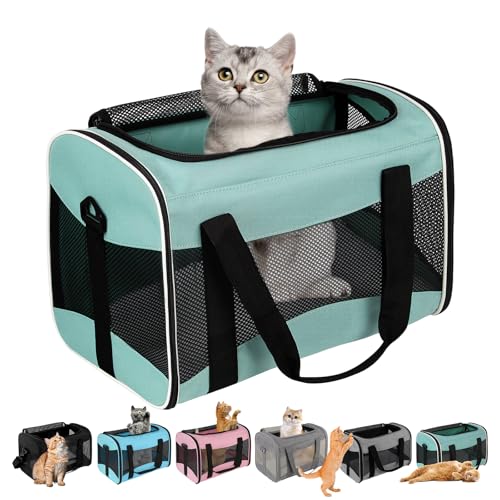
Vceoa 17.5″ x 11″ x 11″ Fabric Carrier
This is the compact option, with exact dimensions printed right in the title. That makes it easy to compare against an under-seat space or your cat’s measurements before ordering. It suits small cats, kittens, and owners who want a carrier that stores in a closet between trips.
- Strength: stated dimensions let you check fit with a tape measure.
- Strength: fabric construction keeps it light for short walks.
- Trade-off: the title lists no weight rating, so confirm capacity on the listing.
Skip it if your cat is large or long-bodied; eleven inches of height is tight for many adult cats. It also makes sense to hold a tape measure against your own cat first, because a carrier this snug works well for a slim kitten and poorly for a stocky adult.
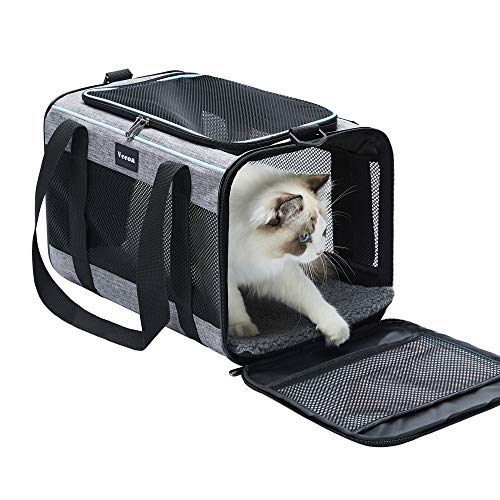
LEHNI Soft-Sided Cat/Dog Carrier
LEHNI targets owners with big cats or small dogs who want hands-free carrying. The title mentions a shoulder strap, a removable mat, and mesh panels, which together point to a walkable, washable design for trips on foot or public transit.
- Strength: shoulder strap spreads the load across the body.
- Strength: removable mat can be cleaned separately.
- Trade-off: soft sides can bulge under a heavier pet, so check the weight rating on the listing.
Skip it if your cat panics around mesh openings and prefers a darker, enclosed space. Owners who walk a lot should also confirm how the strap attaches and whether it needs padding on a longer carry.
Basics Hard-Sided 2-Door Top-Load Carrier
The listed 22.8-inch length stands out in this group, giving a larger cat more room to stretch on longer drives. Front and top entry, a handle, and secure ventilation are all named in the title. It is the most vet-visit-friendly design here, since you can lift a cat out through the top without tipping the carrier.
- Strength: two entry points suit both cooperative and stubborn cats.
- Strength: hard shell holds its shape and wipes clean.
- Trade-off: it does not fold flat, so storage takes real space.
Skip it if you mainly need something to carry on your shoulder through an airport. A rigid carrier of this length also takes up a good share of a back seat, so measure the space in your car, especially if the carrier will share it with a child seat or luggage.
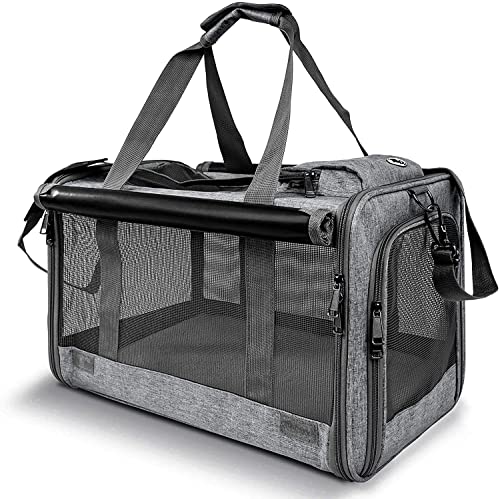
Morpilot Soft Carrier for Large and Medium Cats
Morpilot lists a ceiling of 20 pounds and pairs it with a dual-sided cushion, a secure buckle, and a foldable bowl. That combination speaks to larger cats on longer trips, where comfort and a place to offer water both matter.
- Strength: higher listed weight limit than many soft carriers.
- Strength: foldable bowl is built into the design.
- Trade-off: padding and accessories add bulk when you carry it.
Skip it if you want the lightest possible carrier for a small kitten. Because the cushion is dual-sided, it is worth confirming that it lies flat and does not slide when the carrier is lifted by its handle.
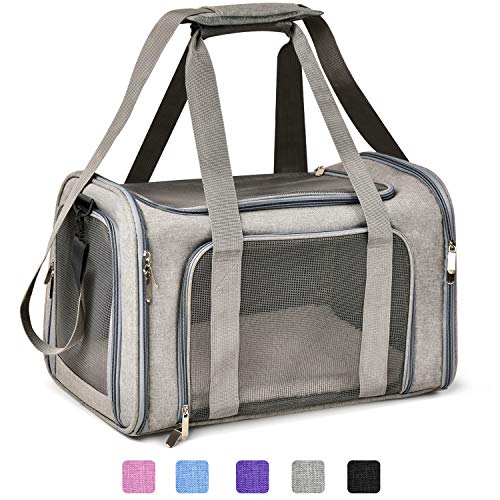
Henkelion Soft Carrier, Up to 15 lbs
Henkelion keeps things straightforward: a soft-sided carrier for small to medium cats, dogs, and puppies up to 15 pounds, with the listing describing it as TSA airline approved. For a cat that travels occasionally, it covers the basics without extras.
- Strength: clear 15-pound limit helps set expectations.
- Strength: airline-friendly design called out in the title.
- Trade-off: the lower ceiling rules out bigger cats.
Skip it if your cat is near or above 15 pounds, and always verify the airline’s current carry-on size rules. Cats that need a lot of stretching room on a long journey may also feel cramped, so compare the listed interior against your measurements.
GAPZER Soft Carrier for Large Cats
GAPZER is aimed at medium to big cats up to 20 pounds and highlights a privacy protection design. Cats that stress out at the sight of strangers or other animals often settle better when the carrier limits what they can see.
- Strength: 20-pound listed limit suits sizable cats.
- Strength: privacy-focused construction for anxious travelers.
- Trade-off: less visibility means you check on your cat more often.
Skip it if your cat is calmer with an open view of the room. Anyone choosing it for a long trip should plan regular, quiet check-ins, since a more enclosed interior hides small signs of restlessness.
SportPet Designs Foldable Plastic Carrier
SportPet offers a collapsible plastic carrier with a front door, sold in gray and tan in a medium size. The foldable shell is the draw: it behaves like a hard carrier on the road and packs down for storage.
- Strength: front door is simple to use for cooperative cats.
- Strength: collapses for storage between trips.
- Trade-off: the title gives no weight limit or interior size, so check the listing.
Skip it if you want a top-loading door or a shoulder strap. Since the title says only “medium,” compare the interior size against your cat’s measurements on the listing before ordering.
Which One Fits Your Situation
You have a large cat that hates the vet
The Basics hard-sided carrier, with its top-load door and 22.8-inch length, is the logical starting point. Lifting the cat out from above avoids the wrestling match at the front opening.
You commute by bus or train with your cat
Go with the LEHNI, since the shoulder strap frees up your hands and the mesh gives airflow in crowded vehicles.
You fly occasionally with a smaller cat
The Henkelion, listed as TSA airline approved and listed up to 15 pounds, fits the profile. Confirm the airline’s size limits for the exact trip before booking.
Your cat is shy and easily overwhelmed
The GAPZER privacy design suits a cat that is calmer when the world is blocked out, and its 20-pound limit leaves room for a bigger frame.
Common Mistakes
- Buying by pet weight alone and ignoring length and height, so the cat cannot turn around.
- Skipping a trial run; leave the carrier open at home for days so it becomes a familiar space.
- Trusting “airline approved” wording without checking the airline’s current dimensions.
- Choosing a soft carrier for a heavy cat and discovering the base sags on the first trip.
- Forgetting a washable liner, which turns an accident into a permanent odor problem.
Related guides
- Battery Powered Floodlight Camera With Local Storage
- Cordless Drill Brush Attachment For Bathroom Grout
- Rechargeable Emergency Lantern For Power Outages
Frequently Asked Questions
Are soft-sided or hard-sided carriers better for cats?
Neither wins outright. Soft-sided carriers are lighter and easier to store, while hard-sided models hold their shape and clean up faster. Pick the one that matches how you travel.
How big should a cat carrier be?
The cat should be able to stand, turn, and lie down comfortably. Measure your pet and compare against the listed dimensions, and stay under the stated weight rating.
Can any carrier go on a plane?
Not automatically. Airlines publish their own size limits and rules, and those can change. Listings that mention airline approval are a starting point only, so confirm directly with the airline.
How can a cat get used to a carrier?
Leave it out with the door open, put a familiar blanket inside, and let the cat explore on its own schedule. Talk to your vet about any persistent stress around travel.
More from Amazon
Programs that pair well with the guide above. Offers and eligibility are set by Amazon and may change.
A free business account with business pricing and bulk-buying tools for work, shop or home office.
Create a business accountFree shipping on eligible items, Prime Video and more. Eligible new members can start with a free trial.
Start a Prime free trialAudiobooks and podcasts to listen to on the go. Eligible new members can start with a free trial.
Try Audible freeAd-free music streaming. Eligible new subscribers can start with a free trial.
Try Music Unlimited freeAs an Amazon Associate we earn from qualifying purchases.