Key takeaways
- Measure your reach first: Stand under the fan, raise your arm, and estimate the gap to the blades. Add a foot of working slack. A 48-inch tool handles standard eight-foot ceilings comfortably; vaulted rooms and open stairwells need something in the 100-inch range or you’ll be back on the ladder anyway.
- Pole rigidity beats raw length: Telescoping poles lose stiffness at every joint. Stainless steel sections and locking twist collars hold their shape under sideways pressure; thin aluminum tubes bow and wobble, which turns precise blade work into flailing.
- Sleeve versus wand head: A U-shaped or pocket-style sleeve grips both blade surfaces in one pass and traps debris inside. Open feather wands cover more square footage on walls and cobwebs but tend to fling dust rather than capture it. Sets that include both give you the most range.
- Pivot and lock mechanism: The head needs to angle up to meet a blade and then stay there. Look for a ratcheting or threaded pivot rather than a friction hinge, which loosens after a few weeks and starts drooping when you apply pressure.
- Washable pads, and enough of them: Microfiber loses grab once it’s loaded. Confirm the sleeves are machine washable and count how many come in the box — a single pad means stopping mid-job to rinse and wait.
What's inside
There’s a particular flavor of dread that comes with looking up at a ceiling fan in July. The blades have gone gray and fuzzy, and you know the moment you flip that switch, half of it is coming down on the bed. The usual workaround involves a step stool, a damp rag, and a lot of one-handed balancing while the other hand smears dust into a paste along the leading edge. Anyone who has done this in a stairwell or over a bathtub knows it stops being a chore and starts being a genuinely bad idea.
The fix is a tool built for the geometry of the problem: a sleeve or U-shaped head that wraps both faces of a blade at once, mounted on a pole long enough to keep your feet on the floor. I’ve spent time with the current crop of these, paying attention to the things that actually matter once you’re working overhead — whether the pole flexes into a noodle at full extension, whether the head stays put or spins off mid-stroke, and whether the microfiber holds dust or just relocates it. Below are six worth your money, plus what separates a duster you’ll keep from one that ends up in the garage.
As an Amazon Associate we earn from qualifying purchases.



How to Choose a Ceiling Fan Dusters (2026)
- Measure your reach first: Stand under the fan, raise your arm, and estimate the gap to the blades. Add a foot of working slack. A 48-inch tool handles standard eight-foot ceilings comfortably; vaulted rooms and open stairwells need something in the 100-inch range or you’ll be back on the ladder anyway.
- Pole rigidity beats raw length: Telescoping poles lose stiffness at every joint. Stainless steel sections and locking twist collars hold their shape under sideways pressure; thin aluminum tubes bow and wobble, which turns precise blade work into flailing.
- Sleeve versus wand head: A U-shaped or pocket-style sleeve grips both blade surfaces in one pass and traps debris inside. Open feather wands cover more square footage on walls and cobwebs but tend to fling dust rather than capture it. Sets that include both give you the most range.
- Pivot and lock mechanism: The head needs to angle up to meet a blade and then stay there. Look for a ratcheting or threaded pivot rather than a friction hinge, which loosens after a few weeks and starts drooping when you apply pressure.
- Washable pads, and enough of them: Microfiber loses grab once it’s loaded. Confirm the sleeves are machine washable and count how many come in the box — a single pad means stopping mid-job to rinse and wait.
The Best Ceiling Fan Dusters (2026)s Reviewed
DRQ Ceiling Fan Cleaner Duster
The 13-to-48-inch pole and snug microfiber sleeve make this the straightforward pick for standard-height rooms, and the removable head means you can toss the dirty sleeve in the wash and keep working with a spare. It’s not built for cathedral ceilings, but for a bedroom or living room fan it does the job in about four passes per blade.
Eyliden 68″ Adjustable Ceiling Fan Duster
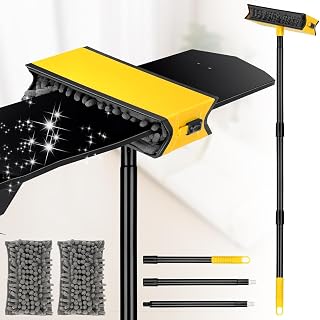
At three-quarters of a pound fully extended, this is the one your wrists will thank you for on a multi-fan afternoon — the dual-sided microfiber head sandwiches the blade so you’re cleaning top and bottom simultaneously. The 68-inch reach splits the difference nicely for rooms with nine- or ten-foot ceilings.
DELUX Microfiber Feather Duster
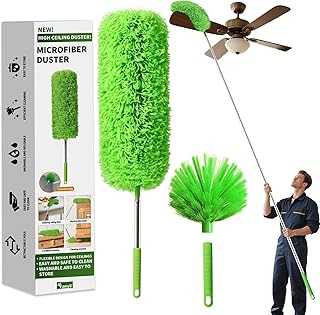
The 100-inch pole and bendable head make this a genuine ladderless solution for vaulted ceilings, high window frames, and the awkward corners above kitchen cabinets. The feather-style head is better suited to general overhead dusting than tight blade wrapping, so treat it as your reach tool rather than your dedicated fan tool.
CLDREAM Ceiling Fan Cleaner Duster
Chenille pads have noticeably more nap than flat microfiber, which helps on blades that have gone past dusty into genuinely grimy — the fibers work into that sticky kitchen-adjacent film instead of skating over it. The three-foot pole keeps it compact and controllable, ideal if your fans are within easy reach.
12pcs Microfiber Duster Set
The stainless steel telescoping pole holds its rigidity better than aluminum at the 100-inch mark, and twelve washable heads mean you can rotate a fresh pad onto each fan rather than spreading the same dust around the house. Best value here if you’re outfitting a whole home or a rental turnover kit.
Frequently Asked Questions
How often should I dust ceiling fan blades?
Every four to six weeks keeps buildup from bonding to the blade. If you run fans year-round or have pets, tighten that to monthly — dust that sits long enough mixes with airborne kitchen grease and stops wiping off dry.
Should I dampen the microfiber sleeve?
Start dry. Dry microfiber holds fine dust through static cling, while a wet pad turns it to mud that streaks. If there’s a stubborn film, mist the pad lightly with water or a diluted all-purpose cleaner and finish with a dry pass.
Can I use these on other surfaces?
Yes, and that’s most of the value. The same tools handle blinds, door frames, baseboards, cabinet tops, light fixtures, and cobwebs in ceiling corners. Bendable heads earn their keep on vent grilles and behind refrigerators.
How do I wash the pads without ruining them?
Cold or warm water, mild detergent, no fabric softener — softener coats the fibers and kills the static grab that makes microfiber work. Air dry or tumble on low; high heat can melt the fine filaments.
Final Thoughts
For most homes, the Eyliden 68″ Adjustable Duster hits the best balance of reach, weight, and dual-sided blade contact — it’s the one I’d grab first. If your ceilings climb past ten feet, the DELUX Extendable Duster and its 100-inch pole eliminates the ladder entirely, while the 12pcs Microfiber Duster Set is the smart buy for larger homes where having a clean pad ready for every room matters more than any single feature.