Key takeaways
- Wet vs. damp rating: Damp-rated fans belong under a full roof with walls on at least two sides. Wet-rated fans can take direct rain and hose spray, which is what you want for open pergolas, gazebos, and anywhere wind-driven water reaches. IP65 is the equivalent spec on many plug-in models. When in doubt, go wet-rated; the price gap is small and the regret is not.
- Mounting reality check: Before you buy, get up on the ladder. A fan-rated box is non-negotiable for hardwired units, and it must be anchored to structure, not just drywall or beadboard. If there’s no box and no easy path to run cable, a plug-in fan with a hanging hook saves you an afternoon of drilling and a conversation with an electrician.
- Blade material and coating: Aluminum and UV-treated ABS resist warping far better than wood or particleboard laminates. UV coating matters more than people expect: it keeps black finishes from chalking to gray after two summers of afternoon sun.
- CFM over blade count: Airflow, not diameter or blade count, tells you how much breeze you’ll actually feel. Aim for roughly 5,000 CFM on a mid-size patio and 7,000-plus for large or open spaces. DC motors deliver more airflow per watt and run quieter, which is why nearly every serious outdoor fan now uses one.
- Controls that survive weather: Pull chains are simple and nearly indestructible but require a reach. Remotes and app control are more convenient and let you skip running a wall switch, though the receiver lives in the canopy and needs the housing to stay sealed. Look for 3CCT color temperature if the fan doubles as your patio lighting.
What's inside
Anyone who has hung a fan on a covered porch knows the failure mode: eighteen months in, the blades start to curl like stale bread, the motor develops a hum you can hear over the crickets, and the pull chain seizes. Outdoor air is a different animal than conditioned indoor air. It carries moisture, pollen, salt if you’re near a coast, and temperature swings that expand and contract every joint in the assembly. A fan built for a bedroom will survive a season out there and then quietly give up.
This guide comes from the perspective of someone who has done the mounting, the fishing of wire through blocking, and the occasional embarrassing re-do. We’ll cover what wet and damp ratings actually mean for your install, how to tell whether you need a hardwired unit or a plug-in caged fan, what CFM figures are worth trusting, and then work through six outdoor fans that hold up in real conditions. Whether you’ve got a pergola with no electrical box at all or a 20-foot covered patio that needs serious air movement, there’s a sensible answer below.
As an Amazon Associate we earn from qualifying purchases.


How to Choose a Ceiling Fan For Outdoors (2026)
- Wet vs. damp rating: Damp-rated fans belong under a full roof with walls on at least two sides. Wet-rated fans can take direct rain and hose spray, which is what you want for open pergolas, gazebos, and anywhere wind-driven water reaches. IP65 is the equivalent spec on many plug-in models. When in doubt, go wet-rated; the price gap is small and the regret is not.
- Mounting reality check: Before you buy, get up on the ladder. A fan-rated box is non-negotiable for hardwired units, and it must be anchored to structure, not just drywall or beadboard. If there’s no box and no easy path to run cable, a plug-in fan with a hanging hook saves you an afternoon of drilling and a conversation with an electrician.
- Blade material and coating: Aluminum and UV-treated ABS resist warping far better than wood or particleboard laminates. UV coating matters more than people expect: it keeps black finishes from chalking to gray after two summers of afternoon sun.
- CFM over blade count: Airflow, not diameter or blade count, tells you how much breeze you’ll actually feel. Aim for roughly 5,000 CFM on a mid-size patio and 7,000-plus for large or open spaces. DC motors deliver more airflow per watt and run quieter, which is why nearly every serious outdoor fan now uses one.
- Controls that survive weather: Pull chains are simple and nearly indestructible but require a reach. Remotes and app control are more convenient and let you skip running a wall switch, though the receiver lives in the canopy and needs the housing to stay sealed. Look for 3CCT color temperature if the fan doubles as your patio lighting.
The Best Ceiling Fan For Outdoors (2026)s Reviewed
addlon 20″ IP65 Plug-in Caged Fan
This is the fan for spaces with no electrical box, full stop. It hangs from a hook, plugs into a nearby GFCI outlet, and the IP65 cage means you can leave it out through a thunderstorm. Six speeds off a reversible DC motor give you real control for a compact unit, and the integrated light saves you from stringing a separate fixture.
56″ Wet-Rated Outdoor Fan, Black
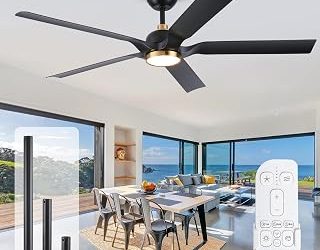
A strong all-around hardwired pick for medium to large covered patios. Seven UV-coated blades move a lot of air quietly, and the dimmable 3CCT light lets you shift from bright task lighting to something warmer after dinner without swapping bulbs.
Hunter Cassius 44″
The no-nonsense choice. No light kit, no remote, no receiver to fail: just a pull chain, three blades, and Hunter’s damp-rated build quality in matte black. For a garage, workshop, or shaded porch where you want one thing to work for a decade, this is the install I’d recommend to a friend.
65″ Waterproof Smart Outdoor Fan
At 8,421 CFM across eight aluminum blades, this is the heavy hitter for wide open spaces where smaller fans just stir the air politely. Alexa and app control are genuinely useful on a fan this size, since nobody wants to hunt for a remote in the dark. Confirm your ceiling height and blade clearance before ordering.
Amico 42″ IP65 Gazebo Fan
A well-judged middle ground: bigger sweep than the compact caged fans, but still plug-in with a hanging hook, so installation stays a fifteen-minute job. The 3000-6000K light range and six speeds make it flexible enough for a pergola that pulls double duty as a dining area.
Frequently Asked Questions
Can I install an outdoor ceiling fan myself?
Plug-in models, absolutely: hook, hang, plug in. Hardwired fans require a fan-rated electrical box securely fastened to a joist or brace, plus safe wiring practices and knowledge of your local code. If there’s no existing box or you’re not confident working in a live panel, hire an electrician for that portion and handle the assembly yourself.
Do I need a downrod outdoors?
Only if your ceiling is above roughly nine feet. Keep blades at least seven feet off the floor for safety and 10 to 12 inches below the ceiling for airflow. Sloped porch ceilings often need both a downrod and a compatible sloped-ceiling canopy.
Will an outdoor fan actually keep mosquitoes away?
Somewhat. Mosquitoes are weak fliers and moving air genuinely makes it harder for them to land, so a fan on medium or high helps. It’s a useful supplement to other measures, not a replacement for them.
Should I take the fan down for winter?
Wet-rated fans are built to stay up year-round. If you get heavy ice or the fan is plug-in and easy to unhook, storing it indoors extends its life and takes ten minutes. Either way, wipe the blades and check the mounting hardware each spring.
Final Thoughts
If your porch already has a fan-rated box, the 56″ wet-rated model is the sweet spot on airflow, lighting, and price, while the 65″ smart fan is the one to pick for genuinely large or open patios. For pergolas and gazebos with no wiring at all, the addlon 20″ caged fan gets you comfortable this weekend with nothing more than a hook and an outdoor outlet.