Key takeaways
- Blade span vs. room size: A 42-inch fan suits bedrooms and spaces up to about 150 sq ft; step up to 52 inches for living rooms and open-plan areas. Undersizing means running high speed constantly, which defeats the efficiency gain.
- Mounting depth: Flush mount (low profile) fans need under 12 inches of clearance and are the right call for 8-foot ceilings. Downrod models need 9-foot ceilings or higher to keep blades at least 7 feet off the floor per code.
- CFM per watt, not just CFM: This is where DC motors shine. A good DC fan moves 4,000–5,600 CFM while pulling 30 watts or less. Check the listed airflow efficiency rather than trusting “energy saving” claims.
- 3CCT and dimming control: Fans with switchable 3000K/4000K/5000K LEDs let you tune warmth per room. Confirm the dimmer is built into the remote, since most integrated LED modules are not compatible with wall dimmers and will flicker or fail.
- Reversibility and speed count: Six speeds plus a reverse function gives you real winter downdraft utility. Look for a memory function so the fan returns to your last setting after a power blip instead of defaulting to high.
What's inside
Swapping an old AC ceiling fan for a DC model is one of those upgrades that pays you back twice: the motor draws roughly 60 to 70 percent less power, and it runs quiet enough that you stop noticing it’s on. The catch is that the DC market has exploded with lookalike listings, and spec sheets rarely tell you what matters on install day — whether the canopy clears a shallow junction box, whether the downrod is included, or whether that “quiet” motor hums at low speed.
I’ve hung enough of these to know the difference between a fan that goes up in twenty minutes and one that eats an afternoon. Below are six DC fans worth your time in 2026, covering flush-mount low profile builds, large-room 52-inch sweepers, and light-free options for rooms that already have overhead lighting. I’ve flagged wiring quirks, blade pitch, and mounting depth where they actually affect the job.
As an Amazon Associate we earn from qualifying purchases.


How to Choose a DC Ceiling Fan (2026)
- Blade span vs. room size: A 42-inch fan suits bedrooms and spaces up to about 150 sq ft; step up to 52 inches for living rooms and open-plan areas. Undersizing means running high speed constantly, which defeats the efficiency gain.
- Mounting depth: Flush mount (low profile) fans need under 12 inches of clearance and are the right call for 8-foot ceilings. Downrod models need 9-foot ceilings or higher to keep blades at least 7 feet off the floor per code.
- CFM per watt, not just CFM: This is where DC motors shine. A good DC fan moves 4,000–5,600 CFM while pulling 30 watts or less. Check the listed airflow efficiency rather than trusting “energy saving” claims.
- 3CCT and dimming control: Fans with switchable 3000K/4000K/5000K LEDs let you tune warmth per room. Confirm the dimmer is built into the remote, since most integrated LED modules are not compatible with wall dimmers and will flicker or fail.
- Reversibility and speed count: Six speeds plus a reverse function gives you real winter downdraft utility. Look for a memory function so the fan returns to your last setting after a power blip instead of defaulting to high.
The Best DC Ceiling Fans (2026) Reviewed
52″ White 3-Blade Ceiling Fan, No Light
A clean choice for bedrooms and hallways that already have adequate lighting, this three-blade design pushes strong air with almost no motor noise thanks to its DC drive. The reversible blades give you a color swap without buying accessories, and wiring is simple since there’s no light kit to land.
42″ Black Low Profile Flush Mount with 3CCT Light
The best pick for 8-foot ceilings — the flush canopy sits tight to the drywall and still clears a standard octagonal box. The 3CCT dimmable LED and quiet reversible motor make it equally at home in a bedroom or under a covered porch, though it’s damp-rated only, so keep it out of direct rain.
42″ Black Outdoor DC Fan, 6-Speed 3CCT
ETL listed for covered outdoor use, this one earns its spot on patios where you need reliable airflow without a roaring motor. Six speeds give you fine control at the low end, which is where cheaper AC fans typically buzz.
52″ 6-Blade Fan with App Control, 5600 CFM
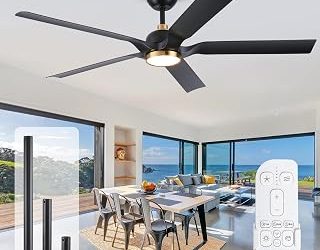
The heavy hitter here: an all-metal body, six blades, and a genuine 5,600 CFM ceiling make it the right fit for large living rooms and vaulted spaces. App and remote control plus a memory function mean you set it once and forget it, and the metal housing resists the wobble that plagues plastic-shrouded fans.
LANMEL 42″ Gold & Black Metal Flush Mount
Easily the best-looking fan on this list, with a gold-and-black metal finish that reads more light fixture than appliance. The flush mount profile and 3CCT dimmable LED make it a strong pick for a bedroom where the fan doubles as the room’s main light.
Frequently Asked Questions
Are DC ceiling fans harder to install than AC models?
No — the wiring is identical (hot, neutral, ground, and sometimes a blue light wire). The only difference is the DC receiver module in the canopy, which is bulkier and needs to be tucked in carefully before you seat the cover plate.
Can I use a DC ceiling fan with an existing wall dimmer?
Don’t. DC motors and their integrated LED drivers require constant line voltage. Replace the dimmer with a standard single-pole switch and control speed and brightness from the remote.
Why does my new fan wobble?
Nine times out of ten it’s the mounting bracket, not the blades. Confirm the box is fan-rated and screwed into a joist or brace, then check that all blade screws are torqued evenly. Balancing clips are a last resort.
How much do DC fans actually save?
A 52-inch DC fan running at medium pulls roughly 15–30 watts versus 60–80 watts for a comparable AC model. Over a summer of daily use, that’s real money — and the quieter operation is arguably the bigger win.
Final Thoughts
For most rooms, the 42″ Black Low Profile Flush Mount hits the sweet spot of ceiling clearance, quiet operation, and tunable light. If you’re cooling a large or open space, the 52″ 6-Blade with app control and its 5,600 CFM output is the one to buy, while the LANMEL 42″ Gold & Black is the pick when the fan needs to look like a design choice rather than a compromise.