Key takeaways
- Choose a compressor model if you need more capacity, live in a warm climate, or want reliable cooling across a broader range of room conditions.
- Choose thermoelectric only when the collection is small, the room stays cool, and quieter operation is a stronger priority than fast or powerful cooling.
- Choose built-in when the cooler will sit inside cabinetry and its front ventilation and cutout dimensions match your opening.
- Choose freestanding when you want flexible placement and can preserve the required airflow around the appliance.
- Pay for independent zone controls if you need two genuinely different setpoints; verify both zones’ ranges before ordering.
The best dual zone wine coolers are the ones that fit your collection and installation space while keeping each zone within its stated temperature range—not simply the ones with the largest bottle-count claim. For a mixed collection, start by checking usable capacity and the temperature range of both zones, then compare shelf layout, cooling system, noise, and whether the unit is freestanding or built in.
Our top picks


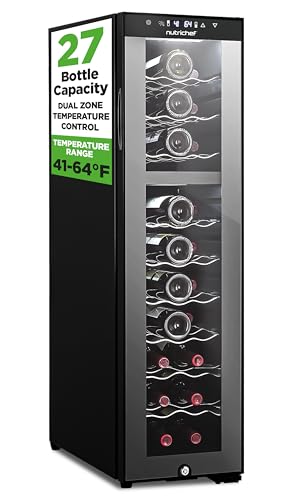
As an Amazon Associate we earn from qualifying purchases at no extra cost to you. Ratings are shown as listed on Amazon.
Choose by collection and placement
| Your situation | What to prioritize | Likely best fit |
|---|---|---|
| Mostly red, with a smaller white collection | A larger upper or lower zone for reds, plus a separately adjustable zone that reaches serving temperatures for whites | A 30–50-bottle compressor model with independently controlled zones |
| Mostly sparkling wine or whites | Confirm that one zone can hold a low enough temperature, and check whether shelves accommodate wider bottles | A compact compressor cooler with a flexible shelf or removable rack |
| Small apartment or open-plan room | Low operating noise, modest depth, and a location away from seating and sleeping areas | A smaller unit with a published noise figure; consider thermoelectric only for a mild room and modest capacity |
| Kitchen renovation or cabinet opening | Front-vented design, exact cutout dimensions, door swing, and required ventilation clearances | A purpose-built built-in or undercounter model |
| Renter or frequently changing layout | Plug-in installation, manageable weight, and clearance for rear or side ventilation | A freestanding model that can be moved without modifying cabinetry |
Use this as a shortlist, not a substitute for the manufacturer’s manual. “Dual zone” describes two temperature areas; it does not guarantee a particular arrangement or that both zones cover the temperatures you want.
Capacity: plan for real bottles, not just the headline number
Advertised capacity is commonly based on standard 750 ml Bordeaux-shaped bottles packed in a specified layout. Pinot Noir bottles can be longer or wider, while Champagne bottles are broader still. If your collection includes those shapes, expect fewer bottles to fit than the stated maximum. Shelves also need enough space to slide out without hitting the door or cabinet frame.
Count the bottles you own, then leave roughly 20–30% spare capacity for a growing collection and awkward shapes. For example, if you regularly keep 24 bottles on hand, a nominal 30-bottle cooler gives you more practical breathing room than a nominal 24-bottle model. Check whether the capacity figure assumes every shelf is installed; removing a shelf can create room for large bottles but reduces total storage.
Temperature ranges and zone layout
Compare the published range of each zone rather than relying on a “red and white” label. Many dual-zone coolers offer a warmer zone for reds and a cooler one for whites, but the actual ranges vary. Some designs use a top-to-bottom temperature gradient, so the two zones may not be independently settable. Others let you select each zone separately. If you want to store reds and whites at different long-term storage temperatures, independent controls matter more than a convenient serving-temperature preset.
For general serving, many people prefer reds around 55–65°F and whites around 45–55°F, adjusting to style and taste. These are serving preferences, not universal storage requirements. Wine is usually stored at a stable, moderate temperature; frequent swings are less desirable than choosing a single exact number.
Compressor or thermoelectric?
| Cooling type | Advantages | Trade-offs | Best suited to |
|---|---|---|---|
| Compressor | Generally stronger cooling, larger capacity options, and better performance in warmer rooms | Can produce vibration and cycling noise; needs the specified ventilation space | Most medium and large collections, and rooms that get warm |
| Thermoelectric | Often quieter and has fewer moving parts in the cooling system | Cooling performance can be limited by high room temperatures; often found in smaller units | Small collections in consistently cool rooms where quiet operation is a priority |
For a compressor model, look for vibration control and sturdy shelf supports if you plan to store bottles for extended periods. For either type, avoid positioning the cooler in direct sun or next to an oven, radiator, or other heat source. A cooler has to work harder when the room is hot, and thermoelectric units are particularly sensitive to ambient temperature.
Measure before choosing an installation style
A freestanding cooler needs the manufacturer’s stated clearance around its vents, often at the back and sides. A built-in model is designed to exhaust heat through the front grille, but still requires the exact cabinet opening and ventilation provisions in its installation guide. Never assume a freestanding unit can be enclosed in cabinetry: restricted airflow can lead to poor cooling or premature wear.
| Measurement or check | Practical planning target | Why it matters |
|---|---|---|
| Side and rear clearance for a freestanding unit | Start with about 2 inches at the sides and rear only if the manual permits; use the manual’s larger figure when specified | Ventilation needs differ by model, and some units require more space |
| Space above the unit | Allow at least 2 inches unless the installation guide calls for more | Helps prevent a tight alcove from trapping heat |
| Door swing and shelf access | Leave enough room for the door to open fully and shelves to extend | A wall or island can block access even when the cabinet fits |
| Delivery path | Measure the narrowest doorway, hallway turn, and stair landing against the packaged dimensions | The box is larger than the appliance, and a heavy unit may be hard to maneuver |
Those clearance figures are planning estimates, not universal installation rules. Confirm the exact dimensions, leveling requirements, and ventilation instructions for the specific cooler before buying. Also check the unit’s weight and whether delivery includes room-of-choice placement. Glass doors and loaded shelves make a cooler awkward to move; transport it upright when required by the manufacturer, and allow the recommended settling time before plugging it in.
Noise, shelves, and everyday use
In a kitchen, occasional compressor cycling may fade into background noise. In a studio apartment or beside a dining table, the same sound can be distracting. If the manufacturer publishes a decibel figure, compare models on that basis, while remembering that measurement conditions differ. A level, stable floor and correct ventilation can help avoid rattles. Avoid placing the cooler against a thin shared wall or directly beside a bed if noise is a concern.
Inspect shelf spacing and construction in the product specifications or manual. Smooth sliding shelves make access easier, while fixed shelves can limit bottle flexibility. Wood shelves may reduce clinking and give a traditional look; metal racks can be lighter but may allow bottles to roll or touch. Check that the lowest shelf can hold heavier bottles and that removing a shelf does not obstruct the fan or temperature sensor.
A simple buying decision
- Choose a compressor model if you need more capacity, live in a warm climate, or want reliable cooling across a broader range of room conditions.
- Choose thermoelectric only when the collection is small, the room stays cool, and quieter operation is a stronger priority than fast or powerful cooling.
- Choose built-in when the cooler will sit inside cabinetry and its front ventilation and cutout dimensions match your opening.
- Choose freestanding when you want flexible placement and can preserve the required airflow around the appliance.
- Pay for independent zone controls if you need two genuinely different setpoints; verify both zones’ ranges before ordering.
As a broad market guide in 2026, compact dual-zone units often fall around $300–$600, while larger-capacity or built-in models can range from roughly $600 to well over $1,000. Treat price as a final filter: a well-fitting, correctly ventilated cooler with suitable zones is a better match than a larger or more feature-heavy model that does not fit your bottles or room.