Key takeaways
- Thermostat accuracy over raw wattage: A heater that holds within a degree or two of your setpoint spends most of its life idling. Vague dial-only controls tend to overshoot, reheat, and quietly burn through kilowatt-hours.
- PTC ceramic or infrared, not exposed coil: PTC elements self-regulate and reach usable output in under a minute. Infrared skips heating the air entirely and warms objects and bodies directly, which suits drafty rooms and open floor plans.
- ECO mode and a timer: ECO modulates between high and low based on ambient temperature instead of slamming between full blast and off. A 12-hour timer means the unit isn’t running at 4 a.m. while you’re asleep under a duvet.
- Oscillation or tilt for coverage: Spreading heat across a room beats blasting one wall. Oscillation suits seated work areas; adjustable tilt is better under a desk or aimed at a reading chair.
- Layered safety hardware: Tip-over cutoff, overheat protection, and flame-retardant housing are non-negotiable. Look for units advertising multiple independent protections and an ETL or equivalent listing.
What's inside
Every winter I run the same experiment in my workshop: crank the central heat versus plug in a single well-placed heater and watch the meter. The heater wins, every time — but only when it’s the right heater in the right room. The trap most buyers fall into is assuming that because nearly every unit on the shelf draws 1500 watts, they all cost the same to run. They don’t. What separates an efficient heater from an expensive one is how quickly it hits temperature, how tightly the thermostat holds it, and how much of that heat actually lands on you instead of the ceiling.
This guide is built around that logic. I’ve focused on ceramic PTC and infrared models with real thermostats, eco modes, and timers — the three features that determine whether your heater cycles off and stays off. Below you’ll find picks for bedrooms, home offices, and larger open living spaces, plus a practical buying checklist and answers to the questions that come up most often once the unit is actually plugged in.
As an Amazon Associate we earn from qualifying purchases.


How to Choose an Energy-Saving Space Heater (2026)
- Thermostat accuracy over raw wattage: A heater that holds within a degree or two of your setpoint spends most of its life idling. Vague dial-only controls tend to overshoot, reheat, and quietly burn through kilowatt-hours.
- PTC ceramic or infrared, not exposed coil: PTC elements self-regulate and reach usable output in under a minute. Infrared skips heating the air entirely and warms objects and bodies directly, which suits drafty rooms and open floor plans.
- ECO mode and a timer: ECO modulates between high and low based on ambient temperature instead of slamming between full blast and off. A 12-hour timer means the unit isn’t running at 4 a.m. while you’re asleep under a duvet.
- Oscillation or tilt for coverage: Spreading heat across a room beats blasting one wall. Oscillation suits seated work areas; adjustable tilt is better under a desk or aimed at a reading chair.
- Layered safety hardware: Tip-over cutoff, overheat protection, and flame-retardant housing are non-negotiable. Look for units advertising multiple independent protections and an ETL or equivalent listing.
The Best Energy-Saving Space Heaters (2026) Reviewed
DREO Quiet Space Heater with 70° Oscillation
The 11.5 ft/s airflow moves heat far enough that a medium bedroom evens out in a couple of minutes, and the 70-degree sweep keeps a corner placement viable instead of forcing it into the middle of the floor. Eight safety protections plus a genuinely accurate thermostat make this the pick I’d hand to someone who wants to set it once and forget about it.
Airnmore Comfort Deluxe Infrared Heater
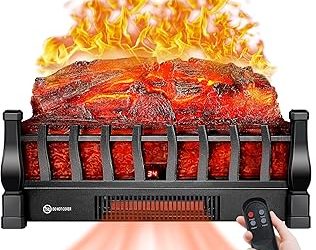
Copper PTC infrared behaves differently from a fan heater — you feel warmth on your skin almost immediately, before the air temperature catches up, which makes it excellent in rooms with high ceilings or leaky windows. The two-year warranty and ETL listing back up build quality that feels a tier above the plastic tower crowd.
DREO Space Heater with 60° Adjustable Tilt
Tilt is underrated: angling output upward from the floor or downward from a shelf gets heat to your body instead of the baseboards. At desk-heater scale with three modes and remote control, this is the one I’d put under a workbench or beside a sewing table.
DREO 2026 Upgraded 34dB Ceramic Heater
At 34dB this is quiet enough to sit beside a microphone or a sleeping toddler, and the five modes give you enough granularity to run it low overnight rather than in wasteful on-off cycles. The gold finish is a nice touch if you’d rather it not look like shop equipment in a finished room.
GiveBest Portable Ceramic Heater
Dual 1500W/750W output covers the two situations that matter — fast warmup and low-cost maintenance heat — without any menu diving. Simple, light, tip-over and overheat protected, and the honest budget pick for a small office or spare room.
Frequently Asked Questions
Does a lower wattage setting actually save money?
Yes, provided the room can hold temperature at that output. Running 750W continuously often costs less than 1500W cycling hard, because you avoid repeated cold-start reheating. Test it over an evening and see which setting keeps the thermostat satisfied.
Can I lower my central thermostat and rely on a space heater?
That’s exactly where the savings come from. Zone heating — dropping the whole-house setpoint several degrees and heating only the room you occupy — typically beats warming empty bedrooms and hallways.
Should I plug it into a power strip or extension cord?
Neither. A 1500W heater draws roughly 12.5 amps and belongs directly in a wall outlet on a circuit that isn’t already loaded with other appliances.
Infrared or ceramic fan for a large room?
Infrared for drafty or high-ceilinged spaces where warming air is a losing battle. Ceramic with oscillation for well-insulated rooms where you want the whole volume brought up.
Final Thoughts
For most homes, the DREO Quiet Space Heater with 70° oscillation is the balanced choice — accurate thermostat, wide coverage, thorough safety hardware. Choose the Airnmore Comfort Deluxe if your problem room is large or drafty enough that infrared makes more sense than moving air, and grab the GiveBest if you just need reliable, protected warmth in a small space without spending much to get it.