Key takeaways
- Adjustable lumbar, not fixed foam: Look for a pad that moves up and down (and ideally in and out). Sit against a wall, find the natural hollow in your lower back, and measure that height from the seat — that number is what the chair has to hit.
- Seat depth and edge: You want two to three fingers of clearance behind your knees. A waterfall front edge keeps pressure off the hamstrings, which is what usually causes that pelvic tuck that flattens your lumbar curve.
- Recline and tilt lock: A backrest that locks between roughly 100 and 110 degrees offloads the discs far better than sitting bolt upright. Skip anything that only offers “locked” or “full rocker.”
- Hardware quality: Check for a Class 3 or 4 gas lift, a steel or nylon five-star base, and a stated weight capacity with real margin over your own. Cheap cylinders sag, and a sinking seat destroys your desk-height alignment.
- Armrest geometry: Arms should support your elbows at roughly 90 degrees with shoulders relaxed. Flip-up arms are worth seeking out if you’re pulling under a keyboard tray or a corner desk return.
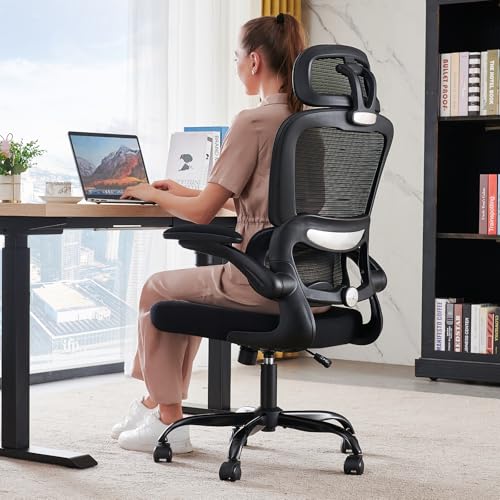
After a season of bolting, shimming, and stress-testing chairs in my own garage-turned-office, the Stella Mia Ergonomic Executive Desk Chair is the best overall pick for lower back pain, with the CASASIO Ergonomic Office Chair as a very close runner-up.
Here’s the problem most of us hit: you build a beautiful L-shaped desk, mount the monitors at perfect eye height, run the cable trays — and then park yourself in a chair that quietly wrecks your lumbar spine by 3 p.m. Chair specs are also the hardest thing to judge from a listing page, because “lumbar support” can mean anything from a genuinely adjustable pad to a lump of foam sewn into the backrest. This guide breaks down what actually matters mechanically, which chairs hold up under real use, and how to tune whichever one you buy so it fits your body instead of the other way around.
Our top picks



As an Amazon Associate we earn from qualifying purchases at no extra cost to you. Ratings are shown as listed on Amazon.
Quick Comparison
| Product | Best For | Standout Feature | Rating |
|---|---|---|---|
| Stella Mia Ergonomic Executive Chair | All-day desk work | Dedicated lumbar support with flip-up padded arms | See live rating above |
| TRALT Ergonomic Desk Chair | Budget builds and second workstations | Adjustable lumbar cushion at a low price | See live rating above |
| CASASIO Ergonomic Office Chair | Long shifts, back and neck relief | 3D headrest plus 2D lumbar adjustment | See live rating above |
| GTPLAYER Big and Tall Chair | Larger frames up to 400 lbs | Pocket-spring cushion and footrest | See live rating above |
| Sweetcrispy Mesh Office Chair | Warm rooms and compact desks | Breathable mesh back with lumbar curve | See live rating above |
How to Choose an Ergonomic Office Chair for Lower Back Pain
- Adjustable lumbar, not fixed foam: Look for a pad that moves up and down (and ideally in and out). Sit against a wall, find the natural hollow in your lower back, and measure that height from the seat — that number is what the chair has to hit.
- Seat depth and edge: You want two to three fingers of clearance behind your knees. A waterfall front edge keeps pressure off the hamstrings, which is what usually causes that pelvic tuck that flattens your lumbar curve.
- Recline and tilt lock: A backrest that locks between roughly 100 and 110 degrees offloads the discs far better than sitting bolt upright. Skip anything that only offers “locked” or “full rocker.”
- Hardware quality: Check for a Class 3 or 4 gas lift, a steel or nylon five-star base, and a stated weight capacity with real margin over your own. Cheap cylinders sag, and a sinking seat destroys your desk-height alignment.
- Armrest geometry: Arms should support your elbows at roughly 90 degrees with shoulders relaxed. Flip-up arms are worth seeking out if you’re pulling under a keyboard tray or a corner desk return.
The Best Ergonomic Office Chairs for Lower Back Pain, Reviewed
Best Overall: Stella Mia Ergonomic Executive Desk Chair
This is the pick I’d hand to someone who sits eight hours a day and wants the fewest compromises: real lumbar support, generous padding, and flip-up arms that let you tuck fully under a desk. Best for home office workers on standard-height or L-shaped desks who want an executive look without executive pricing.
Best Budget: TRALT Ergonomic Desk Chair
A gaming-style seat with an adjustable lumbar cushion, which is the one feature you should never cut to save money. Best for students, secondary workstations, or a workshop desk where you sit for two or three hours at a stretch rather than all day.
Best Premium: CASASIO Ergonomic Office Chair
The 2D lumbar and 3D headrest mean you can dial in both the lower back curve and neck position independently, which matters if your pain runs from lumbar to shoulders. Best for anyone doing genuinely long sessions, especially at a standing desk they alternate with sitting.
Best for Big and Tall Builds: GTPLAYER Big and Tall Gaming Chair
A 400 lb capacity, wide pocket-spring cushion, and integrated footrest make this the sturdiest option here — the springs resist the flattening that ruins foam seats. Best for larger users or taller makers who bottom out in standard chairs.
Best for Warm Rooms: Sweetcrispy Mesh Office Chair
The mesh back keeps airflow moving while still holding a lumbar curve, and its smaller footprint suits corner desks and tight nooks. Best for garages, attics, and sunrooms where a leather back turns into a radiator by noon.
Frequently Asked Questions
Does an ergonomic chair actually fix lower back pain?
It removes a major cause, but it isn’t a cure. Pair it with a desk at correct elbow height, a monitor stand that lifts your screen to eye level, and a break every 30 to 45 minutes.
Mesh or padded leather for back pain?
Support comes from the frame and lumbar mechanism, not the covering. Choose mesh for heat and padding for pressure comfort on longer sits.
Can I add lumbar support to a chair I already own?
Yes — a strapped lumbar pillow or even a firm rolled towel positioned at your beltline works surprisingly well as a test before you buy. If it helps, that confirms lumbar adjustability should be your top spec.
How high should the seat be?
High enough that your feet sit flat with thighs level or angled slightly down. If your desk forces the seat higher, add a footrest rather than dangling your legs.
Final Thoughts
For most home offices, the Stella Mia is the safest all-day bet, the CASASIO earns its premium if neck pain travels with your back pain, and the GTPLAYER Big and Tall is the one to grab if standard chairs have never fit you properly. Whichever you choose, spend ten minutes with an Allen key and a tape measure setting the lumbar height and seat depth — that tuning matters as much as the chair itself.