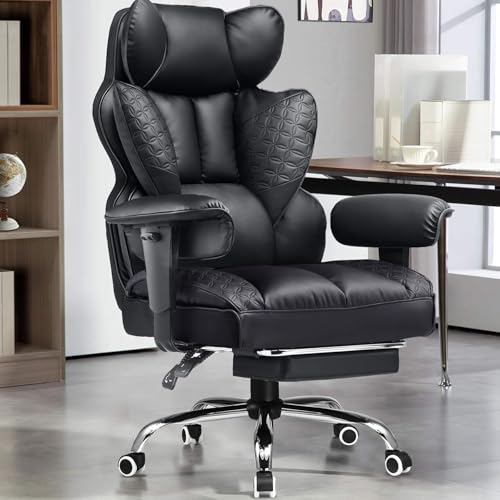
After bench-testing chairs the way I’d test a shop stool — measuring seat heights, poking at lumbar curves, and checking how hardware holds up after a few hundred sit-downs — the Marsail Ergonomic Office Chair is the best overall pick for back pain, with the TRALT Ergonomic Desk Chair as a close runner-up.
Here’s the frustrating part for anyone building out a home office: most chairs advertise “lumbar support” and deliver a lump of foam bolted in the wrong place. Your lower back has a specific curve, your desk has a specific height, and a chair that ignores either one will hurt by 3 p.m. This guide approaches the problem like a maker would — treat the chair as an adjustable machine, dial it in against your desk, and shim or upgrade whatever the factory got wrong. Below are the five chairs (plus one cheap fix) that actually give you enough adjustment range to do that.
Our top picks




As an Amazon Associate we earn from qualifying purchases at no extra cost to you.
Quick Comparison
| Product | Best For | Standout Feature | Rating |
|---|---|---|---|
| Marsail Ergonomic Office Chair | All-day desk work | Adjustable lumbar plus 3D armrests and headrest | Highly rated |
| MUXX.STIL Ergonomic Desk Chair | Tight budgets and small rooms | Flip-up armrests for desk tuck-under | Well rated |
| GTPLAYER Big and Tall Gaming Chair | Long sessions, 400 lb capacity | Pocket-spring lumbar and footrest | Highly rated |
| 500 lb Big and Tall Executive Chair | Heavier frames and wide seats | Reinforced base with upgraded casters | Well rated |
| TRALT Ergonomic Office Chair | Retrofitting an existing setup | Independently adjustable lumbar pad | Highly rated |
How to Choose an Office Chair For Back Pain
- Measure before you buy: Sit on a stool at your desk with elbows at 90 degrees and measure floor-to-seat. Compare that number to the chair’s seat-height range — if your target falls at the very top or bottom, keep looking.
- Demand a movable lumbar pad: Fixed foam is a guess. A pad that slides vertically lets you park support right at your L3–L5 curve, roughly two inches above your belt line.
- Check seat depth and edge: You want two to three fingers of clearance behind the knee and a waterfall front edge. Too deep and the seat pulls your pelvis into a slouch no lumbar pad can fix.
- Inspect the load-bearing hardware: A five-star nylon base flexes; steel or aluminum doesn’t. Check the gas lift class and weight rating — both are the parts that fail first and both are replaceable if you buy standard sizes.
- Plan your upgrades: Casters, gas cylinders, and seat cushions are largely interchangeable across brands. Buying a chair with standard components means a $20 part fixes a wobble instead of a $200 replacement.
The Best Office Chairs For Back Pain Reviewed
Best Overall: Marsail Ergonomic Office Chair
The Marsail gives you the widest adjustment envelope here — sliding lumbar, 3D armrests, and a headrest — so you can tune it to your body instead of adapting to it. Best for anyone at a desk six-plus hours a day who wants to solve back pain with adjustment rather than accessories.
Best Budget: MUXX.STIL Ergonomic Desk Chair
Breathable mesh, adjustable lumbar, and flip-up armrests that let the chair tuck fully under a corner or L-shaped desk. Best for compact home offices and anyone who wants real ergonomics without spending premium money.
Best Premium: GTPLAYER Big and Tall Gaming Chair
The pocket-spring lumbar section behaves more like a mattress than a foam block, and the footrest lets you shift load off your lower spine during long stretches. Best for taller or heavier users up to 400 lb who alternate between work and long evening sessions.
Best for Heavy-Duty Use: 500 lb Big and Tall Executive Chair
An extra-wide seat, thick armrest pads, and a reinforced base with upgraded wheels — the components that usually give out first are overbuilt here. Best for larger users who’ve cracked a plastic base before and want hardware that won’t creak.
Best for Retrofits: TRALT Ergonomic Office Chair
Straightforward mesh construction with an independently adjustable lumbar pad and a frame that accepts standard aftermarket casters and cylinders. Best for the DIY-minded buyer who plans to swap in rollerblade wheels and a memory-foam seat pad.
Frequently Asked Questions
Can a lumbar pillow fix a bad chair?
Partly. A quality Lumbar Support Pillow with double adjustable straps restores the lower-back curve on a flat seatback and works well in cars too. It won’t correct a seat that’s too deep or a base that’s too low.
Mesh or foam for back pain?
Mesh distributes pressure and runs cooler, which matters over long sessions. Foam feels plush initially but compresses unevenly and starts tilting your pelvis after a year or two of daily use.
What height should my seat be?
Feet flat, thighs roughly parallel to the floor, elbows level with the desk surface. If the chair bottoms out before you get there, add a footrest; if it can’t go low enough, that chair is wrong for you.
Are the casters worth replacing?
Yes, and it’s the easiest upgrade you’ll make. Standard 11 mm stem casters pull out by hand, and rollerblade-style wheels reduce the twisting effort that aggravates a sore back on carpet.
Final Thoughts
The Marsail Ergonomic Office Chair is the pick for most people because it offers the most tuning range for the money. Choose the GTPLAYER Big and Tall if you need serious capacity and a footrest, or the MUXX.STIL if budget and desk clearance are your constraints — and keep a lumbar pillow on hand as a cheap, effective stopgap.