Key takeaways
- Most households own a fire extinguisher the way they own a spare key: somewhere, probably, and no one is certain where.
Most households own a fire extinguisher the way they own a spare key: somewhere, probably, and no one is certain where. That is a poor starting point, because an extinguisher is only useful if it is mounted where you pass it, matches the type of fire you might face, and is checked from time to time. This keyword sets a ceiling of under 100 dollars, which is enough for several units, so the practical choice becomes dry chemical canisters versus compact aerosol sprays, and whether one unit or a multi-pack suits your home.
This guide is for new homeowners, renters setting up a kitchen, people with a garage or workshop, and anyone updating a safety checklist for 2026. We compare five listings strictly from their titles. We make no promises about how any extinguisher will perform in a fire, and an extinguisher is never a substitute for getting everyone out and calling emergency services. Where a title mentions a UL label or a letter classification, we repeat it as stated and tell you to confirm it on the listing and on the unit label.
Quick Picks
Our top picks




As an Amazon Associate we earn from qualifying purchases at no extra cost to you.
| Product | Best for | Key spec from the title |
|---|---|---|
| Kidde Basic 110 | A first unit for a home | 1-A:10-B:C, residential, 1 pack |
| First Alert HOME2PRO | Larger or workshop spaces | 2-A:10-B:C, rechargeable, UL rated |
| Kidde Dry Chemical 4 Pack | Outfitting a whole house or rentals | 1-A:10-B:C, mounting bracket, 4 units |
| AmzBoom Aerosol 3 Pack | Kitchen, car, and boat | A, B, C, K spray, mounting bracket |
| First Alert HOME1 | Two-floor homes | UL rated 1-A:10-B:C, 2 pack |
How to Choose
Learn what the letters mean
The letter and number code on an extinguisher describes the kinds of fires it is classified for. A covers ordinary combustibles like wood, paper, and cloth. B covers flammable liquids such as grease and gasoline. C covers energized electrical equipment. K covers cooking oils and fats. The number in front of the A or B is a size-related classification, so a 2-A is not the same as a 1-A. Read the label on the actual unit, and match the letters to the hazards in your home. A kitchen with a deep fryer, a garage with solvents, and a home office full of cables each point to different letters, so walk through the house and list the hazards before you shop. Do not assume that a bigger code is automatically the right answer for a small apartment.
Decide between dry chemical and aerosol styles
Dry chemical canisters are the familiar red steel or aluminum cylinders with a gauge, a pin, and a handle. They leave a powder residue that is a hassle to clean. Compact aerosol sprays are lighter and easier to hold for some people, and a K classification can matter in a kitchen. The trade-off is that size and discharge time vary, so look at the listing for weight, spray duration, and any shelf-life statement.
Think about weight, gauge, and mounting
If a unit is too heavy for the person most likely to use it, it will not get used, so hold the weight in mind alongside the classification. A pressure gauge lets you check the unit at a glance. A mounting bracket keeps it visible and off the floor, and several listings here include one. Place an extinguisher near an exit, not next to the stove, so you can get to it while keeping your back to a clear path out. Mount it at a height that every adult in the home can reach, and keep it away from heat sources and damp spots that shorten the life of the finish and the gauge.
Know the upkeep
Rechargeable models can be serviced and refilled, while disposable ones are replaced, and the listing should say which type you are buying. Both need periodic inspection: check the gauge, the pin, the hose, and the date on the label. Budget units tend to be disposable, and a pack of several is helpful if you want one per floor. Keep the manual, and think about a short training session so your household knows the basics. Many fire departments and local safety groups offer free demonstrations. Even without one, you can read the label together and rehearse the steps printed there, so the first time anyone reads the instructions is not during a real emergency. Cheap units sometimes skimp on the hose, the handle, and the gauge, so look closely at photos of those parts.
The 5 Best Options
Kidde Basic 110 Home Fire Extinguisher
The title describes a residential multi-purpose extinguisher with a 1-A:10-B:C classification, model FA110G, sold as a single unit and aimed at small common household fires. It is a straightforward first purchase for someone who has never owned one, and it can sit by the kitchen door or in a hallway closet.
- Strength: a multi-purpose classification covers ordinary combustibles, flammable liquids, and electrical equipment as stated.
- Strength: buying a single unit lets you try one before committing to a pack.
- Trade-off: the title is cut off, so confirm weight, gauge, and whether it can be recharged.
Skip it if you want a second or third unit for other floors, since a pack may cost less per unit. Also skip it if the household needs a lighter spray for a hand with limited strength.
First Alert HOME2PRO Heavy Duty Extinguisher
This listing describes a heavy duty, rechargeable compliance unit that is UL rated with a 2-A:10-B:C classification, for home and commercial use. The 2-A figure is the higher of the two A numbers in this group, which makes it a reasonable pick for a workshop, a garage, or a larger kitchen where you would like more capacity.
- Strength: the higher A number in the title suggests a larger classification than the 1-A units here.
- Strength: rechargeable construction means it can be serviced rather than thrown out.
- Trade-off: a heavier unit can be harder to hold, so confirm the weight on the listing.
Skip it if you want a lightweight unit for someone with limited strength or a pack of several. Check the label wording on the page.
Kidde 1-A:10-B:C Dry Chemical 4 Pack
The title offers four red dry chemical extinguishers for home, each with a 1-A:10-B:C classification and a mounting bracket included. That quantity suits a two-story house, a rental property with several units, or a household that wants one in the kitchen, garage, basement, and hallway.
- Strength: four units let you spread coverage through a building.
- Strength: each comes with a mounting bracket, as the title notes.
- Trade-off: dry chemical powder leaves a residue after use that takes effort to clean.
Skip it if you only need one unit, or if you want rechargeable models. Check the listing for weight and whether the units are disposable, and keep in mind that four identical canisters still need four separate inspections, so build the habit of checking them all on the same day each season.
AmzBoom Fire Extinguisher Aerosol 3 Pack
This listing sells three portable aerosol spray extinguishers for home, car, kitchen, and boat, classified as A, B, C, and K, with a mounting bracket. The K class is the notable detail, since cooking oils are a kitchen concern, and the compact shape fits a car door pocket or a boat locker where a steel cylinder would not.
- Strength: the A, B, C, and K classes are all named in the title.
- Strength: compact aerosol cans fit tight spaces like cars and galleys.
- Trade-off: the title gives no UL or other certification language, so confirm what the page states.
Skip it if you want a named, widely recognized certification on the label or a heavy-duty canister with a gauge. Read the weight, discharge time, and shelf-life statements first.
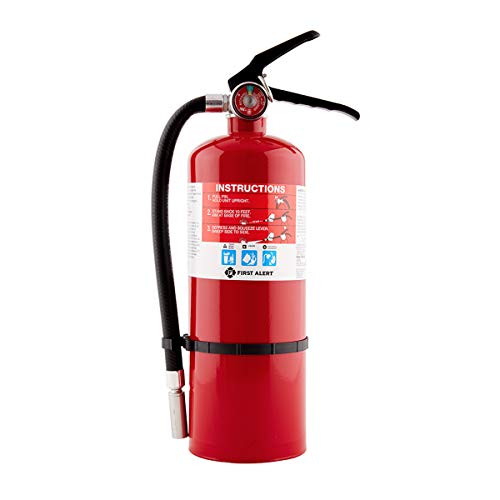
First Alert HOME1 Standard Extinguisher 2 Pack
The title describes a standard home use extinguisher that is UL rated at 1-A:10-B:C, sold as a two pack. It suits a two-floor house or an apartment with a kitchen and a hallway, where one unit can go on each level near an exit.
- Strength: a two pack covers two locations at once.
- Strength: the UL rated wording and the classification both appear in the title.
- Trade-off: the title does not say whether the units are rechargeable.
Skip it if you want a higher A number or a spray with a K class. Confirm the weight and the wording on the label, and check whether a wall bracket is part of the package, because the title for this one does not mention it. If it is missing, plan to buy a bracket so the units stay visible instead of living in a drawer.
Which One Fits Your Situation
You are buying your first extinguisher
The Kidde Basic 110 single unit keeps things simple. Mount it near an exit and learn the pin-and-handle sequence by reading the label together with everyone in the household.
You have a garage or workshop
The First Alert HOME2PRO lists a 2-A:10-B:C classification and rechargeable build. Hang it by the door that leads to the garage, not deep inside the workspace where a fire might block it.
You want one on every floor
The Kidde four pack and the First Alert two pack both give you multiple units. Put one in the kitchen, one near the bedrooms, and the rest in the garage or basement, and write the install date on a label.
You cook often or travel by car and boat
The AmzBoom three pack names a K class and compact cans for kitchens, cars, and boats. Read the label for the discharge time and the shelf-life statement before you decide to depend on them in place of a steel canister.
Common Mistakes
- Leaving the extinguisher on the floor of a cabinet where no one can see it.
- Never reading the label, so the first time you learn how it works is during an emergency.
- Ignoring the gauge and the date for years.
- Mounting it right beside the stove, where a fire could block access.
- Trying to fight a spreading fire instead of leaving and calling emergency services, or buying on pack size alone without checking that each unit’s classification matches the hazards in your rooms and that a bracket is included for each one.
Related guides
- Battery Powered Floodlight Camera With Local Storage
- Cordless Drill Brush Attachment For Bathroom Grout
- Rechargeable Emergency Lantern For Power Outages
Frequently Asked Questions
What does 1-A:10-B:C mean?
It is a classification code printed on the unit that describes the types and relative size of fires it is designed for. Read the label and the manual.
Do I need a K class for the kitchen?
A K class refers to cooking oils and fats. Look for it on the label if you fry often, and confirm what the listing states. Not every home extinguisher carries a K class, so do not assume it from the product name alone.
How often should I check my extinguisher?
Look at the gauge and condition regularly, and follow the maker’s instructions for replacement or service.
Can I rely on an extinguisher alone?
No. It is one part of a plan that includes working smoke alarms, a practiced exit route, and calling emergency services. Make sure everyone knows that getting out comes first and that an extinguisher is for small, contained situations only, as the maker’s instructions describe.
More from Amazon
Programs that pair well with the guide above. Offers and eligibility are set by Amazon and may change.
A free business account with business pricing and bulk-buying tools for work, shop or home office.
Create a business accountFree shipping on eligible items, Prime Video and more. Eligible new members can start with a free trial.
Start a Prime free trialAudiobooks and podcasts to listen to on the go. Eligible new members can start with a free trial.
Try Audible freeAd-free music streaming. Eligible new subscribers can start with a free trial.
Try Music Unlimited freeAs an Amazon Associate we earn from qualifying purchases.