Key takeaways
- Framing and anchor points: Get in the attic or shine a light up before you order. Solid 2x joists on 16″ centers are ideal; engineered trusses need bolts through the top chord or blocking, and drywall-only ceilings are a hard no. Map your usable mounting span first, then pick a system that fits it.
- Real vertical clearance: Measure from finished floor to the underside of your ceiling, then subtract garage door track, opener rail, and torsion spring travel. A 15-ft lift is useless if your opener eats the drop path. Cycle the door and watch where everything sweeps.
- Rated capacity versus what you’ll actually load: Ratings assume evenly distributed weight. I plan for about 70% of the number on the label, which means a 325 lb platform comfortably handles four or five loaded totes, not an engine block.
- Manual winch or motorized: A 42:1 hand winch is cheap, dead reliable, and fine if you lift twice a year. If you’re pulling seasonal gear down monthly, or storing anything you’d rather not crank one-handed, spend the extra on a motor and remote. Your shoulders will file a formal complaint otherwise.
- Cable, locks, and hardware quality: Look for 3/16″ galvanized aircraft cable, a positive safety lock or ratchet that holds the load if the winch lets go, and grade-rated lag bolts. Skip anything using thin braided cord or relying on winch friction alone.
Every garage hits the same wall eventually. The floor fills with totes, the wall cleats are full, and the only real estate left is the eight-foot-plus of dead air above your head. Ladders and a friend can move a few bins up there once, but nobody wants to wrestle a 90-pound Christmas tub down a stepladder every December. That’s the gap a ceiling lift fills: it turns overhead space into something you can actually reach on a Tuesday afternoon without a spotter.
I’ve mounted several of these in stick-framed and truss-framed garages, and the differences that matter aren’t the ones on the box. Below I’ve broken down what to check before you buy — joist spacing, real clearance, cable versus strap, manual versus motorized — then walked through the systems worth your money in 2026, from bare-bones winch kits you deck out yourself to fully motorized platforms you run from a remote.
Our top picks




As an Amazon Associate we earn from qualifying purchases at no extra cost to you. Ratings are shown as listed on Amazon.
🛒 Best Price Today on Amazon
Prime members get fast, free shipping on everything above, plus member-only deals. New members get a 30-day free trial — cancel anytime.
How to Choose a Garage Storage Lift System (2026)
- Framing and anchor points: Get in the attic or shine a light up before you order. Solid 2x joists on 16″ centers are ideal; engineered trusses need bolts through the top chord or blocking, and drywall-only ceilings are a hard no. Map your usable mounting span first, then pick a system that fits it.
- Real vertical clearance: Measure from finished floor to the underside of your ceiling, then subtract garage door track, opener rail, and torsion spring travel. A 15-ft lift is useless if your opener eats the drop path. Cycle the door and watch where everything sweeps.
- Rated capacity versus what you’ll actually load: Ratings assume evenly distributed weight. I plan for about 70% of the number on the label, which means a 325 lb platform comfortably handles four or five loaded totes, not an engine block.
- Manual winch or motorized: A 42:1 hand winch is cheap, dead reliable, and fine if you lift twice a year. If you’re pulling seasonal gear down monthly, or storing anything you’d rather not crank one-handed, spend the extra on a motor and remote. Your shoulders will file a formal complaint otherwise.
- Cable, locks, and hardware quality: Look for 3/16″ galvanized aircraft cable, a positive safety lock or ratchet that holds the load if the winch lets go, and grade-rated lag bolts. Skip anything using thin braided cord or relying on winch friction alone.
The Best Garage Storage Lift Systems (2026) Reviewed
FERO Motorized Overhead Garage Storage Rack, 4×8
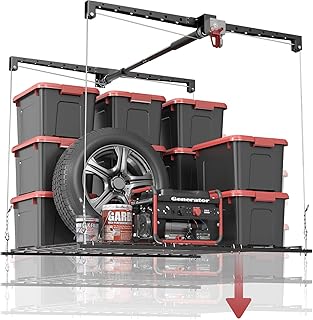
This is the one I’d install in my own garage: a full 4×8 platform, 325 lb capacity, and a remote so you can lower it while your hands are full. Setup takes a solid afternoon and a helper, but daily use is effortively one button, which is exactly what turns overhead storage from a chore into a habit.
FERO Overhead Garage Storage Rack 4×8, 500 lb
The manual sibling, and the capacity king here at 500 lb with a safety lock on the drop mechanism. Great value if you’re storing heavy, low-frequency items like tile, camping gear, or tool cases and don’t mind cranking.
SpaceLift SL 5228-S Motorized Attic Lift
Made in the USA with 15 ft of vertical travel and a 24″ x 41″ platform, this is the pick for genuine attic access through a framed opening rather than open-ceiling storage. The 200 lb rating is modest, but the build quality and travel distance are the best in this group.
Overhead Garage Storage Lift Kit, 42:1 Winch
A bare kit — 3/16″ galvanized cable, hardware, and a 42:1 winch, no deck included — for anyone comfortable cutting their own 3/4″ plywood platform. It’s the cheapest route to 300 lb of overhead capacity and my recommendation for makers who’d rather size the deck to their bay than accept someone else’s dimensions.
Electric Attic Lift with Wired/Wireless Remote
Dual wired and wireless control is genuinely useful when you’re up in the attic and the button is on the floor. With 220 lb capacity and 13 ft of lift, it’s a sensible middle ground between hand-crank kits and premium motorized platforms.
Frequently Asked Questions
Can I install one of these into trusses?
Yes, but bolt through the top chord or add blocking between trusses — never notch or drill the webs. If your trusses are engineered for minimal load, check with a local builder before hanging several hundred pounds.
How much ceiling height do I actually need?
Eight feet is the practical minimum for a platform system, and you’ll want the raised deck sitting above your garage door’s open position. Most kits here handle 8 to 16 ft ranges.
Do motorized lifts need a dedicated circuit?
No. These run on standard 110V and draw far less than a table saw, so an existing garage outlet is fine. Just avoid long, thin extension cords.
Are they safe to leave loaded long-term?
Yes, provided the system has a mechanical safety lock rather than relying on winch tension. Inspect cables and bolts annually and re-torque anything that’s backed off.
Final Thoughts
For most garages, the FERO Motorized 4×8 rack is the buy — remote operation is what keeps you actually using the space. If you want maximum weight for less money, the manual FERO 500 lb rack is hard to beat, and for true attic access through a framed hatch, the SpaceLift SL 5228-S remains the most solidly built option on the list.