Key takeaways
- Match CFM to room volume: Multiply length × width × ceiling height, then aim for a fan that can turn over that volume several times per minute. A 7,400 CFM unit handles most living rooms; shops and gyms want 15,000 CFM or more.
- Insist on a DC motor: DC motors draw roughly 60–70% less power than AC equivalents, run noticeably quieter, and support six or more speed steps instead of three. For a fan that runs all summer, the electricity savings are real.
- Check the joist and box rating: A 96-inch aluminum-bladed fan can weigh 40+ pounds and generates lateral wobble force. You need a fan-rated brace box screwed into solid framing — not a standard plastic electrical box.
- Plan your downrod length: Blades should sit 8–10 feet off the floor for best circulation. Fans that ship with multiple downrods save you a second trip to the hardware store when you’re working with vaulted or industrial ceilings.
- Verify damp or wet rating for outdoor use: Covered patios need at least a damp rating with sealed motor housing and corrosion-resistant blades. Indoor-only fans mounted outside fail fast, usually at the motor bearings.
What's inside
Anyone who has stood on a ladder in a hot garage, sweat dripping onto the drywall, knows the frustration: you finally wire up a ceiling fan and the air barely moves. The blades spin, the motor hums, and the room feels exactly as stuffy as it did before. The culprit is almost always airflow spec — a 42-inch bedroom fan pushing maybe 3,000 CFM was never going to cool 600 square feet of workshop with 12-foot ceilings. Big spaces need big air movement, and that means paying attention to cubic feet per minute rather than blade looks.
This guide walks through the high-CFM fans worth mounting in 2026, from 120-inch industrial monsters built for shop bays down to 52-inch models that punch well above their size class. I’ve focused on what actually matters when you’re the one drilling into a joist: mounting hardware quality, downrod options, motor noise under load, and whether the remote or app control holds up past month three. Every pick below moves serious air.
As an Amazon Associate we earn from qualifying purchases.




🛒 Best Price Today on Amazon
Prime members get fast, free shipping on everything above, plus member-only deals. New members get a 30-day free trial — cancel anytime.
How to Choose a High Cfm Ceiling Fan (2026)
- Match CFM to room volume: Multiply length × width × ceiling height, then aim for a fan that can turn over that volume several times per minute. A 7,400 CFM unit handles most living rooms; shops and gyms want 15,000 CFM or more.
- Insist on a DC motor: DC motors draw roughly 60–70% less power than AC equivalents, run noticeably quieter, and support six or more speed steps instead of three. For a fan that runs all summer, the electricity savings are real.
- Check the joist and box rating: A 96-inch aluminum-bladed fan can weigh 40+ pounds and generates lateral wobble force. You need a fan-rated brace box screwed into solid framing — not a standard plastic electrical box.
- Plan your downrod length: Blades should sit 8–10 feet off the floor for best circulation. Fans that ship with multiple downrods save you a second trip to the hardware store when you’re working with vaulted or industrial ceilings.
- Verify damp or wet rating for outdoor use: Covered patios need at least a damp rating with sealed motor housing and corrosion-resistant blades. Indoor-only fans mounted outside fail fast, usually at the motor bearings.
The Best High Cfm Ceiling Fan (2026)s Reviewed
120-Inch Extra Large Industrial Ceiling Fan
This is the heavyweight of the group — six silver aluminum blades spanning ten feet, driven by a reversible DC motor across six speeds, with three downrods included so you can dial in height on tall shop ceilings. It moves enough air to make a two-car garage genuinely comfortable, and the aluminum blade set keeps rotating mass reasonable for the span.
ZMISHIBO 96-Inch Ceiling Fan with Lights
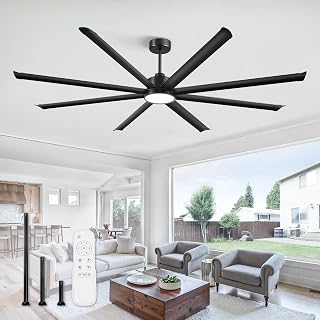
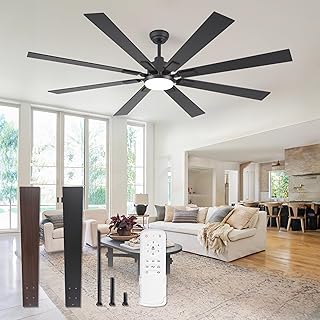
Eight reversible aluminum blades and an industrial-grade quiet DC motor make this the strongest all-rounder for large living spaces, gazebos, and shop areas where you also want light. The 3CCT LED lets you switch between warm and daylight temperatures, and the damp rating covers covered outdoor installs.
60-Inch 7400+ CFM Ceiling Fan
A three-blade design that manages 7,400+ CFM without sounding like an HVAC unit — the noiseless reversible DC motor is the standout here. Six speeds, timer function, and 3CCT lighting make it a smart pick for open-plan living rooms and larger patios where you want performance without industrial styling.
Ohniyou 96″ Industrial Ceiling Fan
Built for warehouses, gyms, and working shops, this eight-blade metal fan skips the light kit entirely and puts everything into airflow. App control alongside the remote is genuinely useful when the fan hangs 14 feet up, and the black finish disappears against exposed ceiling framing.
ZMISHIBO 72″ Ceiling Fan with Lights
The sweet spot for big covered patios and great rooms — strong airflow from a quiet DC motor, a 24W 3CCT LED, and dual-finish blades that let you match either wood or metal decor. Damp rated and indoor/outdoor capable, so it works on a screened porch year-round.
Frequently Asked Questions
What CFM do I actually need?
For a standard bedroom, 4,000–5,000 CFM is plenty. Living rooms and open-plan spaces benefit from 6,000–8,000 CFM. Garages, shops, and gyms with high ceilings want 12,000 CFM and up, which generally means a 72-inch span or larger.
Are big fans louder than small ones?
Not necessarily. A large-diameter fan moves the same air at lower RPM, which usually means less blade noise. Sound comes mostly from motor type and mounting rigidity — a DC motor on a properly braced box is remarkably quiet even at 96 inches.
Can I install one of these myself?
A 52-inch fan is a straightforward afternoon job if you’re comfortable with basic wiring and have an existing fan-rated box. Anything 72 inches or larger is a two-person lift, and if the ceiling box isn’t fan-rated you’ll need to install a brace — worth calling an electrician if that’s unfamiliar territory.
Does reversing the blades in winter actually help?
Yes, in rooms with ceilings above about nine feet. Running the fan in reverse at low speed pulls warm air down off the ceiling without creating a draft, which can meaningfully reduce heating runtime.
Final Thoughts
For most homes, the ZMISHIBO 96-inch is the pick that balances airflow, lighting, and build quality across living rooms and covered patios alike. If you’re outfitting a shop or garage where nothing but volume matters, the 120-inch industrial fan or the Ohniyou 96″ will move air on a scale nothing smaller can match. And for a normal-height living room where you want serious circulation without a ten-foot blade sweep, the 60-inch 7400+ CFM model is the smart, quiet compromise.