Key takeaways
- Motor type: DC motors draw roughly 60 to 70 percent less power than AC equivalents, run noticeably quieter at low speeds, and support six or more speed steps with reverse. For a hugger, where airflow is already constrained, a good DC motor is the single biggest upgrade you can buy.
- Blade span vs. room size: Match diameter to square footage, not taste. A 42-inch fan suits rooms up to about 144 sq ft, 48 inches covers mid-size bedrooms, and 52 inches handles living rooms up to roughly 400 sq ft. Oversizing a small room just creates drafts and noise.
- Light output and color temperature: 3CCT fixtures let you flip between 3000K, 4000K, and 5000K, which matters when the same fan lights a bedroom and a hallway. Check that dimming works from the wall switch or remote, not just one of them.
- Damp and wet ratings: Covered patios and bathrooms need at least a damp rating with ETL or UL listing. An indoor-only fan on a porch will corrode at the bearings within a season or two.
- Mounting hardware quality: Look for a hinged or hook-style bracket that holds the motor while you wire it. That detail turns a two-person job into a one-person job, and it separates well-designed huggers from the frustrating ones.
What's inside
Anyone who has stood on a ladder holding a fan canopy overhead with one hand while fishing for a mounting screw with the other knows the real problem with low ceilings: standard downrod fans hang into the room and eat the headroom you don’t have. At 8 feet, a fan blade sitting 12 inches below the joists puts moving parts right at eye level for a tall adult, and building code wants at least 7 feet of clearance under the blades. Hugger fans, also called flush mount or low profile fans, bolt the motor housing straight to the ceiling bracket and give back those inches. The tradeoff is real, though. Less space between blades and ceiling means less air to pull from, so airflow depends heavily on motor quality and blade pitch rather than sheer drop height.
This guide is built around what actually matters once the fan is up: how much air it genuinely moves, whether the motor stays quiet at low speed, how the light behaves in a room where the fixture sits close to your line of sight, and how forgiving the install is when you are working solo in an attic-adjacent junction box. Below are the hugger fans worth your time in 2026, from budget DC-motor workhorses to a designer piece that earns its price.
As an Amazon Associate we earn from qualifying purchases.




How to Choose a Hugger Ceiling Fan (2026)
- Motor type: DC motors draw roughly 60 to 70 percent less power than AC equivalents, run noticeably quieter at low speeds, and support six or more speed steps with reverse. For a hugger, where airflow is already constrained, a good DC motor is the single biggest upgrade you can buy.
- Blade span vs. room size: Match diameter to square footage, not taste. A 42-inch fan suits rooms up to about 144 sq ft, 48 inches covers mid-size bedrooms, and 52 inches handles living rooms up to roughly 400 sq ft. Oversizing a small room just creates drafts and noise.
- Light output and color temperature: 3CCT fixtures let you flip between 3000K, 4000K, and 5000K, which matters when the same fan lights a bedroom and a hallway. Check that dimming works from the wall switch or remote, not just one of them.
- Damp and wet ratings: Covered patios and bathrooms need at least a damp rating with ETL or UL listing. An indoor-only fan on a porch will corrode at the bearings within a season or two.
- Mounting hardware quality: Look for a hinged or hook-style bracket that holds the motor while you wire it. That detail turns a two-person job into a one-person job, and it separates well-designed huggers from the frustrating ones.
The Best Hugger Ceiling Fans (2026) Reviewed
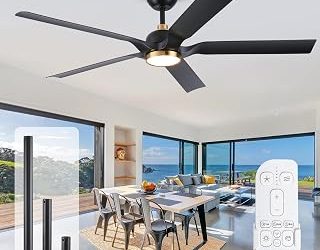
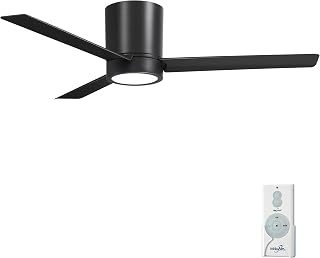
52″ Flush Mount Fan with 3CCT LED and Remote
This one hits the sweet spot for most rooms: a reversible DC motor with six speeds, dimmable 3CCT light, and a wide 90 to 264V input range that makes it usable in workshops and outbuildings. The matte black finish holds up well, and the indoor/outdoor rating means covered porches are fair game.
Design House Millbridge Hugger Fan, 52″
A traditional steel-bodied fan in satin nickel that skips the app-and-remote complexity entirely in favor of a pull chain and pure reliability. If you are outfitting a rental, a guest room, or a house with existing brushed nickel trim, this is the sensible pick.
MINKA-AIRE Roto Flush 52″, Coal
The design-forward choice, with a sculptural three-blade profile and integrated LED that reads more like a light fixture than an appliance. Airflow is strong and the build quality is a clear step up, which is exactly what you are paying the premium for.
52″ Black Flush Mount Fan with App Control
App control alongside the remote is genuinely useful for scheduling and for rooms where the switch is awkwardly placed. The quiet DC motor and 3CCT dimming make it a solid bedroom fan, and the space-saving profile suits 8-foot ceilings without complaint.
42″ Flush Mount Fan with 3CCT LED
The smart choice for compact spaces, whether that is a nursery, a home office, or a small covered patio. It carries the same six-speed reversible DC motor and dimmable 3CCT light as its bigger siblings, with an ETL listing for damp locations.
Frequently Asked Questions
How much clearance does a hugger fan actually need?
Plan for at least 7 feet from floor to blade, which most huggers achieve on an 8-foot ceiling. Also leave a few inches of air gap above the blades, so avoid mounting one inside a shallow coffer or tight soffit.
Do flush mount fans move less air than downrod fans?
Slightly, yes, because the blades draw from a shallower air column. A well-pitched DC-motor hugger closes most of that gap, and sizing the fan correctly for the room matters more than the mount style.
Can I use a hugger fan on a sloped ceiling?
Usually not. Flush mount brackets are designed for flat ceilings, and slopes past a few degrees require a downrod with an angled canopy. Check the manufacturer’s maximum slope before ordering.
Do I need a dedicated wall switch for the light?
No. Remote-controlled models run light and fan over a single hot wire, so you can wire into an existing single-switch box. Keep the switch permanently on and control everything from the remote or app.
Final Thoughts
For most homes, the 52-inch flush mount with 3CCT LED and remote delivers the best balance of airflow, features, and price, and its wide voltage tolerance is a nice bonus for garage or shop use. Choose the MINKA-AIRE Roto Flush if the fan needs to look intentional in a finished room, and the LEDLUX 48-inch if you already have adequate lighting and simply want quiet, efficient air movement without another light source overhead.