Key takeaways
- Opening diameter: Put your whole hand in the tank. If your palm and wrist clear the opening, you can reach every corner with a cloth. Anything narrower and you’re relying on a brush that misses the seams where biofilm actually starts.
- Dishwasher-safe components: A tank rated for the top rack gets a 140°F sanitizing rinse you can’t match at the sink. This single spec cuts weekly maintenance to loading a dish and forgetting about it.
- Interior geometry: Look for rounded corners and no internal baffles, handles, or ribs. Every ridge is a shelf for mineral scale, and scale gives bacteria a textured surface to colonize.
- Humidistat accuracy: A unit that holds 45% RH prevents mold on your walls, window frames, and baseboards. Running open-loop at max output is how people end up with condensation stains behind the dresser.
- Material honesty: Stainless steel and BPA-free polypropylene resist staining and don’t absorb odors. Cheap ABS goes cloudy after a few months, and once it’s etched, you’ll never fully clean it.
What's inside
Pull apart a humidifier that’s been running all winter and you’ll usually find the same thing: a slick pink film in the tank corners, chalky scale on the transducer, and a musty smell that hits before you even lift the lid. That gunk isn’t a manufacturing defect. It’s biofilm, and it grows anywhere standing water meets a surface your hand can’t reach. Most tanks are designed like a bottle with a two-inch neck, which means you’re cleaning it with a bottle brush and hoping for the best.
I’ve taken apart enough of these units to know the fix is structural, not chemical. Wide-mouth tanks, dishwasher-safe parts, smooth interior walls with no ribbing, and stainless or BPA-free surfaces that don’t hold residue do more for mold prevention than any additive you can drop in the water. Below are six units picked specifically for how easy they are to strip down and scrub, plus the criteria I use when evaluating a tank I can’t see inside at the store.
As an Amazon Associate we earn from qualifying purchases.


How to Choose a Humidifier No Mold (2026)
- Opening diameter: Put your whole hand in the tank. If your palm and wrist clear the opening, you can reach every corner with a cloth. Anything narrower and you’re relying on a brush that misses the seams where biofilm actually starts.
- Dishwasher-safe components: A tank rated for the top rack gets a 140°F sanitizing rinse you can’t match at the sink. This single spec cuts weekly maintenance to loading a dish and forgetting about it.
- Interior geometry: Look for rounded corners and no internal baffles, handles, or ribs. Every ridge is a shelf for mineral scale, and scale gives bacteria a textured surface to colonize.
- Humidistat accuracy: A unit that holds 45% RH prevents mold on your walls, window frames, and baseboards. Running open-loop at max output is how people end up with condensation stains behind the dresser.
- Material honesty: Stainless steel and BPA-free polypropylene resist staining and don’t absorb odors. Cheap ABS goes cloudy after a few months, and once it’s etched, you’ll never fully clean it.
The Best Humidifier No Mold (2026)s Reviewed
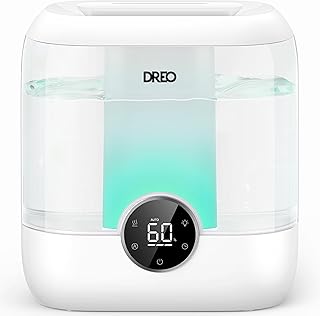
DREO HM524 6L
The 60-hour runtime means fewer refills, but the real draw is the top-fill design paired with genuinely precise humidity control that shuts off before you over-saturate the room. At 28 dB it disappears into a bedroom, and the tank opening is wide enough to wipe by hand without a brush.
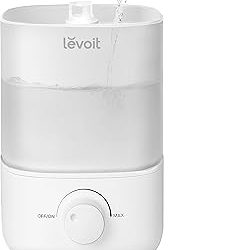
Levoit NeoClassic 650S
Dishwasher-safe at 6.2L with app control, this is the one I recommend when someone wants maintenance to be nearly automatic. The smart scheduling lets you run it only during sleeping hours, which cuts total water sitting time and gives the tank a chance to dry out daily.
Feekaa Stainless Steel 4L
Stainless interior walls are the closest thing to a mold-proof surface in this category, since there’s nothing porous for biofilm to grip. It’s dishwasher safe, wipes clean in under a minute, and the material won’t yellow or hold that stale-water smell that plagues plastic tanks.
Levoit NeoClassic 450 4.2L
At 21 dB this is the quietest unit on the list, and the 42-hour runtime on 4.2L means it’s sipping water rather than blasting it. The top-fill opening is generous, and every water-contact part goes in the dishwasher.
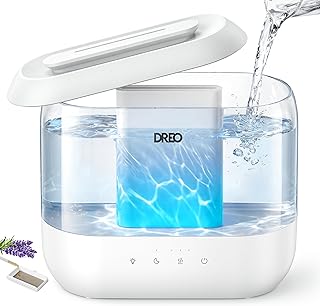
DREO HM311 4L
A simpler, BPA-free take on the HM524 with a 36-hour runtime and the same easy-refill lid. Good pick for a nursery where you want reliable output without an app or a menu to navigate.
Frequently Asked Questions
How often do I actually need to clean it?
Empty and dry the tank daily, and do a full scrub weekly. Standing water more than 24 hours old is where biofilm gets its start, so dumping leftover water each morning matters more than any deep clean.
Does distilled water prevent mold?
It prevents mineral scale and white dust, which removes the rough surface mold likes to anchor to. It won’t stop bacteria on its own, since airborne spores land in an open tank regardless of water purity.
Is vinegar or bleach better for cleaning?
White vinegar dissolves scale; a dilute bleach solution kills organisms. Use vinegar weekly and bleach monthly, never together, and rinse thoroughly between them.
What humidity level should I target?
Hold between 40% and 50% RH. Below 30% you get dry sinuses and cracked wood furniture; above 55% you risk mold growth on drywall, upholstery, and window sills.
Final Thoughts
If you want the lowest-effort setup, the Feekaa stainless steel unit is the one that stays clean because of what it’s made from, not how diligent you are. The Levoit NeoClassic 650S is the best all-rounder thanks to dishwasher-safe parts and scheduling that limits standing water, while the DREO HM524 wins on runtime and humidity accuracy for larger bedrooms.