Key takeaways
- Watts per cubic foot: Divide heater wattage by interior volume. Anything under roughly 25W per cubic foot will struggle to break 130°F in an unconditioned space. A 1200W one-person cabin clears that bar easily; a 1500W two-person cabin is closer to the edge.
- Circuit reality: A 1500W heater pulls about 12.5 amps at 120V. That’s most of a standard 15-amp circuit. Give the sauna its own breaker, skip the extension cord, and use a GFCI outlet if the unit sits near a laundry or bath.
- Floor loss: Bare concrete acts like a heat sink and will cost you 10–15 degrees. Set the cabin on ¾” plywood over foam sheathing, or at minimum a dense rubber mat. This single step does more for peak temperature than any upgrade you can buy.
- Panel fit and sealing: Tongue-and-groove hemlock panels should snap together with no daylight at the seams. Check the door gasket and the roof vent slider — a loose vent bleeds heat continuously.
- Controls that pre-heat: Look for a timer with a pre-warm cycle and temperature presets. Being able to start the cabin from your phone or set it to run 10 minutes before you walk in means you sit down at target temp instead of waiting it out.
What's inside
Most people shopping for a home infrared sauna get fixated on the number printed on the spec sheet: 140°F, 150°F, 167°F. Then the cabin arrives, they run it for 45 minutes in a chilly garage, and the LCD stalls out at 118°F. The disappointment isn’t a defect — it’s physics. Infrared heaters warm your body directly rather than roasting the air, so the ambient reading depends as much on your room, your floor, and your wiring as it does on the wattage rating.
This guide looks at home saunas through a builder’s lens: how fast each cabin actually climbs, how tightly it holds heat, and what you can do during setup to squeeze more consistent temperatures out of it. Below you’ll find six units worth considering in 2026, from a fold-flat tent to a corner cabin that seats three, plus the setup details nobody mentions in the listing photos.
As an Amazon Associate we earn from qualifying purchases.


🛒 Best Price Today on Amazon
Prime members get fast, free shipping on everything above, plus member-only deals. New members get a 30-day free trial — cancel anytime.
How to Choose an Infrared Sauna Temperature (2026)
- Watts per cubic foot: Divide heater wattage by interior volume. Anything under roughly 25W per cubic foot will struggle to break 130°F in an unconditioned space. A 1200W one-person cabin clears that bar easily; a 1500W two-person cabin is closer to the edge.
- Circuit reality: A 1500W heater pulls about 12.5 amps at 120V. That’s most of a standard 15-amp circuit. Give the sauna its own breaker, skip the extension cord, and use a GFCI outlet if the unit sits near a laundry or bath.
- Floor loss: Bare concrete acts like a heat sink and will cost you 10–15 degrees. Set the cabin on ¾” plywood over foam sheathing, or at minimum a dense rubber mat. This single step does more for peak temperature than any upgrade you can buy.
- Panel fit and sealing: Tongue-and-groove hemlock panels should snap together with no daylight at the seams. Check the door gasket and the roof vent slider — a loose vent bleeds heat continuously.
- Controls that pre-heat: Look for a timer with a pre-warm cycle and temperature presets. Being able to start the cabin from your phone or set it to run 10 minutes before you walk in means you sit down at target temp instead of waiting it out.
The Best Infrared Sauna Temperature (2026) Picks, Reviewed
Homsido 1-Person Hemlock Infrared Sauna
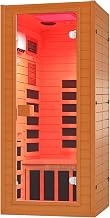
At 1200W in a genuinely compact footprint, this is the strongest heat-per-volume ratio on the list, and the 10-minute pre-warm plus temp presets on the LCD make it the most repeatable performer. Assembly is straightforward hemlock panel work — roughly 30 minutes with a second set of hands.
1-2 Person Infrared Sauna with Red Light Therapy
The 40″ x 36″ footprint gives you room to stretch a leg without ballooning the volume you have to heat, and the red light panel plus 7-color chromotherapy add real value if you’re building a recovery corner rather than just a sweat box. Bluetooth and radio are baked in, so no extra speaker to wire.
2-Person Smart App Control Infrared Sauna
WiFi scheduling is the standout here: set the 1500W heater to spin up while you’re finishing a workout and the cabin is at temperature when you open the door. Flame-retardant construction is a welcome spec for a garage or basement install where you’re less likely to be watching it.
2-3 Person Ceramic Infrared Corner Sauna
Ceramic emitters run hotter at the surface than carbon panels, which helps this larger cabin reach usable ambient temperatures despite the volume. The corner geometry is the practical win — it tucks into dead space in a finished basement instead of eating the middle of the room.
Infrared Sauna Tent with 3L Steamer
Nine heat levels, a 99-minute timer, and five-layer insulated fabric make this the sleeper pick for renters and small spaces, and the steamer adds humidity that a dry cabin can’t. It folds into a closet, which no wood cabin will ever do.
Frequently Asked Questions
What temperature should an infrared sauna run at?
Most sessions land between 120°F and 150°F. Because infrared heats tissue directly, 130°F feels comparable to a 180°F traditional sauna. Start low and work up over a few weeks.
Why won’t my sauna hit its maximum temperature?
Usually room temperature, floor conduction, or an open roof vent. Insulate underneath, close the vent for the first 15 minutes, and pre-warm with the door shut.
Does low EMF matter?
It’s a reasonable comfort factor. Low-EMF carbon or shielded ceramic panels keep field readings low at seat distance, which is why models like the compact Wood Infrared Sauna with red light advertise it.
Do I need an electrician?
Not for the sauna itself — they plug into a standard outlet. You may want one to add a dedicated circuit if your existing outlet already serves a freezer or power tools.
Final Thoughts
For the most reliable temperatures in a real-world room, the Homsido 1-person hemlock cabin is the pick — best heat density, simplest install. Step up to the 2-Person Smart App Control sauna if you want scheduled pre-heating, or grab the Infrared Sauna Tent with steamer if you need something that disappears when you’re done.