Key takeaways
- Measure the opening, not the fireplace: Note width at the front and the back of your firebox, plus height and depth at the shallowest point. Masonry tapers, so a 33-inch front opening can pinch to 30 inches at the rear — check clearance before you commit.
- Circuit capacity: On high heat these draw roughly 12.5 amps. That’s fine on a dedicated 15-amp circuit, but sharing with a TV, subwoofer, and a few lamps will trip the breaker. Map the circuit before you route the cord.
- Mounting method: Drop-in inserts rely on the firebox for support and trim. Recessed units need a framed cavity with proper depth clearance and blocking. Wall-mount hangs on a bracket. Log sets just sit on the hearth. Pick the one that matches how much carpentry you want to do.
- Front air discharge: Most inserts vent warm air out the front or bottom face, so nothing above them can block the grille. If you’re building a mantel shelf or media wall, confirm the clearance spec first — it dictates your framing layout.
- Controls you’ll actually reach: Behind a mantel, front-panel buttons become useless. Remote control is functionally mandatory for a recessed install; smart-home control is worth it if the unit lands somewhere awkward like a basement rec room.
What's inside
Ripping out a dead gas insert or blanking off an old masonry firebox tends to reveal the same problem: a rectangular hole that doesn’t match anything on the shelf. Fireplace openings were built to brick dimensions, not to product SKUs, so the measurement you take with a tape often lands awkwardly between two sizes. Add in the question of whether you’re plugging into an existing outlet or fishing new cable through a stud bay, and a simple weekend swap starts to feel like a framing project.
This guide is written for people who plan to do the install themselves. I’ve grouped the picks by how they actually mount — drop-in inserts that sit inside an existing firebox, recessed or wall-mount panels that need a framed cavity or a few lag bolts, and freestanding log sets that need nothing but a receptacle. For each one, the notes cover real dimensions, heater wiring reality at 1500W, and the trim work you may or may not have to do afterward.
As an Amazon Associate we earn from qualifying purchases.


🛒 Best Price Today on Amazon
Prime members get fast, free shipping on everything above, plus member-only deals. New members get a 30-day free trial — cancel anytime.
How to Choose a/an Insert Electric Fireplace (2026)
- Measure the opening, not the fireplace: Note width at the front and the back of your firebox, plus height and depth at the shallowest point. Masonry tapers, so a 33-inch front opening can pinch to 30 inches at the rear — check clearance before you commit.
- Circuit capacity: On high heat these draw roughly 12.5 amps. That’s fine on a dedicated 15-amp circuit, but sharing with a TV, subwoofer, and a few lamps will trip the breaker. Map the circuit before you route the cord.
- Mounting method: Drop-in inserts rely on the firebox for support and trim. Recessed units need a framed cavity with proper depth clearance and blocking. Wall-mount hangs on a bracket. Log sets just sit on the hearth. Pick the one that matches how much carpentry you want to do.
- Front air discharge: Most inserts vent warm air out the front or bottom face, so nothing above them can block the grille. If you’re building a mantel shelf or media wall, confirm the clearance spec first — it dictates your framing layout.
- Controls you’ll actually reach: Behind a mantel, front-panel buttons become useless. Remote control is functionally mandatory for a recessed install; smart-home control is worth it if the unit lands somewhere awkward like a basement rec room.
The Best Insert Electric Fireplace (2026)s Reviewed
PuraFlame Western 33″ Insert
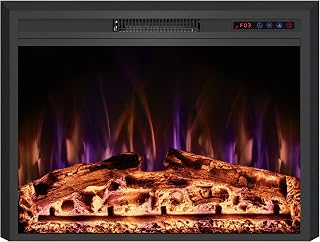
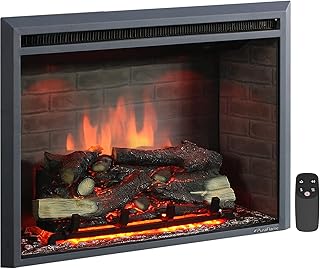
This is the straightforward masonry retrofit: 33 1/16 inches wide by 25 9/16 high, sized to sit inside a standard firebox with minimal shimming. The crackling audio is a genuinely convincing touch, and the open front makes it the easier of the two PuraFlame inserts to clean out after a dusty install.
PuraFlame Klaus 33″ Insert
Same footprint as the Western but with a glass door and mesh screen, which sells the illusion far better when the heater is off — worth it in a living room where the fireplace is a focal point year-round. The screen does trap dust, so plan on a soft brush every few months rather than a quick wipe.
Westinghouse 50″ Recessed Fireplace
The pick if you’re framing a new cavity rather than filling an old one. It handles wall-mount or in-wall recessed installs, adds Alexa and Google Home control, and the 24-hour timer plus color-changing flames give you the most flexibility here — just verify your stud bay depth before you cut drywall.
PuraFlame 27″ Freestanding Log Set
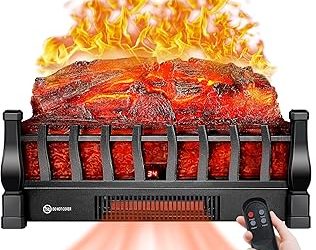
Zero carpentry: set it in the firebox, plug it in, done. Six flame colors with five brightness levels and the crackling effect make it the best option for a rental or a hearth you don’t want to modify permanently.
36″ Recessed Wall-Mounted Insert
A clean, modern linear panel with remote and timer, sized at 36 inches so it fills a wall nicely without dominating a small room. Runs quietly, which matters more than people expect once you’ve lived with a noisy blower.
Frequently Asked Questions
Do I need a dedicated circuit?
Not strictly, but it’s the right call. A 1500W heater pulls about 12.5 amps, leaving little headroom on a shared 15-amp circuit. If the fireplace shares a run with a media center, drop a dedicated line while the wall is open.
Can I hardwire instead of using the plug?
Only if the manufacturer explicitly permits it. Most of these are cord-and-plug rated, and cutting the cord voids listing and warranty. The common fix is installing a recessed receptacle inside the cavity.
How much heat do these actually put out?
At 1500W, expect meaningful supplemental warmth for roughly 400 square feet. Treat them as zone heaters, not whole-house solutions.
Do I need to seal the old chimney?
Yes. Block the damper or install a chimney balloon, otherwise conditioned air escapes straight up and you’ll feel a persistent draft around the insert.
Final Thoughts
For most masonry retrofits, the PuraFlame Klaus is the pick — correct dimensions and a glass front that looks right even when it’s off. Choose the Westinghouse 50″ if you’re framing a new recessed cavity from scratch, or the PuraFlame 27″ log set if you want warmth this weekend without touching a single tool.