Key takeaways
- Rail configuration: Confirm the drawer accepts hanging folders in both directions. Wider cabinets (28″+) let you run letter folders side-to-side and legal front-to-back; narrow ones may need the included rails repositioned, so check that hardware is in the box before you commit.
- Drawer depth vs. room depth: A 15.74″ deep cabinet needs roughly 30″ of clearance to fully extend. Measure your walkway, not just the wall, or you’ll be filing sideways forever.
- Anti-tip and counterweight: Tall four-drawer units get top-heavy when the upper drawer is loaded. Look for an interlock or anti-tip bracket, and plan to anchor anything over 48″ to a stud, especially with kids or pets around.
- Top-surface load rating: If the cabinet is doing double duty as a printer stand, check the stated top capacity. A mid-size laser printer runs 35–60 lbs, and thin sheet-metal tops can oil-can under that without a plywood spreader.
- Assembly honesty: Flat-pack steel cabinets typically take 45–90 minutes and reward a second set of hands plus a magnetic-tip screwdriver. Fully-welded commercial units skip that entirely but arrive heavy and often curbside-only.
What's inside
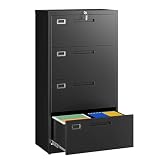
The BYNSOE 4 Drawer Lateral File Cabinet is the best overall pick for legal and letter-size storage, with the Letaya 2 Drawer Lateral File Cabinet as the runner-up for tighter spaces. Both swallow hanging folders in either orientation without the awkward folder gymnastics that vertical cabinets force on you.
Here’s the frustration most home-office builders hit: you finally get a filing system going, then discover your cabinet only fits letter-size folders one way, the rails don’t convert, and legal documents hang out the back like a bad haircut. Lateral cabinets solve this because their wide drawers accept folders side-to-side (letter) or front-to-back (legal) depending on how you set the rails. This guide covers six cabinets I’d actually put under a desk or beside a workbench, with notes on assembly reality, load capacity, and what makes a good printer platform.
As an Amazon Associate we earn from qualifying purchases.




Quick Comparison
| Product | Best For | Standout Feature | Rating |
|---|---|---|---|
| BYNSOE 4 Drawer Filing Cabinet | Whole-home archives | Four full-width steel drawers with central lock | See card above |
| Letaya 2 Drawer File Cabinet | Under-desk placement | 27.95″ height clears most desk aprons | See card above |
| Letaya 3 Drawer File Cabinet | Printer stand duty | Flat 39.84″ top sized for a laser printer | See card above |
| Letaya 4 Drawer File Cabinet | Narrow-footprint volume | 15.74″ depth in a 51.73″ tall tower | See card above |
| STAPLES Commercial 4-Drawer Lateral File | Heavy daily use | 36″ commercial-grade drawer width | See card above |
How to Choose a Lateral Filing Cabinet for Legal and Letter-Size Storage
- Rail configuration: Confirm the drawer accepts hanging folders in both directions. Wider cabinets (28″+) let you run letter folders side-to-side and legal front-to-back; narrow ones may need the included rails repositioned, so check that hardware is in the box before you commit.
- Drawer depth vs. room depth: A 15.74″ deep cabinet needs roughly 30″ of clearance to fully extend. Measure your walkway, not just the wall, or you’ll be filing sideways forever.
- Anti-tip and counterweight: Tall four-drawer units get top-heavy when the upper drawer is loaded. Look for an interlock or anti-tip bracket, and plan to anchor anything over 48″ to a stud, especially with kids or pets around.
- Top-surface load rating: If the cabinet is doing double duty as a printer stand, check the stated top capacity. A mid-size laser printer runs 35–60 lbs, and thin sheet-metal tops can oil-can under that without a plywood spreader.
- Assembly honesty: Flat-pack steel cabinets typically take 45–90 minutes and reward a second set of hands plus a magnetic-tip screwdriver. Fully-welded commercial units skip that entirely but arrive heavy and often curbside-only.
The Best Lateral Filing Cabinets for Legal and Letter-Size Storage Reviewed
Best Overall: BYNSOE 4 Drawer Lateral File Cabinet
This is the pick for anyone consolidating tax records, warranties, permits, and project binders into one place, with lockable drawers that handle A4, letter, and legal without swapping accessories. Assembly is required, so budget an evening and keep the hardware sorted in a muffin tin.
Best Budget: Letaya 2 Drawer File Cabinet
Best for freelancers and side-hustle makers who need two drawers of active files tucked under a desk rather than a filing wall. At 27.95″ tall it slides beneath most standing desks at their lowest setting, and the lock is genuinely useful for client paperwork.
Best Premium: Letaya 3 Drawer Lateral Filing Storage Cabinet
The three-drawer Letaya hits the sweet spot for a dedicated home office: enough capacity for multi-year archives plus a work-height top surface. Its 15.74″ depth keeps it from dominating a small room while the steel body stays rigid when loaded.
Best for Printer-and-Files Combo: Letaya 4 Drawer Lateral Cabinet
Choose this one if you want vertical storage and a printer platform without giving up floor space — 51.73″ of drawers in a footprint barely 16″ deep. Anchor it to the wall before loading the top drawer.
Best for Heavy Daily Filing: STAPLES Commercial 4-Drawer Lateral File
Built for people opening drawers a dozen times a day: 36″ wide, 52″ tall, and specced to office-contract standards. It’s the right call for a home-based practice handling legal-size files in volume, though the weight makes placement a one-time decision.
Frequently Asked Questions
Do I need hanging file frames or rails?
Most of these cabinets include rails or a built-in ledge for hanging folders. If yours ships with loose rails, install them before you load anything — retrofitting a full drawer is miserable.
Can a filing cabinet really hold a printer?
Yes, if you respect the top load rating and keep the printer centered over the side panels. A 1/2″ plywood or MDF cap cut to the cabinet footprint distributes weight and kills vibration noise from the print head.
How do I keep drawers from binding after assembly?
Binding is almost always a squared-up-frame problem. Level the cabinet with shims, check diagonals are equal before final-torquing the panel screws, and don’t overtighten the back panel.
Is a lateral cabinet better than a vertical one?
For mixed letter and legal filing, yes. Lateral drawers give you dual-orientation flexibility, shallower extension into the room, and a usable flat top — three things vertical cabinets can’t match.
Final Thoughts
For most home offices, the BYNSOE 4 Drawer Lateral File Cabinet delivers the best capacity-to-effort ratio, the Letaya 2 Drawer is the smart under-desk buy, and the STAPLES Commercial 4-Drawer is worth the freight if you’re filing legal documents daily. Measure your drawer clearance, anchor anything tall, and cap the top with plywood if a printer’s going up there.