Key takeaways
- Best overall for frequent damp mowing: Honda HRX217, a self-propelled gas walk-behind with a composite deck that does not rust.
- Best mulch-focused gas pick: Toro Recycler 20340, built around a recycling deck and a drive system that matches your walking pace.
- Best battery pick: EGO Power+ LM2142SP, a 56V self-propelled 21-inch mower with no carburetor, choke or fuel to manage.
- Best budget gas pick with rear-wheel drive: PowerSmart 21-inch 170cc.
- Best budget gas alternative: AMRISUN 21-inch 170cc.
- Best for owners already invested in one battery platform: Makita 18V X2 LXT self-propelled mower kit.
- Best for larger battery-powered yards: Greenworks 80V MO80L410.
For wet or damp grass, the Honda HRX217, Toro Recycler 20340 and EGO Power+ LM2142SP are the strongest starting points, with the PowerSmart 21-inch 170cc and AMRISUN 21-inch 170cc as budget-minded gas alternatives. They share the traits that matter when blades are heavy with water: a deck that sheds clippings, a rear-discharge or mulch option, and drive wheels that keep gripping when the lawn is slick.
Mowing wet grass is never ideal, but sometimes the forecast leaves no other window. Wet blades bend instead of standing up, clippings clump into dense wads, and those wads jam the discharge chute, smother the lawn and stall underpowered engines. This guide explains which mower features reduce those problems, compares seven current models by the specs that matter, and walks through a decision matrix so you can match a mower to your lawn size and slope.
Our top picks


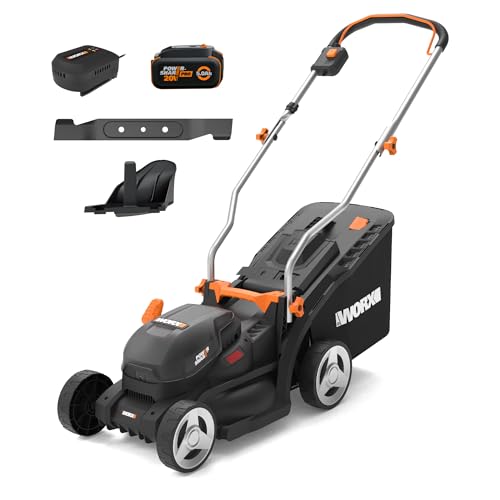

As an Amazon Associate we earn from qualifying purchases at no extra cost to you.
Quick answer: which mower for which wet-lawn problem
- Best overall for frequent damp mowing: Honda HRX217, a self-propelled gas walk-behind with a composite deck that does not rust.
- Best mulch-focused gas pick: Toro Recycler 20340, built around a recycling deck and a drive system that matches your walking pace.
- Best battery pick: EGO Power+ LM2142SP, a 56V self-propelled 21-inch mower with no carburetor, choke or fuel to manage.
- Best budget gas pick with rear-wheel drive: PowerSmart 21-inch 170cc.
- Best budget gas alternative: AMRISUN 21-inch 170cc.
- Best for owners already invested in one battery platform: Makita 18V X2 LXT self-propelled mower kit.
- Best for larger battery-powered yards: Greenworks 80V MO80L410.
How we chose
This guide is built from published manufacturer specifications, owner-manual guidance on mowing in damp conditions, and the buying criteria that repeatedly come up in lawn-care advice. No mower was run in our own yards for this article, so we do not claim performance results. Instead, we ranked models on the features that determine how a mower behaves in heavy, wet grass: drive configuration, engine or motor class, deck material, discharge options and blade design. Where a specification could not be confirmed from a manufacturer source, we describe the spec class instead of quoting a number, and the table below flags where you should check the exact figure for your model year before buying.
Why wet grass causes trouble
Clumping and clogging
Water adds weight and surface tension. Cut blades stick to each other and to the underside of the deck instead of flowing out through the chute or being lifted into the bag. Over a few passes the deck packs with a green paste that reduces airflow, which in turn reduces the lift that holds the clippings in the cutting zone. The result is streaks, clumps left on the lawn and sometimes a stalled engine.
Traction loss
Wet turf is slippery. A front-wheel-drive mower tends to lift its front end when pushed into heavy grass, which takes weight off exactly the wheels that are supposed to pull. Rear-wheel drive keeps weight over the driven axle and generally copes better on slopes and in thick growth. All-wheel drive adds further grip but costs more and is rarely necessary on flat suburban lawns.
Rust and deck wear
Steel decks hold moisture and corrode where paint chips. A composite or polymer deck sidesteps rust entirely, while a steel deck needs to be rinsed, dried and checked for chipped paint. Aluminum decks resist corrosion too but can dent more easily.
Lawn health
Wet clippings that are left in heavy clumps shade the grass beneath and can encourage fungal disease. Cutting tires also leave ruts in soft soil. If the lawn is soggy rather than just dewy, waiting is a better option than the best mower on the market.
What to look for: criteria with thresholds
Deck design and discharge
- Rear discharge or a rear-discharge conversion: Throwing clippings out of the back lets them fall in a narrower band that is easier to rake. Mowers that offer mulch, bag and rear discharge in one deck are the most flexible.
- Side discharge: Generally the least clog-prone option in heavy grass because the chute is short and unobstructed. Useful as a fall-back mode.
- Mulching: Works best when the deck is fully enclosed and the blades keep clippings circulating. Wet grass can overload a mulching deck, so plan to slow down and take narrower passes.
- Bagging: The least suitable choice in truly wet conditions. Damp clippings pack into the bag and block the airflow it relies on.
Power class
For gas mowers, look for an engine in roughly the 160cc to 200cc range or higher for a 21 or 22-inch deck. Smaller engines bog down when the deck fills with wet material. For battery mowers, a 56V platform or higher, or a dual-battery 36V system, provides the sustained torque needed. Single 40V batteries are fine for dry grass but may cut runtime sharply under heavy load.
Drive system
Choose self-propelled rear-wheel drive if your lawn is hilly, soft or thick. Variable-speed drives that follow your pace are better than single-speed drives for wet grass because you can slow down to let the blade keep up. A push mower is workable for tiny, flat lawns only.
Cutting height
Raise the deck one or two notches above your normal setting for the first pass. Cutting less of the blade reduces the volume of wet material each pass has to handle. A second pass at your regular height can follow once the grass has dried a little.
Comparison table
| Model | Power type | Deck class | Drive | Discharge modes | Verify before buying |
|---|---|---|---|---|---|
| Honda HRX217 | Gas, Honda GCV-series engine | 21-inch composite deck | Self-propelled variable speed | Mulch, bag, rear and side discharge in one deck | Exact drive type by model year |
| Toro Recycler 20340 | Gas, Briggs and Stratton engine | 22-inch recycling deck | Self-propelled that matches walking pace | Mulch, bag, rear discharge | Engine displacement and deck width |
| EGO Power+ LM2142SP | 56V battery | 21-inch deck | Self-propelled variable speed | Mulch, bag, rear discharge | Included battery capacity |
| PowerSmart 21-inch 170cc (V8721S1) | Gas, 170cc OHV | 21-inch steel deck | Rear-wheel self-propelled | Mulch, bag, rear and side discharge | Speed range, wheel size |
| AMRISUN 21-inch 170cc | Gas, 170cc | 21-inch deck | Self-propelled | Mulch, bag, side discharge | Drive layout, deck material |
| Makita 18V X2 LXT self-propelled kit | Dual 18V battery (36V total) | 21-inch class deck | Self-propelled | Mulch, bag, rear discharge | Model number, batteries included |
| Greenworks 80V MO80L410 | 80V battery | 21-inch class deck | Self-propelled | Mulch, bag, side discharge | Drive type, deck material |
The seven mowers in detail
Honda HRX217
Specs: Gas · Honda GCV-series engine · 21-inch deck · composite deck · variable-speed self-propelled · 3-in-1 mulch, bag and rear discharge
Best for: Homeowners who mow on a schedule and want a mower that tolerates damp mornings without worrying about deck rust.
Skip if: You want the lowest purchase cost or a battery mower with no engine maintenance.
- Pros: The composite deck does not corrode, the three-way discharge makes it easy to switch to rear discharge when mulching becomes difficult, and the engine class has a long reputation for starting reliably.
- Cons: It sits in the premium tier, it is heavy to lift into a truck, and gas engines still demand oil changes, fuel stabilizer and air-filter care.
Toro Recycler 20340
Specs: Gas · Briggs and Stratton engine · 22-inch class recycling deck · Personal Pace self-propel · mulch, bag and rear discharge · stow-upright design
Best for: Lawns of small to medium size where mulching is the default and you want the drive to follow your pace automatically.
Skip if: You routinely mow heavy, overgrown wet grass; a mulching deck works hardest in those conditions and benefits from a higher-torque machine.
- Pros: The recycling deck is designed to cut clippings finely and keep them circulating, speed control follows your pace so you can slow down in dense patches, and the upright storage design helps in small garages.
- Cons: The steel deck needs rinsing and drying after wet use, and the very finest mulching performance falls off when grass is saturated.
EGO Power+ LM2142SP
Specs: 56V battery · 21-inch deck · self-propelled variable speed · mulch, bag and rear discharge · no gas or oil
Best for: Owners who want strong torque without fuel handling, particularly in suburban neighborhoods where noise matters.
Skip if: Your lawn is large enough that one battery will not cover a typical session, or you do not want to buy extra batteries.
- Pros: Electric motors deliver torque instantly, they do not stall from lack of airflow the way a small gas engine can, and there is no carburetor to gum up in storage.
- Cons: Wet, thick grass drains a battery faster than dry grass, so runtime will be shorter than the headline figure, and charging a spare battery adds cost.
PowerSmart 21-inch 170cc (V8721S1)
Specs: Gas · 170cc OHV · 21-inch steel deck · rear-wheel drive · 3-in-1 mulch, bag and rear discharge
Best for: Budget-conscious buyers who want rear-wheel traction and a rear-discharge option.
Skip if: You want a premium engine brand, a long warranty history or dealer service support.
- Pros: Rear-wheel drive with a mid-size engine is the right formula for damp turf, and entry-level pricing makes it a reasonable second mower.
- Cons: A painted steel deck needs careful drying, and service networks are less established than the major brands.
AMRISUN 21-inch 170cc
Specs: Gas · 170cc · 21-inch deck · self-propelled · mulch, bag and side discharge
Best for: Lawns with tall or thick grass where engine torque matters more than brand name.
Skip if: You want documented rear-discharge capability, since it is described as mulch, bag and side discharge.
- Pros: The engine class is large enough for thick growth, and side discharge is the least clog-prone mode for wet conditions.
- Cons: Fewer published specifications than established brands, so confirm drive layout and deck material before buying.
Makita 18V X2 LXT self-propelled kit
Specs: Dual 18V batteries (36V total) · 21-inch class deck · self-propelled · mulch, bag and rear discharge
Best for: Owners who already use Makita LXT batteries and want one platform for tools and mower.
Skip if: You need to mow a large lawn in a single session or you do not already own Makita batteries.
- Pros: The shared battery system lowers the cost of ownership if you already own the tools, and electric torque is useful in damp grass.
- Cons: Dual 18V packs drain faster in wet, heavy grass, and a full-size mowing session may need extra batteries.
Greenworks 80V MO80L410
Specs: 80V battery · 21-inch class deck · self-propelled · mulch, bag and side discharge
Best for: Mid-size lawns where you want a high-voltage battery platform with strong cutting power.
Skip if: You want a composite deck or a verified rear-discharge mode.
- Pros: The high-voltage class helps sustain motor output under load, and battery power means quiet, low-maintenance operation.
- Cons: Deck material and discharge options vary by version, so check the listing, and the battery is a major part of the price.
Decision matrix: match the mower to your lawn
| Your situation | Choose | Why |
|---|---|---|
| Under a quarter acre, flat, mulching preferred | Toro Recycler 20340 or EGO LM2142SP | Mulching deck or electric torque is enough for modest volume |
| Quarter to half acre, some slope | Honda HRX217 or PowerSmart 21-inch 170cc | Rear-wheel traction and a higher-torque engine |
| Thick, tall grass after a rainy week | AMRISUN 170cc, PowerSmart 170cc or Honda HRX217 | Bigger gas engines tolerate dense material |
| Already own Makita or Greenworks batteries | Makita X2 kit or Greenworks 80V | Shared batteries reduce total cost |
| Rust is a repeated problem in your garage or climate | Honda HRX217 | Composite deck does not corrode |
| Noise limits or no gas storage | EGO LM2142SP, Makita X2 or Greenworks 80V | Battery power, no fuel |
Worked example: how many passes will a wet lawn take?
Take a 5,000-square-foot lawn and a mower with a 21-inch deck, which cuts a swath of about 1.75 feet. Allow an overlap of three inches per pass, so the effective width is about 1.5 feet. That means each pass clears roughly 1.5 square feet per foot walked. To cover 5,000 square feet you walk about 3,333 feet, or roughly 0.63 miles.
Now factor in wet grass. If you raise the deck and make a first pass at a taller height, then a second pass at normal height, you double the distance to about 1.26 miles. At a slower wet-grass pace of 2 miles per hour instead of 3, the total time is about 38 minutes instead of about 13 minutes for a single dry-grass pass. Battery owners should plan accordingly: a battery that could handle a dry lawn in one session may need a swap or recharge partway through.
The takeaway is that wet grass can triple your mowing time. If you cannot afford that time, wait for a drier window or mow a smaller section first.
Step-by-step: mowing wet grass with less mess
- Wait until standing water is gone. Mowing a soggy lawn causes ruts and compaction that outlast any clumps.
- Sharpen the blade beforehand. A dull blade tears wet grass and encourages clumps and uneven cutting.
- Raise the deck one or two notches for the first pass.
- Switch to rear or side discharge if the mulching setting is clogging.
- Mow slowly and take narrower passes so the blade has time to clear each cut.
- Stop and clear the deck whenever grass builds up under it. Shut off the engine or remove the battery first.
- Rake or spread any clumps left behind so they do not smother the lawn.
- Rinse the underside of the deck, dry it and wipe the blade when you finish.
Safety tips for wet-grass mowing
- Footing: Wear closed-toe shoes with good tread. Wet grass is slippery, especially on slopes. Mow across slopes with a walk-behind rather than up and down only if the owner manual recommends it, and never mow a slope that makes you feel unstable.
- Clearing clogs: Always turn the mower off, wait for the blade to stop, and disconnect the spark plug wire on gas models or remove the battery on electric models before reaching under the deck. Use a stick or tool, not your hand.
- Electric mowers: Battery mowers are designed with water resistance in mind, but do not use a mower in rain, standing water or storms. Keep chargers and batteries dry and indoors.
- Corded models: Avoid using corded electric mowers on wet grass entirely, because of the shock risk.
- Debris: Wet conditions hide sticks, stones and toys. Walk the lawn first.
- Fuel: Let a hot gas engine cool before refueling, and refuel on a hard surface away from ignition sources.
Rust prevention and care after wet mowing
Disconnect the spark plug wire or battery, tip the mower according to the manual (usually with the air filter and carburetor side up), and scrape out packed grass. Rinse the deck with a hose if the manual allows, then let it dry completely before storage. A light coat of silicone spray or deck-specific coating on a steel deck reduces sticking and gives some corrosion protection. Check the blade for chips and replace it if it is bent or worn thin.
Mulch, bag or discharge: which mode for damp grass?
Use side or rear discharge as your default when grass is wet, because it clears the deck fastest. Use mulching only when the grass is just damp and you can go slowly. Avoid bagging unless the lawn is nearly dry and you must collect clippings. After the grass dries, rake any clumps and, if possible, run the mower over them again with the mulching plug installed.
Who should skip all of these
If your lawn is steep, regularly waterlogged or larger than about an acre, a walk-behind may not be the right tool at all. A riding mower with larger tires and a fabricated deck, or lawn drainage improvements, may serve you better. For very small lawns, a lightweight battery push mower and a wait-for-dry-weather rule is often the lowest-stress solution.
Frequently asked questions
Can you mow wet grass?
Yes, but it is not recommended unless necessary. Wet grass clumps, clogs the deck and makes slipping more likely. If you must mow, raise the deck, go slowly and use discharge instead of bagging.
Wait for the surface water to disappear whenever you can. Even a few hours of sun and wind help, and the cut will be cleaner and healthier for the lawn.
What is the best type of mower for wet grass?
A self-propelled rear-wheel-drive mower with a rear or side discharge option and a rust-resistant deck is the best fit. Gas engines above about 160cc or high-voltage battery systems handle the load well.
The deck design matters as much as power: a clean, smooth underside sheds clippings more easily than a rough or rusted one.
Should I bag or mulch wet grass?
Neither is ideal. Rear or side discharge usually works better, because wet clippings clog bags and mulching decks. Mulch only if the grass is merely damp and you mow slowly.
If you do mulch, make sure the clippings are broken into small pieces and spread evenly so they do not smother the lawn.
Do battery mowers work in wet grass?
They can, provided the grass is not soaked and you stay out of rain. Look for high-voltage batteries and expect shorter runtime because wet grass puts the motor under more load.
Always keep batteries and chargers dry, and check the manual for the maker’s guidance on wet conditions.
Why does my mower clog on wet grass?
Wet clippings are heavy and sticky, so they pack against the deck and chute instead of flying out. A dull blade, a dirty deck and a low cutting height make this worse.
Sharpen the blade, clean the underside regularly and raise the deck for the first pass.
How can I stop my deck from rusting?
Rinse and dry the deck after wet use, remove packed grass and apply a deck coating or silicone spray to a steel deck. A composite deck avoids the issue entirely.
Touch up chipped paint promptly, since bare steel is where rust begins.
Is a self-propelled mower worth it for wet grass?
Yes, for anything beyond a very small flat lawn. Wet grass is heavy to push, and a rear-wheel-drive self-propelled model saves effort and keeps a steady pace.
Variable-speed drive is best, because you can slow down when the grass is thick without wrestling the mower.
How long should I wait after rain before mowing?
There is no fixed rule, but wait until standing water is gone and the grass blades are no longer dripping. For many lawns that is several hours of sunshine and a light breeze.
If your footprints leave deep, water-filled impressions, the soil is still too soft to mow without causing ruts.