Key takeaways
- Slat gap under 3 inches: This is the single most important number. Foam cores need close support or they’ll dip between slats. If your frame has wider spacing, add a bunkie board or run extra 1x4s — a $25 fix that protects a several-hundred-dollar mattress.
- Total sleep height: Without a box spring you lose 5 to 9 inches of stack. Measure from your floor to the top of your frame’s support surface, add mattress thickness, and aim for 24 to 26 inches at the top for comfortable sit-to-stand. Thicker mattresses (14 to 16 inches) recover that height on low platforms.
- Center support: Any queen or larger frame should have a center rail with at least one leg touching the floor. Two is better. Without a box spring’s rigid frame, the mattress transfers everything straight into the slats.
- Foam vs. hybrid feel: All-foam sleeps softer and quieter on a hard base, and it isolates motion better. Hybrids with pocketed coils give you bounce and stronger perimeter support, which matters if you sit on the edge to lace shoes.
- Airflow underneath: Solid plywood with zero gaps can hold humidity against the foam. Drill a grid of 1-inch holes or leave 1/4-inch spacing between boards. Slatted frames handle this on their own.
What's inside
Ditching the box spring sounds simple until you’re standing in a bedroom holding a bed frame, a tape measure, and a mattress that suddenly sits four inches lower than you pictured. Most modern foam and hybrid mattresses genuinely don’t need one — they’re built to rest on a flat, supported surface — but the catch is what’s underneath. Slats spaced too far apart will sag a foam core in a season. A solid platform with no airflow can trap moisture. And a metal frame rated for a spring set may flex under 90 pounds of dense foam.
This guide comes from the perspective of someone who has assembled, re-slatted, and shimmed more beds than they’d like to admit. Below are six mattresses that work well directly on a platform, slat frame, or DIY plywood-and-2×4 base, plus the specs that actually matter when there’s no box spring doing the load-spreading for you. Height, edge support, and slat compatibility get more attention here than marketing buzzwords.
As an Amazon Associate we earn from qualifying purchases.


How to Choose a/an Mattress No Box Spring (2026)
- Slat gap under 3 inches: This is the single most important number. Foam cores need close support or they’ll dip between slats. If your frame has wider spacing, add a bunkie board or run extra 1x4s — a $25 fix that protects a several-hundred-dollar mattress.
- Total sleep height: Without a box spring you lose 5 to 9 inches of stack. Measure from your floor to the top of your frame’s support surface, add mattress thickness, and aim for 24 to 26 inches at the top for comfortable sit-to-stand. Thicker mattresses (14 to 16 inches) recover that height on low platforms.
- Center support: Any queen or larger frame should have a center rail with at least one leg touching the floor. Two is better. Without a box spring’s rigid frame, the mattress transfers everything straight into the slats.
- Foam vs. hybrid feel: All-foam sleeps softer and quieter on a hard base, and it isolates motion better. Hybrids with pocketed coils give you bounce and stronger perimeter support, which matters if you sit on the edge to lace shoes.
- Airflow underneath: Solid plywood with zero gaps can hold humidity against the foam. Drill a grid of 1-inch holes or leave 1/4-inch spacing between boards. Slatted frames handle this on their own.
The Best Mattress No Box Spring (2026)s Reviewed
EGOHOME 8 Inch Green Tea Memory Foam, Full
At 8 inches this is the thin-profile option, which makes it the right call for tall platform frames, daybeds, or a guest room build where you don’t want the mattress towering over the rails. The green tea gel infusion is more about odor control than dramatic cooling, but the CertiPUR-US foam is fiberglass-free and holds its shape well on close-set slats.
Nectar 12″ Memory Foam, Queen
Nectar’s 12-inch build is the safest all-foam pick for someone putting a mattress straight onto a frame for the first time — the density is consistent enough that it tolerates slightly imperfect slat spacing better than budget foam does. The year-long trial gives you real time to test it against your setup rather than guessing in a showroom.
Ashley Chime 12 Inch Memory Foam, Queen
The stretch knit cover and straightforward foam layering make this an easy-setup mattress that expands quickly and doesn’t fight you during the unboxing. Motion isolation is its strongest trait, so it pairs well with older wooden frames that tend to creak when weight shifts.
Novilla 14 Inch Gel Memory Foam, Queen
Two extra inches over the standard 12 make a real difference on low platform beds where you’re trying to claw back sitting height. The gel layer keeps the surface temperature reasonable for a plush all-foam feel, and it’s a genuine value pick for a spare room.
16 Inch Luxury Hybrid with 7-Zone Support, Queen
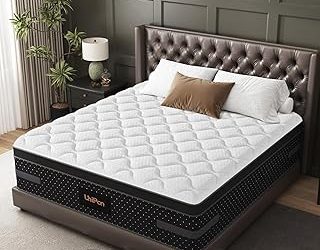
This is the one for a bare-bones metal frame or a DIY plywood base — the pocketed coil unit plus 16-inch height does the height-recovery and edge-support work a box spring normally handles. The 365-night trial is a strong safety net given how much the feel depends on your specific base.
Frequently Asked Questions
Can I put a foam mattress directly on the floor?
Short term, yes. Long term it’s a mold risk because the foam can’t breathe and condensation collects underneath. If you’re going floor-level, use a low slatted platform or at minimum rotate and stand the mattress up weekly to dry out.
What if my slats are 5 inches apart?
Add a bunkie board, a sheet of perforated 3/4-inch plywood, or cut additional slats to fill the gaps. Manufacturers frequently void warranties over slat spacing, so document your base before you file a claim.
Does a platform bed need a box spring at all?
No. Platform frames are designed to be the full support system. Adding a box spring on top just raises the bed uncomfortably high and can void the mattress warranty in some cases.
Will an old spring-era frame hold a 16-inch hybrid?
Check the center rail and leg count first. Many pre-2010 frames were built to carry a rigid box spring that distributed load; a heavy hybrid resting on thin side rails can bow them. Reinforce with an extra center leg before assuming it’ll hold.
Final Thoughts
For most people replacing a box spring setup, the Nectar 12″ is the reliable middle path — forgiving foam, generous trial window, no surprises during setup. If your frame sits low and you want that height back, the 16 Inch Luxury Hybrid brings the strongest edge support and does the most to make a bare platform feel like a proper bed. And on a tall frame or in a guest room, the EGOHOME 8 Inch keeps the profile trim without cutting corners on the foam.