Key takeaways
- Measure your cavity, not your bed size: Pull a tape from the deck platform to the inside face of the closed door. Subtract half an inch for the strap and bedding, and that number is your maximum mattress thickness. Nominal “queen” and “full” labels vary by two inches between brands, so check the listed dimensions against your frame’s interior width.
- Match weight to your lift mechanism: Piston and spring systems are tuned for a range, usually printed on the hardware or in the manual. A 40-pound foam mattress in a frame balanced for 60 pounds will slam shut; too heavy and it drifts open. Foam tri-folds land in the 30-50 pound window, which suits most residential kits.
- Prioritize breathability over plushness: A mattress stored vertically in a closed cabinet doesn’t get airflow. Gel-infused or open-cell foam and a cover with some weave to it will shed moisture between uses. Solid closed-cell memory foam in a sealed box invites mildew at the seams.
- Check the fold geometry: Tri-folds crease at two points. If those creases land where your hips go, you’ll feel them. Some designs use hinged foam channels that flatten under load; cheaper ones just fold the slab and hope. Look for a segmented core rather than a single compressed block.
- Verify the cover comes off: Guest mattresses see irregular use and unpredictable guests. A zippered, machine-washable cover is worth more than an extra half-inch of foam. Non-slip bottoms matter too, since these double as floor mattresses more often than people expect.
What's inside
If you’ve built or installed a Murphy bed, you already know the mattress is the part that trips people up. The cabinet depth is fixed, the lift mechanism is calibrated for a weight range, and the retaining strap only cinches so far. Drop a standard 10-inch innerspring into that frame and the doors won’t shut, the pistons fight you on the way up, and the whole assembly sits proud of the wall by an inch or two. Most kits are engineered around a 6-inch profile for exactly this reason, and swapping in something thicker means re-drilling the strap anchors or living with a cabinet that never quite closes flush.
This guide covers the folding foam mattresses that actually work inside a wall bed cabinet. All of them sit at 6 inches, stay light enough to lift with one hand while you thread the strap, and flex at the tri-fold seams instead of fighting the fold. I’ve noted where a model runs short of nominal size, which covers survive a wash cycle, and which ones handle the airflow problem that comes with a mattress spending twenty-two hours a day sealed inside a plywood box.
As an Amazon Associate we earn from qualifying purchases.


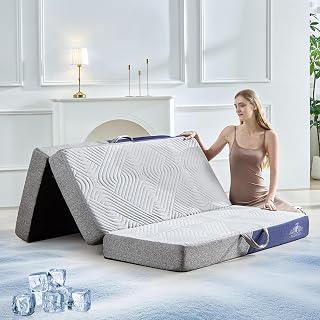


How to Choose a Murphy Bed Mattresses (2026)
- Measure your cavity, not your bed size: Pull a tape from the deck platform to the inside face of the closed door. Subtract half an inch for the strap and bedding, and that number is your maximum mattress thickness. Nominal “queen” and “full” labels vary by two inches between brands, so check the listed dimensions against your frame’s interior width.
- Match weight to your lift mechanism: Piston and spring systems are tuned for a range, usually printed on the hardware or in the manual. A 40-pound foam mattress in a frame balanced for 60 pounds will slam shut; too heavy and it drifts open. Foam tri-folds land in the 30-50 pound window, which suits most residential kits.
- Prioritize breathability over plushness: A mattress stored vertically in a closed cabinet doesn’t get airflow. Gel-infused or open-cell foam and a cover with some weave to it will shed moisture between uses. Solid closed-cell memory foam in a sealed box invites mildew at the seams.
- Check the fold geometry: Tri-folds crease at two points. If those creases land where your hips go, you’ll feel them. Some designs use hinged foam channels that flatten under load; cheaper ones just fold the slab and hope. Look for a segmented core rather than a single compressed block.
- Verify the cover comes off: Guest mattresses see irregular use and unpredictable guests. A zippered, machine-washable cover is worth more than an extra half-inch of foam. Non-slip bottoms matter too, since these double as floor mattresses more often than people expect.
The Best Murphy Bed Mattresses (2026)s Reviewed
Odorless Foldable Twin XL 6-Inch Trifold
The 80″ x 38″ footprint is the one that fits vertical Twin XL cabinets without the corner bind you get from full-width twins, and the fiberglass-free construction means you can strip the cover without releasing anything you’d rather not breathe. Off-gassing is genuinely minimal, which matters when the mattress lives in an enclosed cabinet that concentrates whatever the foam releases.
AMERLIFE 6″ Queen Tri-Fold with Cooling Gel
The only queen on this list, and it holds its shape better than most folding foam at that width, where sag between segments usually shows up first. Medium-firm is the right call for a wall bed since softer foam collapses under the retaining strap and develops a permanent belt-line crease.
Cooling Foldable Mattress 6-Inch Full
Runs cooler than the gel-infused competition thanks to a more open foam structure, which pays off in a cabinet that traps body heat overnight. Works as a topper over an existing thin deck if your frame was built for a 4-inch slab and you want more cushion without exceeding the door clearance.
Foldable Mattress Full 75″ x 54″ x 6″
True full dimensions with a non-slip base that keeps it from creeping toward the cabinet lip when someone sits on the edge. The washable cover has a tighter weave than most in this bracket, so it survives repeated laundering without the seams pulling.
ROXGOX Trifold Full 73″ x 52″ x 6″
Slightly undersized at 73″ x 52″, which is a feature if your DIY frame came out tight on interior width — that extra inch of clearance makes strapping it in far less of a wrestling match. The integrated handle earns its keep during install, when you’re lifting the thing into a vertical cabinet solo.
Frequently Asked Questions
Will a 6-inch mattress feel too thin for regular sleeping?
For nightly use over a solid platform deck, 6 inches of quality foam is adequate for most sleepers under 200 pounds. Side sleepers and heavier bodies will bottom out at the hips. If your Murphy bed is a primary bed rather than a guest setup, consider whether the cabinet can accept 8 inches before you commit.
Do I need to strap the mattress in?
Yes, and don’t skip it. Every wall bed kit includes a retaining strap because the mattress will slide out of a vertical frame under its own weight. Foam tri-folds compress under the strap, so cinch it firm but not so tight that you’re crushing the core along a single line.
Can I use my existing box spring or foundation?
No. Murphy bed decks are the foundation, and they’re built with slats or a solid panel sized so mattress plus deck fits the cabinet depth. Adding a foundation puts you several inches over and the doors won’t close.
How do I keep a stored mattress from smelling musty?
Leave the bed down for a few hours after guests check out so moisture can evaporate before you close the cabinet. Drilling a pair of half-inch vent holes in the back panel, hidden behind the headboard shelf, does more for airflow than any cover claim.
Final Thoughts
For a queen cabinet, the AMERLIFE 6″ Tri-Fold is the most reliable pick — it holds its shape at a width where cheaper foam gives up. In full size, the 75″ x 54″ Foldable Mattress hits true dimensions with a cover built to survive actual laundering, while the ROXGOX is the smarter choice if your homemade frame came out tight and you need the clearance. Twin XL builders should go straight to the Odorless 80″ x 38″, which is the rare model dimensioned for a vertical cabinet rather than adapted to one.