Key takeaways
- Material over marketing: Look for polypropylene straw or PP woven construction, not “water-resistant” pile. Flat-woven plastic straw lets rain pass through in seconds; tufted or looped fibers trap it against your surface and invite mildew.
- Open weave and drainage: Hold the corner up to a light. A slightly open weave means water and debris fall through rather than pooling. Solid backings and rubber grips are a red flag for rainy climates — they turn the rug into a moisture barrier.
- UV stabilization: Rain rarely arrives alone. Look for UV-treated fibers if your patio gets afternoon sun, otherwise you’ll trade water damage for a bleached, brittle rug by August.
- Reversible patterning: A double-sided rug effectively doubles your lifespan. When one face fades or stains, flip it. It also lets you swap looks seasonally without buying anything new.
- Size and edge finish: Measure your usable space, then subtract 8–12 inches on each side so furniture legs land fully on the rug. Check for bound or heat-sealed edges — raw cut edges fray fast once wind and water start working on them.
What's inside
I learned the hard way that “outdoor rug” and “rain-proof rug” are two very different products. My first patio rug was a plush polypropylene weave that looked fantastic for exactly one season — then a week of spring storms turned it into a soggy sponge that held water against my deck boards. When I finally peeled it up, the cedar underneath had gone black. That single mistake cost me a weekend of sanding and two coats of stain, and it taught me the rule I now apply to every outdoor textile purchase: if water can’t drain straight through it, it doesn’t belong outside.
This guide is built around that principle. Every rug here uses flat-woven polypropylene straw — the same material family you’ll find on RV awning mats — which sheds water instead of absorbing it. I’ve focused on reversible, foldable designs you can hose down, flip for a fresh pattern, and roll up in November without a second thought. Below you’ll find my picks, a checklist of what actually matters when rain is the deciding factor, and answers to the questions I get asked most from readers doing their own deck and balcony projects.
As an Amazon Associate we earn from qualifying purchases.


🛒 Best Price Today on Amazon
Prime members get fast, free shipping on everything above, plus member-only deals. New members get a 30-day free trial — cancel anytime.
How to Choose a Outdoor Rug For Rain (2026)
- Material over marketing: Look for polypropylene straw or PP woven construction, not “water-resistant” pile. Flat-woven plastic straw lets rain pass through in seconds; tufted or looped fibers trap it against your surface and invite mildew.
- Open weave and drainage: Hold the corner up to a light. A slightly open weave means water and debris fall through rather than pooling. Solid backings and rubber grips are a red flag for rainy climates — they turn the rug into a moisture barrier.
- UV stabilization: Rain rarely arrives alone. Look for UV-treated fibers if your patio gets afternoon sun, otherwise you’ll trade water damage for a bleached, brittle rug by August.
- Reversible patterning: A double-sided rug effectively doubles your lifespan. When one face fades or stains, flip it. It also lets you swap looks seasonally without buying anything new.
- Size and edge finish: Measure your usable space, then subtract 8–12 inches on each side so furniture legs land fully on the rug. Check for bound or heat-sealed edges — raw cut edges fray fast once wind and water start working on them.
The Best Outdoor Rug For Rain (2026)s Reviewed
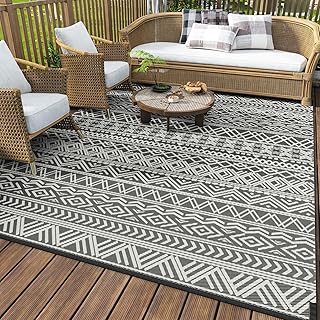
MontVoo Waterproof Outdoor Rug 5×8 (Boho Grey)
This is the one I keep recommending to friends setting up a first balcony or camper setup — the boho grey pattern hides dirt remarkably well, and the plastic straw weave drains so fast you can hose it and sit down twenty minutes later. At 5×8 it’s the sweet spot for a bistro set or a two-chair reading nook.
GENIMO Outdoor Rug 5’x8′ Grey White Leaf
The oversized leaf motif gives this rug more visual presence than most flat-weaves, which helps if your deck is otherwise plain wood. It folds down small enough to stash in a deck box, and the reversible face means a quick flip when the sunny side starts to lighten.
GENIMO Outdoor Rug 6’x9′ Black Grey
My pick when you need real coverage — 6×9 comfortably anchors a full dining table and four chairs with legs on the mat. The black and grey geometric reads modern rather than beachy, and the darker tone is forgiving on a patio that sees muddy boots and dog traffic.
MontVoo Reversible Patio Rug Mat 5×8
Essentially the workhorse version of MontVoo’s line, built for camping and RV use where it gets rolled and unrolled constantly. It handles that abuse better than most, and the UV-resistant straw shrugs off the sun-then-storm cycle that destroys cheaper mats.
GENIMO Outdoor Rug 5’x8′ Coffee Beige
If you’re working with teak, cedar, or warm-toned composite decking, the coffee beige colorway blends instead of competing. Same drainage and fold-flat convenience as the rest of the GENIMO range, just a quieter finish.
Frequently Asked Questions
Can I leave a plastic straw rug out all season?
Yes, that’s the point of the material. I leave mine down from April through October and only lift it every few weeks to sweep underneath. For winter, roll it up dry and store it indoors to protect the fibers from freeze-thaw stress.
Will it damage my wood deck?
Not the way a rubber-backed rug will, since water passes through instead of sitting. Still, lift and dry the deck surface periodically — anything laid flat on wood for months will slow evaporation somewhat.
How do I stop it blowing away on a balcony?
Weight the corners with planters or furniture legs, or add outdoor-rated Velcro tabs to the underside. Skip heavy adhesive; you want to be able to lift the rug for cleaning.
What’s the cleaning routine?
Sweep, then hose. For stubborn spots, mild dish soap and a soft brush is plenty. Avoid pressure washers, which can separate the weave, and let it dry fully before folding.
Final Thoughts
For most patios and balconies, the MontVoo 5×8 in Boho Grey is the easiest recommendation — good drainage, forgiving pattern, honest value. Step up to the GENIMO 6’x9′ Black Grey if you’re covering a full dining setup, or go with the GENIMO Coffee Beige when you want something that disappears into warm-toned decking rather than announcing itself.