Key takeaways
- Panel material and gauge: Tempered hardboard is cheap and fine for hand tools, but it sags under battery packs and clamps. Powder-coated steel panels hold heavy loads, resist moisture in an unconditioned garage, and won’t crumble around the hole when a hook gets yanked.
- Hole size, 1/8″ vs 1/4″: This is the single most common buying mistake. Quarter-inch boards take beefier hooks and carry more weight; eighth-inch boards suit lighter accessories and older stock hooks. Buy the accessory kit that explicitly matches, or buy a kit that covers both.
- Mounting standoff: Hooks need clearance behind the panel to seat properly. Metal panels usually have a built-in offset, while flat hardboard needs furring strips or spacers. Plan to hit studs at 16 inches on center, and use toggles or self-drilling anchors only for lighter panels.
- Accessory mix, not accessory count: A 278-piece kit sounds impressive until you realize 200 of those pieces are identical single hooks. Look at the actual assortment: J-hooks, double-prong loops, bins, baskets, screwdriver racks, and shelf brackets do more real work than sheer volume.
- Hook retention: Cheap hooks pop out when you lift a tool off them. Systems with locking clips, rubber grommets, or a friction fit into slotted steel stay put. If you’re stuck with loose hooks, a dab of hot glue or a small zip tie through the back hole solves it permanently.
What's inside
Anyone who has spent a Saturday hunting for a 10mm socket knows the real problem isn’t a lack of tools. It’s that a garage wall is dead space until you make it work. Loose tools migrate to the bench, then the floor, then a plastic tote where they rust quietly for two years. Drawer systems help, but drawers hide things. A pegboard puts your whole kit at eye level, and you can see a missing tool from across the shop.
The catch is that “pegboard” now covers everything from flimsy hardboard that bows under a cordless drill to powder-coated steel panels rated for serious weight. Hook compatibility, hole spacing, mounting depth, and panel gauge all vary, and getting one wrong means starting over. This guide breaks down the systems worth your wall space in 2026, whether you’re kitting out a two-car garage, a laundry-room drop zone, or a craft desk that needs to stay tidy.
As an Amazon Associate we earn from qualifying purchases.



🛒 Best Price Today on Amazon
Prime members get fast, free shipping on everything above, plus member-only deals. New members get a 30-day free trial — cancel anytime.
How to Choose a Pegboard System (2026)
- Panel material and gauge: Tempered hardboard is cheap and fine for hand tools, but it sags under battery packs and clamps. Powder-coated steel panels hold heavy loads, resist moisture in an unconditioned garage, and won’t crumble around the hole when a hook gets yanked.
- Hole size, 1/8″ vs 1/4″: This is the single most common buying mistake. Quarter-inch boards take beefier hooks and carry more weight; eighth-inch boards suit lighter accessories and older stock hooks. Buy the accessory kit that explicitly matches, or buy a kit that covers both.
- Mounting standoff: Hooks need clearance behind the panel to seat properly. Metal panels usually have a built-in offset, while flat hardboard needs furring strips or spacers. Plan to hit studs at 16 inches on center, and use toggles or self-drilling anchors only for lighter panels.
- Accessory mix, not accessory count: A 278-piece kit sounds impressive until you realize 200 of those pieces are identical single hooks. Look at the actual assortment: J-hooks, double-prong loops, bins, baskets, screwdriver racks, and shelf brackets do more real work than sheer volume.
- Hook retention: Cheap hooks pop out when you lift a tool off them. Systems with locking clips, rubber grommets, or a friction fit into slotted steel stay put. If you’re stuck with loose hooks, a dab of hot glue or a small zip tie through the back hole solves it permanently.
The Best Pegboard Systems (2026) Reviewed
Wall Control 4 ft. Metal Pegboard Tool Storage Kit
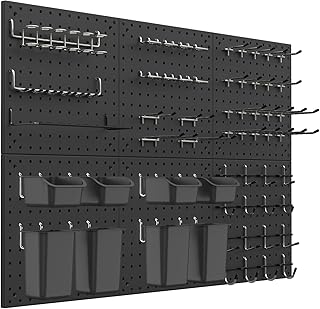
This is the benchmark for a reason: heavy-gauge galvanized steel with a slotted-and-holed layout that accepts both traditional pegs and Wall Control’s own locking hooks. The panels ship with the correct standoff built in, so you mount straight to studs and start hanging in under an hour, and the assortment included is genuinely usable rather than padded with filler.
INCLY 48×24 Inch Metal Peg Board Kit
Four panels plus 156 accessories makes this the strongest value if you’re covering a full workbench wall from scratch. The 1/4-inch holes take real weight, and the modular panel layout lets you tile around outlets, windows, or an existing shelf instead of fighting one oversized sheet.
PBHEPJ 10 Pcs Metal Pegboard Panels
Ten 16×12-inch steel tiles with anchors and screws included, which is the smart pick when your wall is awkward or you want to expand in stages. Small panels are far easier to level solo, and you can add a two-tile cluster above a garden bench without committing to a full build-out.
INCLY 278PCS Pegboard Accessories Organizer Kit
If you already have a board, this is the deepest single accessory buy here, with hooks, bins, and holders that fit either 1/8-inch or 1/4-inch spacing. Sort the whole lot into groups before you touch the wall, mock up your layout on the floor first, and you’ll avoid re-drilling hooks three times.
129-Piece Peg Board Kit with Hooks and Bins
Scaled for craft rooms, home offices, and display walls rather than a garage, this kit pairs a compact board with small-parts bins that suit thread, brushes, or hardware. It’s the one I’d put above a hobby desk where a full steel system would be overkill and visually heavy.
Frequently Asked Questions
How much weight can a pegboard actually hold?
The panel is rarely the weak link, the mounting is. Steel panels screwed into studs commonly handle 50 to 200 pounds spread across the surface, while hardboard on drywall anchors should stay under about 20 pounds total. Distribute load and keep heavy items low.
Do I need spacers behind the board?
Yes, unless the panel has a factory offset. Hooks need roughly a half inch of clearance to hook through and sit flat. Furring strips ripped from a 1×2 are the cheapest fix and add a useful cable channel behind the panel.
Will accessory kits fit any pegboard?
Only if the hole diameter matches. Confirm 1/8-inch or 1/4-inch before ordering, and check hole spacing too, since most boards use one-inch centers but not all do. Kits advertising both sizes, like the INCLY 238-piece set, hedge that risk.
Can I install a pegboard by myself?
Absolutely. Mark your studs, snap a level line, and pre-drill the panel. Smaller tiles are easiest solo; for a 4-foot panel, screw a temporary ledger board to the wall to rest the bottom edge on while you drive the top screws.
Final Thoughts
For a shop wall you’ll keep for a decade, the Wall Control 4 ft. metal kit is the one to beat on build quality and hook security. If you’re covering more square footage per dollar, the INCLY 48×24 four-panel kit delivers the most wall for the money, and the PBHEPJ 10-panel set is the flexible choice for piecing together an odd layout one tile at a time.