Key takeaways
- Fill weight over listed thickness: “Extra thick” means nothing without a number behind it. GSM ratings (grams per square meter) or stated fill ounces tell you how much material is actually in there. A 1400 GSM pad has real substance; an unlabeled 3-inch topper often compresses to under an inch under body weight.
- Quilt pattern and stitch density: Box quilting is your friend. Sewn compartments trap fill where it belongs, so you don’t end up with a lumpy perimeter and a bare middle. Diamond patterns look nicer but usually let fill drift more. Count the stitch lines in product photos — tighter grids last longer.
- Skirt depth versus your actual stack: Measure your mattress with a tape, then add your protector and any existing pad. A 20-inch deep pocket sounds like overkill until you’ve got a 14-inch hybrid plus a waterproof cover. Undersized skirts pop corners loose every night.
- Cover fiber and breathability: Rayon and viscose derived from bamboo move heat and moisture better than polyester microfiber, which is why hot sleepers gravitate toward them. Memory foam does the opposite unless it’s gel-infused or channeled for airflow.
- Wash compatibility: Check whether the whole unit is machine washable or cover-only. Fiber-fill toppers generally go straight in a front-loader; foam cores never do. If you have pets or kids, washability outranks nearly everything else.
What's inside
A sagging mattress rarely announces itself. It creeps up over a few seasons until you’re waking with a stiff lower back, blaming the pillow, the weather, the gym. Then you pull the sheets off and run a straightedge across the surface — the same way you’d check a workbench for twist — and there it is: a shallow trough right where your hips land. Replacing the whole mattress is a four-figure fix. Adding a pillow topper is a fifty-to-two-hundred-dollar one, and it buys back most of the comfort you lost.
The catch is that toppers are wildly uneven in build quality. Some are genuinely well-made: baffled or box-quilted chambers that hold fill in place, generous elastic skirts, stitch lines dense enough to survive the dryer. Others are a bag of polyester that migrates to the corners after three washes. This guide breaks down what to inspect before you buy, then walks through the toppers currently worth your money in 2026 — including which ones suit hot sleepers, which handle real back pain, and which are simply the best value per inch of loft.
As an Amazon Associate we earn from qualifying purchases.




How to Choose a Pillow Topper For Mattress (2026)
- Fill weight over listed thickness: “Extra thick” means nothing without a number behind it. GSM ratings (grams per square meter) or stated fill ounces tell you how much material is actually in there. A 1400 GSM pad has real substance; an unlabeled 3-inch topper often compresses to under an inch under body weight.
- Quilt pattern and stitch density: Box quilting is your friend. Sewn compartments trap fill where it belongs, so you don’t end up with a lumpy perimeter and a bare middle. Diamond patterns look nicer but usually let fill drift more. Count the stitch lines in product photos — tighter grids last longer.
- Skirt depth versus your actual stack: Measure your mattress with a tape, then add your protector and any existing pad. A 20-inch deep pocket sounds like overkill until you’ve got a 14-inch hybrid plus a waterproof cover. Undersized skirts pop corners loose every night.
- Cover fiber and breathability: Rayon and viscose derived from bamboo move heat and moisture better than polyester microfiber, which is why hot sleepers gravitate toward them. Memory foam does the opposite unless it’s gel-infused or channeled for airflow.
- Wash compatibility: Check whether the whole unit is machine washable or cover-only. Fiber-fill toppers generally go straight in a front-loader; foam cores never do. If you have pets or kids, washability outranks nearly everything else.
The Best Pillow Topper For Mattress (2026)s Reviewed
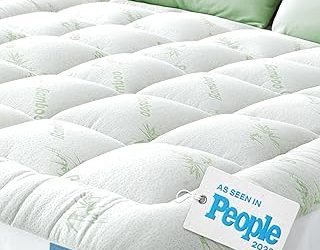
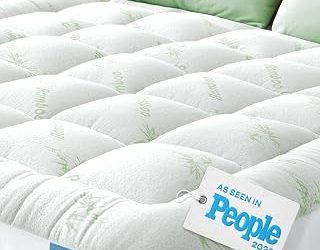
Niagara Sleep Solution Bamboo Cooling Topper
The rayon-from-bamboo surface is the standout here — it stays noticeably cooler to the touch than microfiber alternatives, and the 20-inch skirt swallows even tall pillow-top mattresses without straining the elastic. A solid pick if overheating is your primary complaint and you want cushioning as a bonus rather than the main event.
ELEMUSE Queen Extra Thick Pillowtop
This one is built for people who want to feel a difference immediately: overfilled down-alternative chambers create genuine loft that softens pressure at the hips and shoulders. It’s the most effective option on this list for masking a firm or slightly worn mattress, though the plushness means side sleepers will benefit more than stomach sleepers.
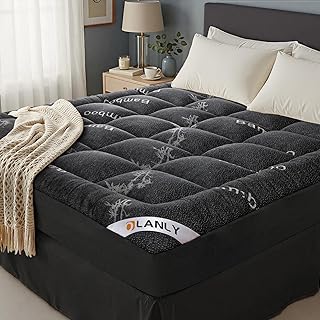
OLANLY Bamboo Viscose Cooling Topper
A well-balanced middle ground — quilted bamboo viscose cover, plush down-alternative fill, and a deep elastic pocket that actually grips. The dark gray colorway hides wear better than white pads, and the whole thing tolerates repeated machine washing without the fill clumping, which is the failure point on cheaper units.
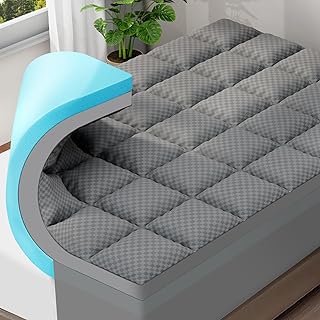
OLANLY 4 Inch Gel Memory Foam Topper
The only true support-focused option here: a dual-layer build with gel memory foam underneath a quilted pillow-top surface. Four inches is enough to meaningfully change how a mattress feels, making it the right call for chronic back pain — just know that foam retains more heat than fiber fill, even with gel infusion.
1400 GSM King Extra Thick Plush Pad
The published GSM figure is what earns this a spot — 1400 is substantial, and the box quilting keeps it distributed. Fitting mattresses from 6 to 22 inches deep makes it unusually forgiving on sizing, and it’s the strongest all-around value if you’re outfitting a king bed.
Frequently Asked Questions
Can a topper fix a genuinely sagging mattress?
It can mask a shallow dip, but it can’t rebuild lost support. If you can see daylight under a straightedge laid across the mattress, or the sag exceeds about an inch and a half, a topper is a stopgap. Check whether your warranty covers the indentation first.
Fiber fill or memory foam for back pain?
Foam, generally. Fiber fill adds softness on top of your existing support layer; foam changes the support profile itself by letting hips settle while keeping the lumbar curve filled. Fiber fill helps when the mattress is too firm rather than too unsupportive.
Will it slide around during the night?
Not if the skirt is correctly sized. Measure before ordering, and if the fit is loose, add mattress suspender straps at the corners — a five-dollar fix that solves most shifting complaints.
How often should a pillow topper be replaced?
Two to four years for fiber fill, longer for quality foam. Rotate it head-to-foot every couple of months and fluff it in the dryer on low with wool balls to extend that considerably.
Final Thoughts
For hot sleepers, the Niagara bamboo topper is the straightforward choice — breathable cover, deep pocket, no fuss. If back pain is what’s waking you, the OLANLY 4 Inch gel memory foam topper offers real structural change rather than just surface softness. And for maximum plushness per dollar on a larger bed, the 1400 GSM king pad delivers the most measurable fill weight of anything here.