Key takeaways
- Running watts, not BTUs first: Divide your battery capacity by the unit’s wattage to get rough runtime. A 400W tent AC on a 1000Wh power station gives you around two hours of continuous cooling, closer to four or five if the compressor cycles. A 14000 BTU room unit pulling 1200W or more needs a generator or a 30-amp pedestal, full stop.
- Exhaust routing: Every compressor-based AC produces hot air that must leave your sleeping space. Tent-specific models use a short flexible duct you can pass through a rolled-back door flap or a zippered vent port. Room units ship with a window slider kit that you’ll need to adapt with a foam board panel or a sewn canvas sleeve.
- Condensate handling: Humid air means water. Look for self-evaporating designs or a gravity drain hose you can run into a bucket. A unit with only an internal tank will shut down mid-night and wake you up with a beeping error code.
- Weight and case rigidity: Under 25 pounds means one person can carry it from the tailgate to the tent pad. Anything heavier wants a hand truck or a two-person lift, and plastic casters will fight you on gravel.
- Noise you can sleep through: Compact 4-in-1 units sit in the 50 dB range, which reads as white noise inside a tent. Larger room ACs run louder and vibrate through whatever they’re sitting on, so plan on a rubber mat or a plywood pad underneath.
What's inside
Anyone who has tried to sleep in a nylon tent after a 95-degree afternoon knows the problem: the fabric holds the day’s heat like a thermos, and no amount of mesh venting fixes still, humid air. The obvious move is to bring a small air conditioner, but that’s where things get complicated fast. Camp AC units have to run on whatever power you’ve managed to haul out there, whether that’s a shore hookup at a state park, a 1000Wh power station in the truck bed, or a portable generator you’re already trying not to annoy your neighbors with. Add in the fact that every AC needs somewhere to dump its hot exhaust, and a tent doesn’t come with a window frame, and you can see why so many campers give up and buy another fan.
This guide sorts through the options with a builder’s mindset. Some of these units are purpose-designed for tents and vans, sipping 400 watts or so and small enough to sit on a cooler lid. Others are conventional room ACs that punch far harder on BTUs and work beautifully at a powered campsite or in a converted van build, provided you’re willing to rig a duct port yourself. I’ll cover what actually matters in the spec sheet, walk through five units worth considering, and answer the questions that come up once you start planning the vent and the wiring.
As an Amazon Associate we earn from qualifying purchases.


🛒 Best Price Today on Amazon
Prime members get fast, free shipping on everything above, plus member-only deals. New members get a 30-day free trial — cancel anytime.
How to Choose a/an Portable Air Conditioner For Tent Camping (2026)
- Running watts, not BTUs first: Divide your battery capacity by the unit’s wattage to get rough runtime. A 400W tent AC on a 1000Wh power station gives you around two hours of continuous cooling, closer to four or five if the compressor cycles. A 14000 BTU room unit pulling 1200W or more needs a generator or a 30-amp pedestal, full stop.
- Exhaust routing: Every compressor-based AC produces hot air that must leave your sleeping space. Tent-specific models use a short flexible duct you can pass through a rolled-back door flap or a zippered vent port. Room units ship with a window slider kit that you’ll need to adapt with a foam board panel or a sewn canvas sleeve.
- Condensate handling: Humid air means water. Look for self-evaporating designs or a gravity drain hose you can run into a bucket. A unit with only an internal tank will shut down mid-night and wake you up with a beeping error code.
- Weight and case rigidity: Under 25 pounds means one person can carry it from the tailgate to the tent pad. Anything heavier wants a hand truck or a two-person lift, and plastic casters will fight you on gravel.
- Noise you can sleep through: Compact 4-in-1 units sit in the 50 dB range, which reads as white noise inside a tent. Larger room ACs run louder and vibrate through whatever they’re sitting on, so plan on a rubber mat or a plywood pad underneath.
The Best Portable Air Conditioner For Tent Camping (2026)s Reviewed
5200 BTU Portable Tent Air Conditioner, 400W 4-in-1
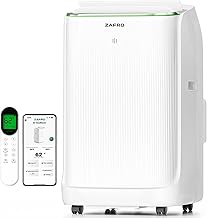
This is the closest thing to a purpose-built tent unit on the list, and the 400W draw is the headline: it’s the only power figure here that a mid-sized lithium power station can realistically sustain overnight. The 4-in-1 layout adds fan, dehumidify, and sleep modes, and the compact footprint means it fits on a milk crate beside your cot with the duct running out through the door zipper.
5100 BTU Portable Tent Air Conditioner, 410W
Nearly identical in concept to the pick above, drawing 410W for around 5100 BTU, and worth cross-shopping since availability and pricing on these compact units bounce around. It’s tuned for enclosed small volumes, so it shines in a two-person tent, a van bunk, or a truck cab and will struggle if you point it at an eight-person cabin tent with the vestibule open.
Garvee 14000 BTU Portable AC, 3-in-1
At 14000 BTU covering up to 750 square feet, this is the powered-campsite and van-conversion answer, not a battery-friendly option. The Follow Me remote sensor and 24-hour timer earn their keep in a build where you’re mounting the unit in a cabinet, and the included window kit gives you usable hardware to cut into a plywood duct panel.
COSTWAY 10000 BTU Portable Air Conditioner
A sensible middle ground for a large canvas wall tent or a small camper at a hookup site, covering roughly 350 square feet with drying and fan modes plus a sleep setting that steps the fan down. The stock window slider is the weak point for camping, so budget an afternoon to fabricate a foam-board port you can seal with adhesive weatherstrip.
COSTWAY 8000 BTU Portable Air Conditioner
Rated for about 230 square feet, this is the lightest and least power-hungry of the conventional room units, which makes it a reasonable compromise if you want real cooling capacity without a 14000 BTU electrical load. The 24-hour timer and remote are practical for pre-cooling a tent while you’re still cooking dinner.
Frequently Asked Questions
Can I actually run one of these off a portable power station?
Only the compact 400 to 410W tent units are realistic candidates, and even then you want at least 1000Wh of capacity plus a pure sine wave inverter rated well above the unit’s startup surge. The 8000 to 14000 BTU room units need generator or grid power.
How do I vent the exhaust hose out of a tent?
Some camping tents include a zippered stove jack or accessory port that fits a 4 to 5 inch duct directly. Otherwise, cut an opening in a scrap of rigid foam board, sandwich it into a partially unzipped door with the flap folded over the seam, and tape the gaps. Never let hot exhaust recirculate back inside.
Do I need to drain water overnight?
In dry climates the self-evaporating function usually keeps up. In humid conditions, attach the gravity drain hose and run it downhill out of the tent into a bucket or a gravel patch, and check it before bed.
Is an evaporative cooler a better choice for camping?
Swamp coolers draw far less power but only work in low humidity, and they add moisture to a space that’s already condensation-prone. A compressor unit is the reliable answer if you’re camping anywhere muggy.
Final Thoughts
For off-grid tent camping where battery capacity dictates everything, the 5200 BTU 400W 4-in-1 unit is the pick, with the 5100 BTU 410W model as a near-equal alternative worth checking on price. If you’re at a powered site, running a generator, or building out a van, step up to the Garvee 14000 BTU for genuine cooling headroom and spend your effort on a well-sealed duct panel instead.