Key takeaways
- Motor type: Reversible DC motors dominate this price bracket now, and they earn it — quieter operation, six or more speeds, and roughly a third of the power draw of an old AC motor. If a cheap fan still lists an AC motor, keep scrolling.
- Ceiling height and mount style: Under eight feet, go flush mount or low profile so you keep blade clearance above head height. Nine feet and up, use the included downrod and consider a longer one. Sloped ceilings need a canopy rated for the angle, so check that spec before you buy.
- Blade span versus room size: A 52-inch fan suits most bedrooms and mid-sized living rooms. Push to 60 inches for open-plan spaces or vaulted rooms where air needs to travel. Undersizing is the most common mistake, and no speed setting fixes it.
- Light module and CCT: 3CCT means you can toggle warm, neutral, and daylight without swapping bulbs. Look for dimming and, ideally, memory so the fan returns to your last setting after a power cut rather than blasting 5000K at midnight.
- Wet or damp rating: Covered porches need at least a damp rating; anything exposed to blown rain needs wet. The listing language matters here — “outdoor use” without a rating usually means covered only.
What's inside
Anyone who has stood on a ladder at 9pm with a fan canopy in one hand and a bundle of 14-gauge wire in the other knows the real cost of a ceiling fan is not the sticker. It is the hour you lose because the mounting bracket assumes a brace box you do not have, or the wobble that shows up at speed three because the blades were packed unevenly. Budget-friendly fans have gotten genuinely good, but the gap between a clean install and a weekend of shimming washers is wider than the price spread between models.
This guide comes from that ladder-level view. I have looked at these fans the way a maker does: how the hanging hardware behaves, whether the DC motor housing gives you room to tuck wire nuts, how the light module attaches, and whether the remote pairing survives a breaker flip. Below are six well-priced fans worth your time in 2026, followed by the specs that actually matter and honest notes on each.
As an Amazon Associate we earn from qualifying purchases.



How to Choose a Price Ceiling Fan (2026)
- Motor type: Reversible DC motors dominate this price bracket now, and they earn it — quieter operation, six or more speeds, and roughly a third of the power draw of an old AC motor. If a cheap fan still lists an AC motor, keep scrolling.
- Ceiling height and mount style: Under eight feet, go flush mount or low profile so you keep blade clearance above head height. Nine feet and up, use the included downrod and consider a longer one. Sloped ceilings need a canopy rated for the angle, so check that spec before you buy.
- Blade span versus room size: A 52-inch fan suits most bedrooms and mid-sized living rooms. Push to 60 inches for open-plan spaces or vaulted rooms where air needs to travel. Undersizing is the most common mistake, and no speed setting fixes it.
- Light module and CCT: 3CCT means you can toggle warm, neutral, and daylight without swapping bulbs. Look for dimming and, ideally, memory so the fan returns to your last setting after a power cut rather than blasting 5000K at midnight.
- Wet or damp rating: Covered porches need at least a damp rating; anything exposed to blown rain needs wet. The listing language matters here — “outdoor use” without a rating usually means covered only.
The Best Price Ceiling Fan (2026)s Reviewed
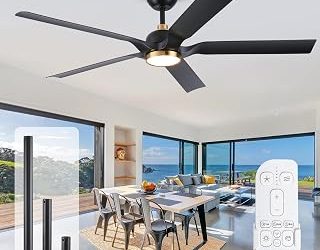
52″ Modern Ceiling Fan with Lights and Remote, DC Reversible Motor
A straightforward modern fan that gets the fundamentals right: quiet DC motor, reversible for winter circulation, and 3CCT lighting on remote control. The blade attachment is tool-friendly and the canopy leaves enough slack for tidy wire management, which makes this an easy first-fan install.
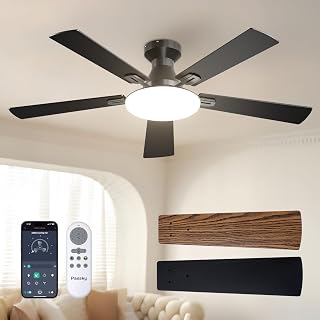
Passky 52″ Black Low Profile Flush Mount Fan
My pick for eight-foot ceilings and finished basements. The flush mount hugs the ceiling without sacrificing much airflow, and the app control plus memory function means you are not hunting for the remote every evening. Black finish hides dust better than white in my experience.
VONLUCE 52″ Wood Ceiling Fan, Nickel
Three solid wood blades and a nickel housing give this one a build quality that reads well above its price. Six speeds, a timer, and full-spectrum 3CCT light make it versatile, and the solid blades feel noticeably more balanced out of the box than pressed composite alternatives.
60″ Walnut Wood Farmhouse Ceiling Fan with Remote
If you have a great room, a vaulted ceiling, or an open kitchen-living space, the 60-inch span moves air where smaller fans stall. Walnut blades and a quiet reversible DC motor make it handsome and unobtrusive; just budget for a second set of hands during the hanging step.
52″ Smart Outdoor Ceiling Fan, Dark Walnut
Alexa, Google, and app control at this price is the standout here, and it genuinely changes how you use a porch fan — schedules beat remembering to switch it off. Confirm your patio is properly covered before installing, and mount to a fan-rated brace box.
Frequently Asked Questions
Do I need a special electrical box?
Yes. Fans must hang from a fan-rated (UL-listed) brace box, not a standard lighting box. If yours is plastic and screwed to a joist by two nails, replace it with an adjustable metal brace before you hang anything.
Why does my new fan wobble?
Usually loose blade screws or a blade set that shifted in shipping. Tighten every screw, then check blade tip distance from the ceiling with a tape measure. A balancing kit fixes the rest for a couple of dollars.
Can these fans work without a wall switch?
Most remote and app-controlled fans run fine on a single switched hot line, which is what makes them appealing in older homes with one wire pair. You keep speed and light control at the remote.
Which direction should the blades spin?
Counterclockwise in summer to push air down, clockwise on low in winter to pull warm air off the ceiling and circulate it. All the fans here reverse from the remote.
Final Thoughts
For most rooms, the VONLUCE 52″ wood fan offers the best balance of build quality and features at this price. Choose the Passky low-profile flush mount if your ceiling is under eight feet, and step up to the 60″ walnut farmhouse fan when you need real air movement across an open space.