Key takeaways
- Dual motors, not single: One motor moves the back and footrest together on a fixed arc, which locks you into whatever angle the factory chose. Two independent motors let you drop the back to near-horizontal while keeping your legs slightly elevated — the position that actually keeps pressure off your lumbar spine all night. If a listing says “infinite position,” it means dual motor. Anything else is a two-position chair with marketing.
- Measure your body, then the chair: Seat width, seat depth, and back height all matter more than the overall footprint. If you’re over 6 feet, look for a back height of 30 inches or more so your head lands on the headrest instead of hanging past it. Broad through the shoulders or hips? A 26-inch-wide seat gives you room to shift positions without your arms pinned to the bolsters.
- Look at the frame, not the upholstery: Ask what the base and lift mechanism are made of. Steel tubing at the scissor lift and hardwood or plywood at the seat box will survive years of nightly cycling. Particleboard and MDF in load paths will creak within a season, and there’s no fix short of rebuilding the box yourself.
- Weight capacity with headroom: Buy a chair rated at least 75 pounds above your actual weight. Motors that run near their ceiling every night wear their gearboxes fast, and you’ll notice it as slow, groaning travel long before anything fails outright.
- The overnight extras that earn their keep: USB-A and USB-C ports beside the seat mean your phone charges without a cord snaking across the floor. Heat in the lumbar panel helps if stiffness wakes you. Massage is genuinely nice for winding down but noisy enough that it’s not a sleep feature — treat it as a bonus, never the deciding factor.
What's inside
Sleeping in a recliner isn’t a compromise for a lot of people. Post-shoulder-surgery, chronic reflux, sleep apnea, a bad lower back that hates lying flat, or just a body that finally found the one position that works — plenty of us end up spending nights in a chair. The trouble is that most recliners are engineered for a couple of hours of TV, not eight hours of load-bearing sleep. Pull the lever on a standard two-position model and you get a shallow tilt, a footrest that stops at your ankles, and a seat that dumps all your weight onto your tailbone. By 3 a.m. you’re awake and rearranging pillows.
I’ve spent enough time under recliner frames with a socket wrench to know what separates a chair you can actually sleep in from one that just looks like it. The answer is almost always dual motors, a true lay-flat range past 170 degrees, and a frame built with steel where it counts. Below are six chairs that hold up to nightly use, along with the specs I’d check before I spent a dime and the questions I get asked most often.
As an Amazon Associate we earn from qualifying purchases.


How to Choose a/an Recliner Chair To Sleep In (2026)
- Dual motors, not single: One motor moves the back and footrest together on a fixed arc, which locks you into whatever angle the factory chose. Two independent motors let you drop the back to near-horizontal while keeping your legs slightly elevated — the position that actually keeps pressure off your lumbar spine all night. If a listing says “infinite position,” it means dual motor. Anything else is a two-position chair with marketing.
- Measure your body, then the chair: Seat width, seat depth, and back height all matter more than the overall footprint. If you’re over 6 feet, look for a back height of 30 inches or more so your head lands on the headrest instead of hanging past it. Broad through the shoulders or hips? A 26-inch-wide seat gives you room to shift positions without your arms pinned to the bolsters.
- Look at the frame, not the upholstery: Ask what the base and lift mechanism are made of. Steel tubing at the scissor lift and hardwood or plywood at the seat box will survive years of nightly cycling. Particleboard and MDF in load paths will creak within a season, and there’s no fix short of rebuilding the box yourself.
- Weight capacity with headroom: Buy a chair rated at least 75 pounds above your actual weight. Motors that run near their ceiling every night wear their gearboxes fast, and you’ll notice it as slow, groaning travel long before anything fails outright.
- The overnight extras that earn their keep: USB-A and USB-C ports beside the seat mean your phone charges without a cord snaking across the floor. Heat in the lumbar panel helps if stiffness wakes you. Massage is genuinely nice for winding down but noisy enough that it’s not a sleep feature — treat it as a bonus, never the deciding factor.
The Best Recliner Chair To Sleep In (2026)s Reviewed
Dual Motor 26″ Extra Wide Power Lift Recliner with Zero Gravity
The 26-inch seat and flip-arm storage make this the most practical pick for anyone who wants a chair that doubles as a nightstand, and the zero-gravity preset is the closest thing to a hospital bed you’ll find at this price. Assembly is a two-person job because of the back weight, but the mechanism arrives pre-mounted and the whole thing goes together in under half an hour.
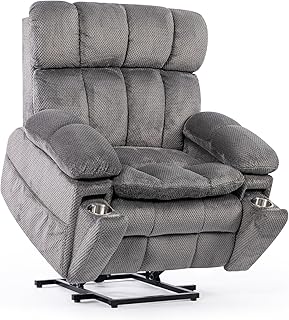
Oversized Dual Motor Lay Flat Power Lift Recliner (Grey)
Built for big-and-tall frames with an infinite-position range that genuinely reaches flat, this one has the wide, well-padded seat cushion that keeps hips from sinking overnight. The textile upholstery breathes far better than faux leather, which matters if you run warm while you sleep.
EONIX Dual Motor Zero Gravity Recliner (Navy Blue)
Independent backrest and footrest controls are the whole story here — you can dial in a slight leg lift with a nearly horizontal back, then leave it there permanently. The plush padding is soft out of the box and settles further, so if you prefer a firm seat, look elsewhere.
MCombo Lift Chair for Tall Men 7755 (Grey)
Purpose-built for frames up to 6’6″, with the tall back and long footrest extension that shorter chairs simply can’t offer. Faux leather wipes clean easily, which is a real advantage for medical recovery use, though a mattress protector-style throw helps with breathability.
Korser 360° Swivel Rocker Recliner with Massage and Heating
The manual outlier in this group and the one I’d recommend for nursing parents or anyone in a small bedroom — no power cord, no motor hum, and a 360-degree swivel that lets you get in and out without moving the chair. It won’t lay fully flat, so treat it as a nap-and-rock chair rather than a full-night sleeper.
Frequently Asked Questions
Is sleeping in a recliner every night bad for you?
For most people it’s fine, and for some conditions — reflux, sleep apnea, post-surgical recovery — doctors actively recommend it. The main risks are reduced circulation in the legs and pressure points at the tailbone, both of which are largely solved by a dual-motor chair that lets you elevate your feet above hip level. Check with your physician if you have a history of blood clots.
How much clearance do I need behind the chair?
Most lay-flat lift recliners need 12 to 18 inches from the wall to reach full recline, though a few wall-hugger designs cut that to about 4 inches. Measure before you commit, because the difference between a chair that reclines fully and one that stops short is often just a few inches of floor space.
Do I need a dedicated outlet?
No, a standard 15-amp household circuit handles these easily. Do keep the transformer box accessible rather than pinning it under the chair, and if you lose power often, look for a model with a battery backup that can return the chair to upright.
Can I add my own lumbar support or foam?
Yes, and it’s one of the easiest upgrades. A dense wedge cushion at the seat back or a two-inch layer of high-density foam under the existing seat cover fixes a soft seat without touching the mechanism. Avoid stuffing anything into the footrest hinge area — that’s where you’ll cause real damage.
Final Thoughts
If you want one chair that handles nightly sleep without asterisks, the Dual Motor 26″ Extra Wide Power Lift Recliner is the pick — wide seat, real zero-gravity range, and storage where you need it. Taller sleepers should go straight to the MCombo 7755 for its extended back and footrest, and anyone in a tight bedroom or nursery will get more use out of the Korser 360° Swivel Rocker, which trades lay-flat capability for a much smaller footprint and no motor noise at all.