Key takeaways
- Suction with a floor seal: Raw pascal ratings only matter if the nozzle stays close to the floor. Look for a low-profile intake and rubber side skirts — a 5,000Pa unit with a tight seal often beats a 10,000Pa unit that leaks air around the edges. Test it yourself: sprinkle a tablespoon of litter on hard floor and run one pass.
- Anti-tangle roller design: Rubber fins or a comb-cut bristle pattern shed cat fur far better than dense nylon. If you’re handy, unclip the roller before buying accessories and check whether the end caps come off with a coin or need a Phillips driver.
- Self-empty base capacity: Litter is dense, so a robot’s onboard bin fills by weight long before it fills by volume. A base rated for 30 to 60 days of normal debris realistically gives you two to four weeks with a litter box in play.
- Sealed HEPA filtration: Clay dust is respirable. Check that the filter sits in a gasketed housing rather than a loose slot, and plan on replacing it more often than the manual suggests.
- Mapping and no-go zones: Precise LiDAR mapping lets you fence off the litter area itself while still cleaning the perimeter — the difference between a robot that manages the mess and one that redistributes it.
What's inside
Cat litter is a uniquely hostile material for a robot vacuum. It’s abrasive enough to score plastic, heavy enough to sit like gravel on a rug pile, and it travels — a single trip out of the box can scatter granules ten feet down a hallway. Anyone who has knelt down with a shop light and watched a cheap robot skate over clay pellets instead of lifting them knows the frustration. Add long-haired cats to the equation and you get the second failure mode: brushrolls wound so tightly with fur that the motor stalls mid-run.
This guide comes from a maker’s perspective, which means paying attention to the parts that actually wear out: roller geometry, bin volume, filter seals, and how easy the machine is to disassemble on a workbench. Below are six current picks worth considering, followed by a practical buying framework, honest reviews of the top five, and answers to the questions that come up once the unit is out of the carton.
As an Amazon Associate we earn from qualifying purchases.



How to Choose a Robot Vacuum For Cat Litter (2026)
- Suction with a floor seal: Raw pascal ratings only matter if the nozzle stays close to the floor. Look for a low-profile intake and rubber side skirts — a 5,000Pa unit with a tight seal often beats a 10,000Pa unit that leaks air around the edges. Test it yourself: sprinkle a tablespoon of litter on hard floor and run one pass.
- Anti-tangle roller design: Rubber fins or a comb-cut bristle pattern shed cat fur far better than dense nylon. If you’re handy, unclip the roller before buying accessories and check whether the end caps come off with a coin or need a Phillips driver.
- Self-empty base capacity: Litter is dense, so a robot’s onboard bin fills by weight long before it fills by volume. A base rated for 30 to 60 days of normal debris realistically gives you two to four weeks with a litter box in play.
- Sealed HEPA filtration: Clay dust is respirable. Check that the filter sits in a gasketed housing rather than a loose slot, and plan on replacing it more often than the manual suggests.
- Mapping and no-go zones: Precise LiDAR mapping lets you fence off the litter area itself while still cleaning the perimeter — the difference between a robot that manages the mess and one that redistributes it.
The Best Robot Vacuum For Cat Litter (2026)s Reviewed
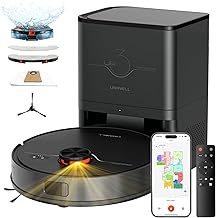
eufy C28 Robot Vacuum and Mop Combo
At 15,000Pa with a zero-tangle roller and a HydroJet mop that washes and dries itself, this is the most complete answer to a litter-adjacent floor plan. The auto-refill and self-empty station means the only routine maintenance is emptying the dust bag, and the roller genuinely shrugs off long cat hair.
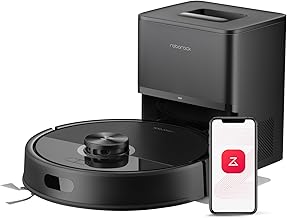
roborock Q7 M5+
The dual anti-tangle system and PreciSense LiDAR make this the pick for multi-room homes where the litter box lives in a specific corner you want mapped and fenced. Its 10,000Pa suction pulls clay granules out of low-pile carpet, and the self-empty dock holds up well even with heavy litter loads.
Shark AV2501S AI Ultra
Matrix Clean runs an overlapping grid pattern instead of a single pass, which is exactly what scattered litter needs — repeated coverage in a tight area. The self-cleaning brushroll and bagless HEPA base are also the easiest of this group to service without tools.
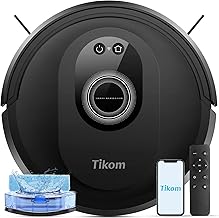
Tikom G8000 Max
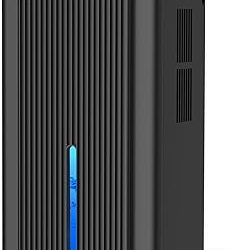
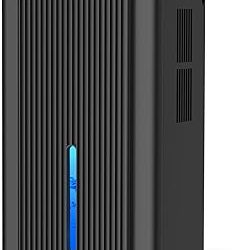
A straightforward, serviceable machine at 5,000Pa with a 150-minute runtime, best suited to hard floors and single-level homes. There’s no self-empty base, so you’ll be emptying the onboard bin every day or two, but the tradeoff is a simpler mechanism with fewer parts to fail.
ROPVACNIC 5200Pa Robot Vacuum and Mop
Solid obstacle avoidance and app-based cleaning adjustments make this a sensible entry point if you’re testing whether automation fits your setup at all. Expect to supplement with a stick vacuum near the box itself.
Frequently Asked Questions
Will litter damage the vacuum’s internals?
Silica and clay are abrasive, so wheel bearings and roller end caps wear faster than average. Blow out the wheel wells with compressed air monthly and the machine will last considerably longer.
Should the robot clean inside the litter area?
Set a no-go zone around the box itself and let the robot handle the surrounding two to three feet. That’s where the scatter lands, and it keeps the robot from pushing the mat or bumping the box.
Can a mopping robot handle litter?
Only if it vacuums first and mops second in separate passes. Wet clay smears badly, so disable simultaneous mop-and-vac in the litter zone.
How can I cut down the scatter at the source?
A shallow plywood tray lined with a coarse ridged mat catches most granules before they reach open floor — a twenty-minute build that meaningfully reduces the robot’s workload.
Final Thoughts
For most cat households, the eufy C28 is the strongest all-around choice thanks to its tangle-free roller and hands-off station, while the roborock Q7 M5+ is the better fit if precise zone mapping matters more than mopping. On a tighter budget, the Tikom G8000 Max handles hard floors capably as long as you don’t mind emptying the bin yourself.