Key takeaways
- Go thin, not thick: Over carpet, 1/4″ is the sweet spot. Anything thicker adds a second layer of give, which lets the rug flex, walk, and ripple. Save the 1/2″ pads for hard flooring where cushion actually helps.
- Prioritize grip on both faces: A dual-surface pad with natural rubber on one side and dense felt on the other gives you a choice at install time. On low-pile carpet, rubber down usually bites best; on textured or looped carpet, flipping to felt-down sometimes wins. Test both before you commit.
- Match pile height honestly: Low-pile, Berber, and commercial-grade carpet are the friendliest hosts. Deep plush or shag carpet will defeat almost any pad, and the fix there is a heavier rug plus fewer thin edges, not a fancier pad.
- Cut it 1″ smaller than the rug on all sides: This keeps the pad invisible and lets the rug edges taper down cleanly. Chalk a line, use a fresh utility blade against a metal straightedge, and cut on cardboard so you don’t slice the carpet underneath.
- Check for adhesives and off-gassing: Look for needle-punched felt bonded without glue and natural rather than synthetic rubber. In a closed room over carpet, low-VOC construction is worth the small premium.
What's inside
Putting an area rug on top of carpet sounds simple until you actually do it. The rug creeps a few inches every week, the corners lift into tripping hazards, and within a month you get that soft ripple down the middle that no amount of smoothing will flatten. The culprit is almost always the wrong pad — or no pad at all. Carpet already gives underfoot, so stacking a plush pad on top creates a floating layer with nothing to grip. What you need is stability and density, not more squish.
I’ve cut, layered, and stress-tested pads under everything from a flatweave in a hallway to a heavy wool rug in a family room over builder-grade plush carpet. Below are the pads that genuinely held position, plus a straight-talking buying framework covering thickness, backing material, carpet pile height, and how to trim a pad to size with nothing more than a utility knife and a straightedge.
As an Amazon Associate we earn from qualifying purchases.


🛒 Best Price Today on Amazon
Prime members get fast, free shipping on everything above, plus member-only deals. New members get a 30-day free trial — cancel anytime.
How to Choose a Rug Pad For Carpeted Floors (2026)
- Go thin, not thick: Over carpet, 1/4″ is the sweet spot. Anything thicker adds a second layer of give, which lets the rug flex, walk, and ripple. Save the 1/2″ pads for hard flooring where cushion actually helps.
- Prioritize grip on both faces: A dual-surface pad with natural rubber on one side and dense felt on the other gives you a choice at install time. On low-pile carpet, rubber down usually bites best; on textured or looped carpet, flipping to felt-down sometimes wins. Test both before you commit.
- Match pile height honestly: Low-pile, Berber, and commercial-grade carpet are the friendliest hosts. Deep plush or shag carpet will defeat almost any pad, and the fix there is a heavier rug plus fewer thin edges, not a fancier pad.
- Cut it 1″ smaller than the rug on all sides: This keeps the pad invisible and lets the rug edges taper down cleanly. Chalk a line, use a fresh utility blade against a metal straightedge, and cut on cardboard so you don’t slice the carpet underneath.
- Check for adhesives and off-gassing: Look for needle-punched felt bonded without glue and natural rather than synthetic rubber. In a closed room over carpet, low-VOC construction is worth the small premium.
The Best Rug Pad For Carpeted Floors (2026)s Reviewed
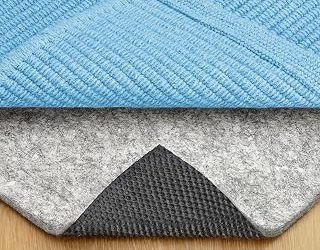
RUGPADUSA Dual Surface 1/4″
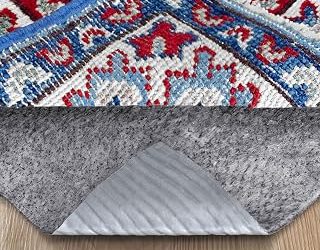
This is my default recommendation for rug-over-carpet, and it earns it: the natural rubber face grabs low-pile carpet fibers without fusing to them, while the felt side supplies just enough body to keep a rug from folding at the corners. It’s stiff enough to resist creeping and thin enough that the rug edge still lies flat.
RUGPADUSA Eco-Plush 1/2″
The most comfortable pad here by a wide margin, and the one I’d only put over carpet in a low-traffic room like a bedroom under a bed-anchored rug. All-felt construction means no rubber grip, so it relies on rug weight and furniture to stay put — brilliant on hardwood, situational on carpet.
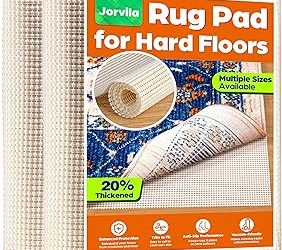
Jorvila Non-Slip Rug Pad Gripper
An affordable open-weave gripper that solves the specific problem of a lightweight flatweave sliding across low-pile carpet. It adds essentially no height, so there’s no ripple risk, though the thin construction won’t do much for underfoot feel or protecting the carpet beneath from rug-backing abrasion.
RUGPADUSA Basics 1/4″ Felt
Pure needle-punched felt at a sensible thickness, best used as a buffer layer rather than a grip solution. If your rug is heavy enough to stay put on its own and your real concern is crushing the carpet pile or hiding subfloor texture, this is the economical, low-fuss pick.
RUGPADUSA Dual Surface (Custom-Cut Runners and Odd Shapes)
The same dual-surface build shines when you buy oversized and trim to fit awkward layouts — L-shaped landings, around radiators, under a bay window. The felt-and-rubber laminate cuts cleanly without fraying, which is not true of most cheap grippers.
Frequently Asked Questions
Do I really need a rug pad if I already have carpet?
Yes, for two reasons: movement and wear. A rug over carpet has nothing anchoring it, and the rug’s stiff backing slowly abrades the carpet fibers underneath.
Will a rubber-backed pad damage or discolor my carpet?
Natural rubber pads are generally safe on synthetic carpet. Avoid cheap PVC or adhesive-coated pads, which can leave residue or yellow light-colored fibers over time.
Can I use two thin pads instead of one thicker one?
Don’t. Stacked layers slide against each other and make creeping worse. One dense 1/4″ pad beats two 1/8″ pads every time.
How do I stop rippling that has already started?
Lift the rug, let it relax flat for a day, then reinstall over a properly sized 1/4″ dual-surface pad and weight the corners with furniture for a week.
Final Thoughts
For most people layering a rug over carpet, the RUGPADUSA Dual Surface 1/4″ is the pad to buy — dense, grippy on both faces, and easy to trim to size. Choose the Jorvila Gripper if you’re wrangling a lightweight flatweave on a budget, and save the RUGPADUSA Eco-Plush 1/2″ for hardwood or a quiet bedroom where comfort outranks stability.