Key takeaways
- Ball diameter: 2.4″ spheres suit rocks glasses and Glencairn-adjacent pours, melting slowly enough for a long sip. The 2″ size fits narrower highballs and coupes, and stacks better in a freezer bin. Measure your favorite glass before you commit.
- Cycle time vs. daily yield: These are separate numbers. A machine making three balls per 40-minute cycle beats one making a single ball in the same window if you host. If it’s just you and a nightly dram, low yield is fine and usually means a smaller footprint.
- Water supply: Auto-supply models accept a line or a large external tank, so you can run unattended batches. Manual reservoirs mean topping off between cycles — no dealbreaker, but plan for it during a party.
- Insulation and storage: A well-insulated basket keeps finished spheres from welding together. Thin bins refreeze into a single mass, which means chiseling. Look for enhanced insulation if you’re batching ahead.
- Self-cleaning and access: Every one of these should have a self-clean mode, but check how easily you can reach the tray and drain plug for a vinegar flush. Scale buildup is what kills these units, not the compressor.
What's inside
Anyone who has tried the silicone-mold route knows the letdown: you wait eight hours, pop out a cloudy softball, and it cracks the moment bourbon hits it. Directional freezing in a cooler works, but it eats freezer real estate and turns a Tuesday nightcap into a weekend project. Countertop sphere makers finally solve the geometry problem, though the spec sheets bury the details that actually matter — ball diameter, cycle time, and whether the machine plumbs itself or expects you to refill a reservoir every hour.
I put these through the same tests I’d run on any shop tool: how long until first usable output, how consistent the results are across a full day, and how much fiddling the thing demands. Below are six machines worth considering in 2026, plus the buying criteria I’d use if I were starting from scratch, and answers to the questions that come up once one of these lands on your bar cart.
As an Amazon Associate we earn from qualifying purchases.


🛒 Best Price Today on Amazon
Prime members get fast, free shipping on everything above, plus member-only deals. New members get a 30-day free trial — cancel anytime.
How to Choose a Sphere Ice Maker (2026)
- Ball diameter: 2.4″ spheres suit rocks glasses and Glencairn-adjacent pours, melting slowly enough for a long sip. The 2″ size fits narrower highballs and coupes, and stacks better in a freezer bin. Measure your favorite glass before you commit.
- Cycle time vs. daily yield: These are separate numbers. A machine making three balls per 40-minute cycle beats one making a single ball in the same window if you host. If it’s just you and a nightly dram, low yield is fine and usually means a smaller footprint.
- Water supply: Auto-supply models accept a line or a large external tank, so you can run unattended batches. Manual reservoirs mean topping off between cycles — no dealbreaker, but plan for it during a party.
- Insulation and storage: A well-insulated basket keeps finished spheres from welding together. Thin bins refreeze into a single mass, which means chiseling. Look for enhanced insulation if you’re batching ahead.
- Self-cleaning and access: Every one of these should have a self-clean mode, but check how easily you can reach the tray and drain plug for a vinegar flush. Scale buildup is what kills these units, not the compressor.
The Best Sphere Ice Makers (2026) Reviewed
Silonn 2.4″ Sphere Ice Maker
The combination of Crystal Sphere and Rapid Sphere modes gives you a genuine choice between optical clarity and throughput, and at 100 balls a day it keeps up with a crowd. This is the pick if you want one machine that handles both a quiet Wednesday and a full dinner party.
ecozy 2″ Ice Ball Maker with Auto Water Supply
At 144 spheres per day with four per cycle, this is the highest-volume unit here, and the auto water supply means you can load it and walk away. The 2″ size is the sweet spot for cocktails rather than neat pours — clarity from the CrystalFlux system is consistently good.
ecozy 2″ Clear Ice Ball Maker
Functionally the same engine as its sibling above, with the same 40-minute four-ball cycle and enhanced insulation on the storage bin. Worth comparing on price, since the two models frequently trade places depending on the day.
ecozy 2.4″ Clear Ice Ball Maker
One sphere per cycle and 32 per day sounds modest until you see how little counter space it occupies — this is the model for a tight bar cart or a galley kitchen. The 8-hour timer means you can set it before bed and wake up to a ready ball.
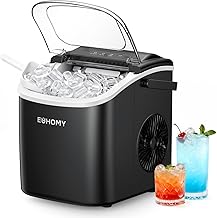
EUHOMY 2.4″ Ice Ball Maker (108 Pcs/Day)
Three 2.4″ spheres every 40 minutes puts this in Silonn territory for output, and the clarity holds up well across back-to-back cycles. A strong choice if you specifically want full-size whiskey balls at volume rather than the smaller 2″ format.
Frequently Asked Questions
Why is my ice cloudy instead of clear?
Usually dissolved minerals or trapped air. Use filtered or briefly boiled-and-cooled water, and pick the clarity-focused mode if your machine offers one. Cloudiness also creeps in as scale builds up, so a monthly descale helps.
Do I need a plumbing connection?
No. Every unit here runs from an onboard reservoir. Auto-supply models simply let you attach a larger external container so you’re not refilling mid-batch.
How long do the spheres last in a drink?
A 2.4″ ball in a rocks glass typically holds its shape for 30 to 45 minutes, roughly double a standard cube of the same volume. That’s the whole point — less surface area, slower dilution.
Can I store the ice long-term?
These aren’t freezers, so transfer finished spheres to a freezer bag or lidded bin. Give them space so they don’t fuse, and they’ll keep for weeks.
Final Thoughts
For most people, the Silonn 2.4″ is the balanced buy — real 2.4″ spheres, dual clarity modes, and enough daily output to host. If you want maximum volume and hands-off operation, the ecozy 2″ with auto water supply is the workhorse, while the EUHOMY 108-per-day model splits the difference with full-size balls at high throughput.