Anyone who has spent a Saturday afternoon crawling under a car knows the real enemy isn’t a seized bolt — it’s the moment you set down a 10mm socket and it vanishes into the void. Loose tools scattered across a workbench, milk crates, and the garage floor turn a two-hour brake job into a four-hour scavenger hunt. A proper tool chest fixes that, but the market is crowded with thin-gauge boxes that sag under a set of impact sockets and drawers that stick the second you load them past half capacity.
This guide cuts through it. We looked at load ratings, steel gauge, drawer slide quality, caster construction, and the small details that only matter once you’ve actually lived with a chest — whether the top surface can take a torque wrench beating, whether the power strip is positioned somewhere useful, and whether the thing rolls over an extension cord without fighting you. Below are six rolling chests worth the garage floor space, from compact five-drawer carts to full 72-inch workbench setups.
Our top picks
 8-Drawers Rolling Tool Chest
- ✅【Durable】 Tool chest is made of premium steel…
- ✅【High-capacity】Rolling tool box is equipped with 8 sliding…
- ✅【Easy Moving& Storing】 Top box with 2 handles,…



As an Amazon Associate we earn from qualifying purchases at no extra cost to you.
🛒 Best Price Today on Amazon
Prime members get fast, free shipping on everything above, plus member-only deals. New members get a 30-day free trial — cancel anytime.
How to Choose a/an Tool Chest For Mechanics (2026)
- Steel gauge and load rating: Look for 16-gauge steel on the frame and a published total capacity. A 1,750 lb rating means the chest handles a full mechanic’s set plus a bench vise bolted to the top without the shell flexing.
- Drawer slides: Ball-bearing slides are the dividing line between a chest you love and one you resent. Test the deepest drawer loaded — if it binds empty, it will jam full of wrenches.
- Work surface material: Solid oak or thick hardwood tops absorb hammer blows and won’t telegraph dents like painted steel. A 1.2-inch top also gives you something to clamp to.
- Casters: Five-inch swivel casters with two locking wheels beat four small hard-plastic rollers every time, especially on epoxy floors with expansion joints or gravel-tracked concrete.
- Power and hanging storage: An integrated ETL-listed power strip and rear pegboard turn a storage box into a real station. Count the hooks — 50-plus means your pry bars, straps, and cords come off the wall.
The Best Tool Chest For Mechanics (2026)s Reviewed
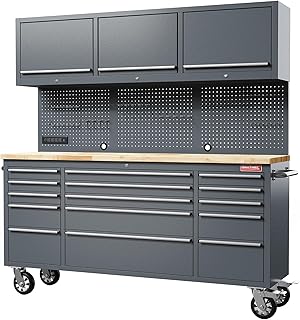
HAUTMEC 72″ Rolling Tool Chest, 15 Drawers
This is the one to buy if you want a permanent build station rather than a rolling box. The 16-gauge shell, three upper cabinets, and solid oak top handle abuse that would dent lesser chests, and the 51-hook pegboard plus ETL power strip means your grinder, chargers, and air tools all live within arm’s reach.
Garvee 60″ Rolling Tool Chest, 10 Drawers
A 1,750 lb load rating in a 60-inch footprint makes this the sweet spot for a two-car garage where a 72-inch bench won’t fit. The charging station is genuinely useful for cordless platform users, and the pegboard keeps the drawer space free for hand tools instead of chargers.
72″ Rolling Tool Chest, 1.2″ Solid Wood Top
The 18-inch-deep drawers swallow full socket trays and breaker bars that overhang shallower chests, and the 1.2-inch hardwood top doubles as a legitimate assembly bench. Lockable drawers and a built-in outlet round out a chest that competes well above its price bracket.
8-Drawer Rolling Tool Chest, Detachable Top Box
The detachable top box is the standout feature here — pull it off and carry it to the job instead of hauling the whole cart. Comes with drawer liners and a tray divider out of the box, and it ships assembled, which saves you an evening with an Allen key.
Metal Rolling Tool Cabinet with Dual Pegboards
Two pegboards and ten hooks give this cabinet far more vertical storage than its drawer count suggests, making it a smart pick for anyone with more clamps and cords than sockets. The included workbench liner protects the top surface from the start.
Frequently Asked Questions
How many drawers do I actually need?
For general home maintenance and light repair, five to eight drawers is plenty. If you own multiple socket drives, a full metric and SAE wrench set, and specialty tools, step up to 10 or 15 so each drawer holds one logical category.
Is a wood top better than steel?
For mechanics, yes. Hardwood absorbs impact, won’t chip paint onto your parts, and doesn’t conduct electricity when you’re testing components. Steel is easier to wipe clean but shows every dent.
Can I bolt a vise to a rolling tool chest?
On a 1.2-inch solid wood top with a heavy-duty frame and a four-figure load rating, yes — through-bolt it near a corner over the frame rail, not the middle of an unsupported span. Lock the casters before you apply real force.
Do I need lockable drawers in a home garage?
If you have kids, share space with a tenant, or store expensive diagnostic gear, locks are worth it. They also keep drawers shut when you roll the chest across an uneven floor.
Final Thoughts
For a full workshop build, the HAUTMEC 72″ chest with its oak top and 51-hook pegboard is the most complete package here. The Garvee 60″ is the better fit for tighter garages that still need serious load capacity, and if you want a chest that travels with you, the 8-drawer model with the detachable top box is the practical choice.