Key takeaways
- One hose, one set of plants, no phone: a basic electronic timer with a rain delay button (Rain Bird Premium Electronic Hose Timer).
- Several beds with different needs: a multi-outlet timer, either a two-zone Melnor AquaTimer or a four-port Orbit B-hyve XD.
- You want it to skip watering after rain without touching it: a Wi-Fi timer with a weather feed (Orbit B-hyve, Rachio Smart Hose Timer).
- You live in a smart-home ecosystem: check the platform. Eve Aqua is built around Apple Home, and Husky and Orbit list Alexa and Google voice support.
- Your spigot is far from the router: a hub or gateway system (LinkTap G2S, Orbit or Rachio hubs) beats direct Wi-Fi.
The best garden hose water timers for most yards are the Orbit B-hyve Smart Hose Watering Timer with Wi-Fi Hub for app and weather-based control, the Rain Bird Premium Electronic Hose Timer for simple no-app scheduling with a brass coupler, and the Melnor RainCloud when you need four independent zones from one spigot. The rest of this guide shows how to match a timer to your spigot, your zones and your tolerance for apps.
A hose timer is a battery-powered valve that screws onto an outdoor faucet and opens the water on a schedule. It will not fix a leaking hose or a weak spigot, but it ends the two classic failures of manual watering: forgetting, and leaving the water on overnight. The differences between models come down to six questions: how many zones, how it is powered, how it handles rain, what the threads are made of, whether it needs Wi-Fi, and how painful it is to program.
Our top picks


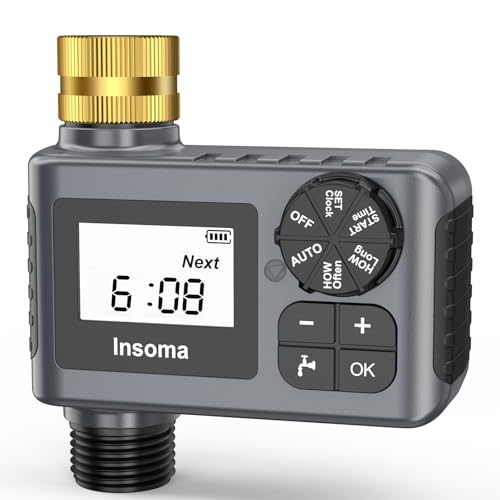

As an Amazon Associate we earn from qualifying purchases at no extra cost to you.
Quick answer: which type of hose timer fits you
- One hose, one set of plants, no phone: a basic electronic timer with a rain delay button (Rain Bird Premium Electronic Hose Timer).
- Several beds with different needs: a multi-outlet timer, either a two-zone Melnor AquaTimer or a four-port Orbit B-hyve XD.
- You want it to skip watering after rain without touching it: a Wi-Fi timer with a weather feed (Orbit B-hyve, Rachio Smart Hose Timer).
- You live in a smart-home ecosystem: check the platform. Eve Aqua is built around Apple Home, and Husky and Orbit list Alexa and Google voice support.
- Your spigot is far from the router: a hub or gateway system (LinkTap G2S, Orbit or Rachio hubs) beats direct Wi-Fi.
How we chose
This is a research-based guide, not a lab write-up. We compared manufacturer specification sheets and published buyer guides, cross-checked each model name against current product lines, and kept only specs that appeared in more than one source. Where a detail varied between listings, such as battery life, we describe it as a range or by class instead of quoting a single number. Models were scored on six criteria: zone count, power and battery life, rain handling, thread and body material, connectivity, and programming effort.
Comparison table
| Timer | Zones / outlets | Connectivity | Rain handling | Power | Best fit |
|---|---|---|---|---|---|
| Orbit B-hyve Smart Hose Watering Timer with Wi-Fi Hub | 1 to 3 outlets depending on kit | Wi-Fi hub, Bluetooth setup, Alexa and Google | Rain delay plus weather-based skipping | Batteries | App-managed multi-bed watering |
| Orbit B-hyve XD 4-Port | 4 outlets | Wi-Fi hub, Bluetooth, Alexa and Google | Weather-based adjustment, WaterSense listed | Batteries, weather-resistant body | Four beds from one spigot |
| Rain Bird Premium Electronic Hose Timer | 1 | None | Manual rain delay up to 96 hours | Batteries | Simple, durable, no app |
| Melnor RainCloud | 4 independent zones | Direct Wi-Fi | Manual rain delay | AA batteries | Multi-zone with remote control |
| Melnor AquaTimer 2-Zone | 2 | None | Manual | Batteries | Two beds, no app |
| Rachio Smart Hose Timer | Kit with 2 valves, expandable | Wi-Fi hub | Weather-aware scheduling | Valve batteries | Weather logic with expansion |
| Eve Aqua | 1 | Apple Home (Thread, Bluetooth) | Home automations | AA batteries | Apple Home households |
| LinkTap G2S | 1 per unit, shared gateway | Separate gateway radio | Gateway scheduling, flow monitoring | AA batteries | Spigots far from the router |
| Husky Smart Watering Timer | Single or multi by kit | Wi-Fi, Alexa and Google | Rain delay | Batteries | Voice-assistant homes |
Kit configurations change often, so confirm the outlet count and whether a hub is included on the exact listing you buy.
Single vs multi-zone: how many outlets you need
A single-outlet timer controls one hose line. That is enough if everything you water is one connected area, or if you move a sprinkler by hand. A multi-outlet timer has two to four valves on one body, each with its own schedule, so you can run a lawn sprinkler on Tuesday and Friday while a drip line for tomatoes runs every morning.
Count the distinct watering needs you have, not the number of beds. Lawn, shrub borders, container pots and a vegetable bed often need four different run times. Two plantings that like the same soil moisture can share a zone. If you land at two zones, a two-outlet Melnor AquaTimer is a lean answer; at three to four, an Orbit B-hyve or Melnor RainCloud avoids buying stacked single timers.
One limit applies to every multi-zone timer: the zones share a single spigot, so they should run one after another, not at the same time. Running two sprinklers together can drop pressure below what either needs.
The picks, grouped by buyer criteria
Best for app control and weather skipping: Orbit B-hyve Smart Hose Watering Timer with Wi-Fi Hub
Spec line: Up to 3 outlets by kit · Wi-Fi hub · Bluetooth setup · Alexa and Google · rain delay · weather-based adjustments · battery powered
Best for: households that want schedules to adjust to the forecast and want to manage several beds from a phone.
Skip if: you do not want a hub plugged in indoors, or your spigot is out of range of your router and hub.
- Pros: independent zone schedules, forecast-based skipping, 24, 48 and 72 hour delay options reported in published reviews, widely stocked.
- Cons: the app is required for the smart features, and a hub adds one more device to power.
Best for four zones: Orbit B-hyve XD 4-Port
Spec line: 4 outlets · Wi-Fi hub included · Bluetooth · Alexa and Google · WaterSense listed · weather-resistant body · batteries
Best for: large yards or gardens split between lawn, beds and containers.
Skip if: you only water one line. A single-outlet timer costs less and is easier to mount.
- Pros: four independent valves from one faucet, EPA WaterSense listing, one app for everything.
- Cons: bulkier body that hangs more weight on the spigot, so support the hoses to avoid strain on the faucet.
Best simple timer: Rain Bird Premium Electronic Hose Timer
Spec line: 1 outlet · brass coupler · large display · rain delay up to 96 hours · one-touch manual watering · batteries
Best for: anyone who wants a dependable schedule without an app or Wi-Fi.
Skip if: you want it to react to weather forecasts by itself, since the rain delay is manual.
- Pros: brass threads resist cross-threading wear, on-device buttons and a countdown display, no accounts or firmware.
- Cons: single zone, and you must press the delay button yourself when rain is coming.
Best remote multi-zone: Melnor RainCloud Smart Water Timer
Spec line: 4 independent zones · direct Wi-Fi · AA batteries · manual rain delay · app control
Best for: four-zone control without a separate hub, where the router signal reaches the spigot.
Skip if: Wi-Fi at the spigot is weak. Direct Wi-Fi timers lose connection more often than hub systems.
- Pros: four zones, remote start and stop, familiar Melnor valve design.
- Cons: weather logic is basic compared with Orbit and Rachio, and four AA cells can need replacing roughly once a year or sooner with heavy use.
Best budget two-zone: Melnor AquaTimer 2-Zone
Spec line: 2 outlets · digital programmable · no Wi-Fi · battery powered
Best for: two beds or a lawn plus a drip bed without an app.
Skip if: you want phone notifications or weather skipping.
- Pros: two independent schedules in one unit, no connectivity to maintain.
- Cons: the on-body programming menu takes a few minutes to learn, and there is no automatic rain skipping.
Best for weather-intelligent scheduling: Rachio Smart Hose Timer
Spec line: 2-valve kit, expandable · Wi-Fi hub · weather-aware scheduling · battery valves
Best for: gardeners who like evapotranspiration-based logic and may add valves later.
Skip if: you want everything on the device without an app.
- Pros: expandable, hub-based connection is more reliable than direct Wi-Fi.
- Cons: higher entry cost for the kit, and the app is central to setup.
Best for Apple Home: Eve Aqua
Spec line: 1 outlet · Apple Home via Thread and Bluetooth · AA batteries · automations by Home app
Best for: Apple-centered households that want local control and Siri.
Skip if: you use Android only, or you want built-in forecast skipping.
- Pros: local HomeKit control, privacy-friendly, simple single valve.
- Cons: needs an Apple Home hub for full remote use, no native weather intelligence.
Best for distance: LinkTap G2S Wireless Water Timer
Spec line: 1 outlet per unit · separate gateway radio with long range · AA batteries · flow monitoring
Best for: spigots at the far end of a property, or monitoring for leaks and stuck valves.
Skip if: you want a single self-contained box.
- Pros: long radio range, flow readings to spot a burst hose, gateway stays indoors.
- Cons: more parts to set up, and each additional spigot needs its own unit.
Brass vs plastic threads
Brass threads are harder to cross-thread and survive the repeated on and off of a hose better than molded plastic. Plastic bodies are fine when the timer stays on one faucet all season and you hand-tighten it only. Whichever you choose, use a good washer in the coupling, hand-tighten, and do not use pliers on a plastic coupler.
- Brass coupler: best for frequent removal, hard water or heavy hoses.
- Plastic coupler: acceptable for a fixed mount and light hoses.
- Either way, take the timer inside before freezing weather. Water left in the valve can crack the housing.
Battery life and rain delay: what to expect
Most hose timers run on two to four AA or similar batteries. Published numbers range from roughly 8 to 18 months depending on how often the valve opens, how long each run lasts, and whether Wi-Fi or radio is active. A timer that opens twice a day uses its batteries faster than one that runs three mornings a week. Use alkaline or lithium cells, replace them at the start of the season, and treat a low-battery warning as a deadline, not a suggestion. A dead battery usually leaves the valve closed, which means plants dry out silently.
Rain delay comes in two forms. A manual delay (typically selectable for 24, 48, 72 or 96 hours) pauses the schedule when you press it. A weather skip asks a forecast service and cancels the run automatically. Manual delay is dependable but needs you to notice the storm. Weather skip is hands-free but depends on your timer reaching the internet, and forecast data covers an area, not your yard.
Worked example: how long should each zone run?
Use this method to set run times from your hose flow instead of guessing.
- Pick a target depth. Most lawns and beds do well with about 1 inch of water per week during warm weather, split into two or three sessions.
- Convert depth to gallons. One inch over one square foot is about 0.62 gallons. A 400-square-foot bed needs about 400 x 0.62 = 249 gallons per week.
- Measure your flow. Time how long a 5-gallon bucket takes to fill from the hose and sprinkler setup. If it takes 75 seconds, flow is 5 / 1.25 = 4 gallons per minute.
- Divide. 249 gallons / 4 gpm is about 62 minutes per week.
- Split into sessions. Three sessions of about 21 minutes each is a clean schedule.
With a drip line that delivers 1 gpm to the same bed, the same weekly total needs about 249 minutes, which is just over 4 hours, or roughly 35 minutes a day. This is why zone count and flow matter: a timer cannot water faster than your hose and heads allow. For multi-zone timers, add the zone run times together and make sure the total fits inside your watering window.
Decision matrix
| If you need | Choose | Why |
|---|---|---|
| One line, zero tech | Rain Bird Premium Electronic Hose Timer | Brass coupler, on-device controls, manual rain delay |
| Two beds, no app | Melnor AquaTimer 2-Zone | Two schedules without Wi-Fi |
| Automatic rain skipping | Orbit B-hyve or Rachio | Forecast-based schedule changes |
| Four zones | Orbit B-hyve XD 4-Port or Melnor RainCloud | Four independent valves |
| Weak Wi-Fi at the faucet | LinkTap G2S or any hub-based kit | Separate radio link to the faucet |
| Apple Home | Eve Aqua | Native Home integration |
Programming ease
On-device timers with a small screen and three buttons are quick once you know the menu, but every schedule change means standing at the spigot. App-based timers are easier to adjust and let you start a run from the couch, but they depend on setup steps: Bluetooth pairing, hub placement, Wi-Fi band, account creation. Before you buy, check that the app is maintained and that the timer still has a manual mode if the cloud service is down. Keep the schedule simple. Early morning watering reduces evaporation and leaves foliage time to dry, which lowers fungal risk.
Installation and care tips
- Flush the spigot for a few seconds first to clear grit that could jam the valve.
- Check the washer before you attach the timer. A worn washer is the most common cause of dripping at the faucet.
- Mount the timer so the display faces out and the hose hangs without kinking.
- Check the pressure rating. Many small valves are rated for a limited maximum pressure, so confirm it if your home pressure is high.
- Add a filter or screen if you draw from well water or hard water, because sediment is hard on small valves.
- Store indoors for the winter, with batteries removed.
Frequently asked questions
Do I need a Wi-Fi hose timer?
No. A basic electronic timer handles fixed schedules well. Wi-Fi adds remote control and automatic weather skipping, which matter most if you travel or run several zones.
If you only water one bed on a regular routine, the extra setup rarely pays off.
How many zones do I need?
One zone per distinct watering need, usually lawn, borders, containers and vegetables. Most households land on one to three zones, and four-zone timers suit larger yards.
Can a hose timer run a sprinkler and a drip line together?
Yes on a single outlet, if you add a splitter and a pressure regulator for the drip line. Running separate zones at the same time on one spigot can cut pressure for both.
How long do hose timer batteries last?
Published figures range from about 8 to 18 months, depending on watering frequency and connectivity. Replace them at the start of each season to be safe.
What happens if the batteries die while the valve is open?
Most designs close the valve when power fails, so water stops. Confirm this fail-closed behavior in the manual, and use a low-battery alert if available.
Are brass threads worth it?
Yes if you remove the timer often or use heavy hoses. Brass resists cross-threading and wear better than plastic, which is fine for a permanent mount.
Should I leave a hose timer outside in winter?
No. Drain it and bring it indoors before the first hard freeze, because trapped water can crack the housing and valve. Remove the batteries for storage.
Will a timer save water?
It usually does, because it prevents forgotten hoses and overwatering. Weather-skipping models save more by cancelling runs after rain, but only if the schedule was set sensibly first.