Key takeaways
- Camco identifies NSF/ANSI/CAN 61 drinking-water hose material for this 25-foot product.
- The published three-year warranty offers longer stated coverage than many alternatives.
- A 5/8-inch bore allows less restriction than a comparable 1/2-inch line.
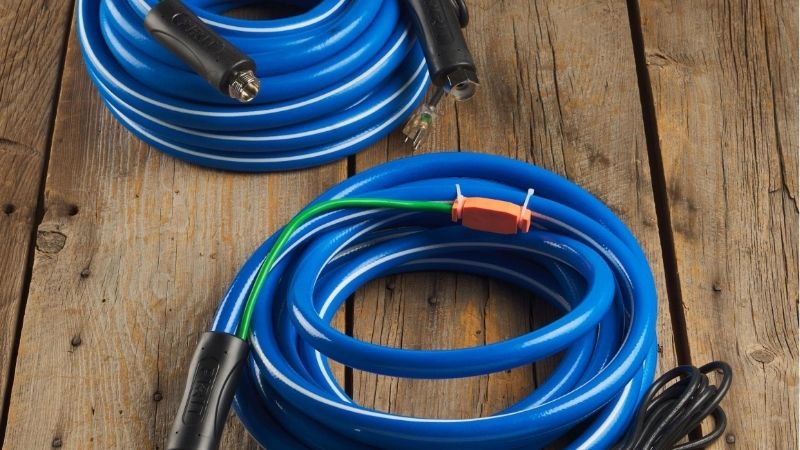
An outdoor spigot can still work while the ordinary hose attached to it has turned into a tube of ice. A heated garden hose addresses that exposed run with an electrical heating element, making it useful for winter livestock watering, garden chores, and RV hookups. These products protect the hose itself, not an uninsulated faucet, regulator, or storage tank. CPSC guidance calls for GFCI protection and a weatherproof cover at outdoor outlets.
Quick Verdict: For most buyers needing a 25-foot potable-water connection, the Camco 22911 is our Best Overall: its published minus 20 degrees F protection, 5/8-inch bore, and three-year warranty make the choice unusually straightforward. For short occasional winter tasks on a tighter budget, compare the VEVOR MT-130-25ft. These are editorial judgments from published specifications as of October 2026, not in-house tests. Check current prices and confirm the electrical connection before ordering.
As an Amazon Associate we earn from qualifying purchases.
By DIY Ideas 4 Home Editorial Team
The Best Heated Water Hoses Reviewed
We selected five identifiable 25-foot models using manufacturer product pages, seller listings with exact model numbers, and available installation details. The 25-foot format makes cold rating, bore size, fittings, and purchase price easier to compare than mixing very different lengths. Listed prices ranged from $65.90 to $192.82 as of October 2026. Those figures are snapshots, not price guarantees; the colder claimed ratings below are manufacturer or seller specifications rather than promises that every connected faucet will remain unfrozen.
| Product | Best For | Key Spec | Listed Price (as of October 2026) | Watch Out For |
|---|---|---|---|---|
| Camco 22911 | Best Overall | 25 ft; 5/8-in ID; rated to -20 F | $180.99, Camco | Higher upfront cost; protect exposed spigot separately |
| VEVOR MT-130-25ft | Winter Yard Tasks | 25 ft; 5/8-in ID; 160 W; claimed -45 F | $65.90, VEVOR | No separately documented NSF 61 claim in checked listing |
| PIRIT PWL-05-25 | Barn Work | 25 ft; 5/8-in ID; 200-psi working pressure | $159.95, Lowe’s | Confirm Series V, not older Series II |
| AquaFresh W01-5325 | RV Water Pressure | 25 ft; 1/2-in ID; 160-psi rating | $192.82, etrailer | Narrower bore; thermostat placement matters |
| Kohree KR211A2 | Midpriced RV Hookups | 25 ft; 5/8-in ID; claimed -40 F | $119.99, Kohree | NSF 372 concerns lead content, not all water-contact effects |
Camco 22911: Best Overall
Best For: Households or RV owners who prioritize a documented drinking-water hose over the lowest listed purchase price.
Camco makes the strongest all-around case here because buyers can reconcile the published drinking-water construction, freeze rating, warranty, and exact part number without relying entirely on an anonymous marketplace description. That matters for a connection which may be left outside while temperatures fluctuate through the night. It is not our pick for every climate: buyers facing repeated temperatures well below minus 20 degrees F should compare the colder-rated alternatives and plan how to protect every connection.
Camco’s product page for SKU 22911 identifies a 25-foot hose with a 5/8-inch internal diameter, manufacturer-stated freeze protection down to minus 20 degrees F, and an official listed price of $180.99 in October 2026. Camco’s RV accessories catalog also identifies a thermostat-controlled heating cable, NSF/ANSI/CAN 61 drinking-water hose construction, and a six-foot, 18-AWG power cord. The manufacturer’s product page gives a three-year warranty with proof of purchase. That places this model toward the premium end of our specific 25-foot comparison, rather than the entry tier represented by VEVOR.
Camco lists an item weight of 8.25 pounds for the 22911, a meaningful consideration if the hose must be carried between a kennel tap and a storage area after each chore. Its tough outer jacket and plated couplings are intended to shield the heated assembly from routine outdoor handling; they are not permission to drag a live power connector through standing water. The thermostat reduces unnecessary heating when conditions are warmer, but the exposed metal tap and any downstream pressure regulator still need their own cold-weather assessment. Before seasonal storage, follow Camco’s instructions for emptying the water line and protecting the electrical connector.
Pros:
- Camco identifies NSF/ANSI/CAN 61 drinking-water hose material for this 25-foot product.
- The published three-year warranty offers longer stated coverage than many alternatives.
- A 5/8-inch bore allows less restriction than a comparable 1/2-inch line.
Cons:
- The $180.99 manufacturer price is substantially above VEVOR’s 25-foot listing.
- Its minus 20 degrees F claim provides less cold margin than several competing claims.
Who Should Buy It: Choose Camco 22911 for a well-documented everyday winter hookup; choose PIRIT PWL-05-25 when repeated barn handling is the deciding need.
VEVOR MT-130-25ft: Best for Winter Yard Tasks
Best For: Owners who need an occasional powered hose for a garden, wash area, or winter cleanup without premium pricing.
The VEVOR makes financial sense when the hose is an occasional piece of winter equipment rather than a permanently connected drinking-water supply. Its selection is about the unusually low current price and specific published heating wattage, not an assumption that the lowest-price assembly will last as long as higher-priced designs. A buyer watering a small greenhouse during a brief cold snap may favor this trade-off, while a full-time RV resident should give more weight to documented water-contact standards and long-term support.
VEVOR’s product page for model MT-130-25ft lists a 25-foot hose, 5/8-inch inner diameter, 160-watt heating system, and 3/4-inch garden-hose-thread connector. VEVOR advertises protection down to minus 45 degrees F and a price of $65.90 as of October 2026. Treat the temperature as a maker claim for the hose under suitable conditions, not a field-proven rating for a bare spigot in wind. The product page calls its inner PVC hose lead-free and BPA-free but does not supply an independently checked NSF/ANSI 61 document, so we would not substitute those material claims for potable-water certification paperwork.
For storage planning, the VEVOR specifications give a coiled product size of about 12.2 inches by 12.2 inches by 4.7 inches; this is a packed-size reference, not a diameter for a hose in use. The manufacturer’s question-and-answer section describes the power lead as about 1.5 meters and says it must not be extended, a limitation worth checking against the outlet position before buying. The illuminated plug can help confirm supplied power, but a lit indicator cannot prove that every section is heating correctly. Keep the connection elevated, use GFCI protection, and examine the sheath for damage after contact with ice or coarse ground.
Pros:
- At $65.90, the official 25-foot listing sets the lowest price here.
- VEVOR specifies 160 watts rather than leaving heater power entirely unstated.
- The 5/8-inch bore and 3/4-inch fittings suit typical garden connections.
Cons:
- Potable-water materials are maker-described without checked NSF 61 documentation.
- The short lead may put the outlet too far from the desired spigot.
Who Should Buy It: Buy VEVOR MT-130-25ft for occasional noncritical watering; choose Camco 22911 when traceable drinking-water documentation matters more.
PIRIT PWL-05-25: Best for Barn Work
Best For: Livestock owners moving hoses among stalls, paddocks, and wash stations in freezing conditions.
For a working barn, a heated hose is handled like a tool. Fittings get twisted at taps, hose sections rub across rough ground, and a frozen line can interrupt chores at exactly the wrong time. PIRIT’s Series V is especially relevant because its product information emphasizes couplings, reinforced construction, and working pressure rather than relying on a headline temperature alone. The model identification is important: older PIRIT Series II documentation describes related technology, but its electrical and warranty figures should not be silently assigned to the current Series V.
Lowe’s product listing for the PIRIT Series V PWL-05-25 specifies a 25-foot, 5/8-inch heated hose with a 200-psi working-pressure figure and a listed price of $159.95 in October 2026. The current Series V descriptions at Lowe’s and Target cite a manufacturer cold claim of minus 42 degrees F and a hose construction advertised as meeting NSF/ANSI/CAN 61 for potable water. The manufacturer’s published design uses thermostat-responsive heating, but the specific Series V page should be checked for power draw before planning a shared electrical circuit; a Series II wattage figure is not a substitute.
Target’s Series V listing gives the 25-foot unit a weight of about 8.08 pounds and describes nickel-plated brass couplings with reinforced nozzle assemblies. A listed 18-month limited warranty offers a useful inspection window for a product used through one winter and into the next. This is still a garden hose with embedded electrical parts, not a tow rope; repeated sharp bends near the fitting can strain the heating assembly even if the outer cover looks intact. Position the cord where livestock cannot chew, step on, or pull it, and confirm the intended outdoor electrical arrangement against the model’s instructions.
Pros:
- Its 200-psi working-pressure listing supports demanding short-run water-transfer tasks.
- Reinforced ends and brass couplings address common barn-hose stress points.
- The Series V description identifies NSF/ANSI/CAN 61 potable-water compliance.
Cons:
- The 8.08-pound weight is inconvenient when carrying equipment long distances.
- Series changes make checking the exact PWL-05-25 listing especially important.
Who Should Buy It: Select PIRIT PWL-05-25 for routine cold-weather livestock chores; AquaFresh W01-5325 better suits an RV system with a documented 160-psi hose rating.
AquaFresh W01-5325: Best for RV Water Pressure
Best For: Winter campers who want published pressure limits and insulated hose ends for a 25-foot RV supply.
AquaFresh takes a more connection-focused approach than products marketed mainly around dramatic subzero numbers. Its zippered insulated cuffs protect vulnerable fitting areas, and the listing states a clear pressure rating. That combination is attractive when a drinking-water line connects a campground standpipe to an RV inlet. The drawback is an internal passage narrower than the 5/8-inch options: a 1/2-inch hose can impose more flow resistance over the same distance, so high pressure rating does not automatically mean the highest shower flow.
etrailer’s product page for the Valterra AquaFresh W01-5325 specifies a 25-foot length, 1/2-inch inside diameter, 160-psi hose-pressure rating, and 120-volt heating arrangement. The retailer listed it at $192.82 in October 2026. The page also states the water-contact construction meets NSF/ANSI 61 and NSF/ANSI 372 and gives a three-year warranty. In a separate expert response for this exact part, etrailer quotes 150 watts and freeze protection to roughly minus 15 degrees F; that retailer figure is useful context, not a universal guarantee for the whole RV plumbing system.
The heating cable includes a six-foot power lead, while the end cuffs introduce extra bulk close to valves and RV wall fittings. Account for that physical space before routing the hose through an enclosed water compartment. An etrailer answer specifies that the temperature sensor is near the female end and needs to sense outside air; placing it in a warm, enclosed bay can stop heating while exposed hose sections are freezing. The illuminated connector indicates power presence, but routine leak checks remain necessary, especially if the hose stays under pressure for weeks.
Pros:
- The stated 160-psi hose rating is useful for pressurized campground hookups.
- Zippered insulated cuffs cover the end connections where ice can form.
- etrailer documents NSF 61 and 372 claims for part W01-5325.
Cons:
- Its 1/2-inch passage is narrower than the other four reviewed models.
- The thermostat can misread conditions if sheltered inside a heated compartment.
Who Should Buy It: Choose AquaFresh W01-5325 for a pressure-rated RV hookup; choose Kohree KR211A2 when the wider 5/8-inch flow path takes priority.
Kohree KR211A2: Best for Midpriced RV Hookups
Best For: Winter RV travelers seeking a 25-foot supply hose with clearly described electrical and water-contact specifications.
Kohree fills a price gap between the inexpensive VEVOR and the more established premium-priced choices. The advantage is not merely that it claims a low-temperature limit; its current product page spells out the length of the heating cable, the supply cord, and the precise scope of its lead-related standard. Buyers can therefore plan a connection with fewer assumptions. Those who require independent evidence about every possible water-contact health effect should understand the difference between two NSF standards before treating a certification badge as sufficient.
Kohree’s product page for model KR211A2 lists a 25-foot heated PVC water hose with a 5/8-inch internal diameter, a 30-foot heating cable, and standard 3/4-inch male and female fittings. It advertises freeze protection down to minus 40 degrees F and an October 2026 price of $119.99. Most importantly, the seller explicitly describes NSF/ANSI 372 as compliance with lead-content requirements for drinking-water-system components. That is meaningful, but it does not itself document the broader drinking-water material assessment associated with NSF/ANSI 61. Verify any additional claimed standards on the exact SKU before making a potable-water purchase.
The six-foot power cord provides a physical planning reference, especially where the nearest protected receptacle sits on the opposite side of an RV from the water pedestal. Kohree specifies temperature-responsive heating and recommends a GFCI-protected outlet, so installation should preserve room for the sensor to read outdoor conditions. The manufacturer’s page describes an upgraded PVC hose rather than the premium-rubber design used on its separate KR2112 product; mixing those versions would make an incorrect material comparison. Before packing the line for summer, inspect each electrical junction and drain water in the manner Kohree specifies.
Pros:
- The $119.99 price creates a midrange option among these 25-foot hoses.
- A published six-foot cord simplifies planning for a protected outdoor outlet.
- Its NSF/ANSI 372 description clearly identifies the lead-content certification scope.
Cons:
- NSF 372 alone does not establish the broader scope of NSF 61.
- The claimed minus 40 degrees F performance remains manufacturer-stated, not our measurement.
Who Should Buy It: Choose Kohree KR211A2 for a midpriced winter hookup with published specifications; choose Camco 22911 if broader documented drinking-water construction is essential.
How to Choose a Heated Garden Hose
A powered hose is one part of a winter water system. At a minimum, the hose length must reach without a tight bend, its temperature protection must suit local conditions, and its plug must be usable at a protected outlet. Comparing those requirements prevents paying for a severe-cold rating that cannot compensate for a frozen supply tap or a thermostat hidden indoors.
Start With the Exposed Run and Cold Rating
Measure from the threaded outlet to the destination, following the actual path around gates, steps, or an RV hitch. The five models here all provide 25 feet of hose, making their prices directly comparable, but that length should not be stretched tight between rigid fittings. A little route slack protects couplings; excess hose piled at an icy doorway can create a trip hazard and is no substitute for correct length. If a longer run is necessary, shop the right length from the outset rather than assuming two powered hoses may be coupled together.
The Camco 22911 advertises protection to minus 20 degrees F, while VEVOR MT-130-25ft and Kohree KR211A2 publish claims of minus 45 and minus 40 degrees F respectively. PIRIT Series V sellers state minus 42 degrees F; an etrailer product expert discusses AquaFresh W01-5325 protection to about minus 15 degrees F. These are not identically documented laboratory results. Wind exposure, unheated water source hardware, installation practices, and power loss can defeat an otherwise correctly chosen hose. Plan an unpowered backup for critical livestock water access rather than relying on a single electrical line.
Match Water-Contact Standards to the Job
For irrigating dormant plantings or washing outdoor equipment, a maker’s declared garden-water application may be enough if the product otherwise suits the task. Drinking water is different. NSF/ANSI 61 addresses health effects associated with materials in drinking-water systems, while NSF/ANSI 372 is specifically about lead content. A 372 statement should not be represented as complete evidence of 61 compliance. Camco’s technical material describes NSF/ANSI/CAN 61 drinking-water hose construction; etrailer gives both standard numbers for AquaFresh W01-5325. Lowe’s and Target also describe PIRIT Series V potable-water compliance, but verify the label on the delivered product.
Both VEVOR and Kohree discuss drinking-water suitability, yet the checked VEVOR page does not independently document an NSF 61 certification, and Kohree explicitly limits its cited NSF 372 scope. That distinction matters if water will be used for beverages or food preparation. For any use, protect the interior from soil contamination by keeping hose ends capped or clean. A drinking-water hose is also not appropriate as a black-tank rinse line after cross-contamination. Treat such service lines as separate equipment even when their connectors fit.
Plan GFCI Power and Thermostat Exposure
A standard outdoor hose becomes an electrical appliance once heating cable is built into it. The CPSC’s Home Electrical Safety Checklist advises GFCI protection for outdoor outlets and weatherproof in-use covers, especially relevant where snow can melt into receptacles. Verify 120-volt compatibility, intact grounding, cable strain relief, and the manual’s position on extension cords. VEVOR’s answer for MT-130-25ft specifically cautions against extending its approximate five-foot power lead. Do not assume an ordinary indoor power strip will make a safe winter hookup.
Temperature controls create a second installation trap. A sensor inside a warm utility bay may stay off while 20 feet of hose outside approaches freezing. etrailer identifies that risk for the AquaFresh W01-5325 female-end sensor. On other models, inspect the manufacturer instructions rather than guessing sensor location from plug appearance. A lighted connector may show incoming power, but it does not verify heating output or water flow. If a receptacle trips repeatedly, unplug the hose and investigate moisture or equipment failure instead of bypassing the GFCI.
Check Bore Size, Couplings, and Long-Term Costs
Four choices use a 5/8-inch inner diameter: Camco 22911, VEVOR MT-130-25ft, PIRIT PWL-05-25, and Kohree KR211A2. AquaFresh W01-5325 uses 1/2 inch. That smaller opening can restrict flow in longer hookups, even though AquaFresh separately advertises a 160-psi working-pressure limit. PSI indicates pressure tolerance, not the gallons-per-minute delivered at an RV faucet. PIRIT’s 200-psi listing likewise should not be read as proof that it heats more effectively. Confirm 3/4-inch thread compatibility and use the correct washers instead of overtightening a leaking fitting.
Electricity and replacement risk belong in the budget. VEVOR publishes a 160-watt specification for its 25-foot hose, but thermostat operation means actual electricity use depends on how long the element runs. A quoted wattage is not a 24-hour cost prediction. At the upper purchase tier, Camco 22911 and AquaFresh W01-5325 both carry stated three-year coverage, while PIRIT’s Series V product page advertises an 18-month warranty. Consider whether a failed hose would mean missed farm chores or an uncomfortable RV night; that consequence may justify paying more for service terms and documentation rather than a larger claimed temperature number.
Frequently Asked Questions
Before treating a powered hose as a winter fix, separate the temperature inside the hose from the condition of the water supply around it. These practical questions cover failure points beyond length and purchase price.
Will a heated water hose give me hot water?
No. The heating element is intended to resist freezing inside the hose, not bring a cold supply to a useful bathing or cleaning temperature. PIRIT’s official heated-hose FAQ makes that distinction explicitly. Water temperature also depends on how long the line has been idle, incoming water temperature, and whether the heating control is active. If you need warm water for washing equipment or animals, select equipment designed and rated to heat water instead of expecting a freeze-protection hose to serve as a water heater.
Will it keep an outdoor faucet from freezing?
No, not automatically. Heating cable embedded along a hose cannot guarantee that the exposed hydrant, hose bibb, splitter, regulator, or valve is protected. The frost-proof capability of a wall faucet depends on its actual installation, including proper drainage and shutoff location. Where a component outside the hose is vulnerable, follow the fixture maker’s winterization instructions or use a separate approved protection method. For a barn trough, check the tank’s own freeze strategy independently; an unfrozen supply hose does not keep an open tub ice-free.
Can I leave a heated hose plugged in without water flowing?
It depends on the model instructions and intended installation. PIRIT describes normal continuous service, and VEVOR’s product material discusses its heating system operating without water. Those statements do not authorize dry operation of every heated hose, especially a damaged one. Keep a GFCI-protected electrical connection, follow the model’s minimum bend and thermostat-position instructions, and do not energize a hose with a compromised outer jacket. If the installation will be unattended for an extended period, confirm the manufacturer’s requirements and arrange a backup for animals needing water.
What should I do if a heated hose is already frozen?
First check whether the outdoor supply tap or fittings are frozen rather than assuming the entire heated hose failed. Inspect the plug and cord while the circuit is off, and do not apply a torch, open flame, or uncontrolled high heat. PIRIT’s instructions indicate that a frozen hose may require several minutes of appropriate heating before flow returns, but follow your specific product manual and avoid forcing water through a blocked system. If a leak, split jacket, damaged fitting, or repeated GFCI trip appears, discontinue use and seek a manufacturer-approved replacement instead of patching around embedded wires.
Final Thoughts
The Camco 22911 remains our Best Overall heated garden hose for a typical 25-foot winter supply where published water-contact information and a three-year warranty justify the higher price. An exposed barn line with tougher everyday handling may favor PIRIT PWL-05-25, while VEVOR MT-130-25ft is an economical choice for occasional yard jobs. The purchase can be overturned by one detail that product rankings cannot solve: a safe outlet or unprotected hose bibb outside the heater’s reach. Before checkout, inspect the actual tap-to-outlet route, confirm permitted power connections, and recheck the current price and exact model on the listing.