Key takeaways
- Selectable 750-watt stage helps temper milder nights without full output.
- Movable digital sensor measures temperature near the crop rather than heater.
- Manufacturer lists IPX4 protection and two-year replacement warranty coverage.
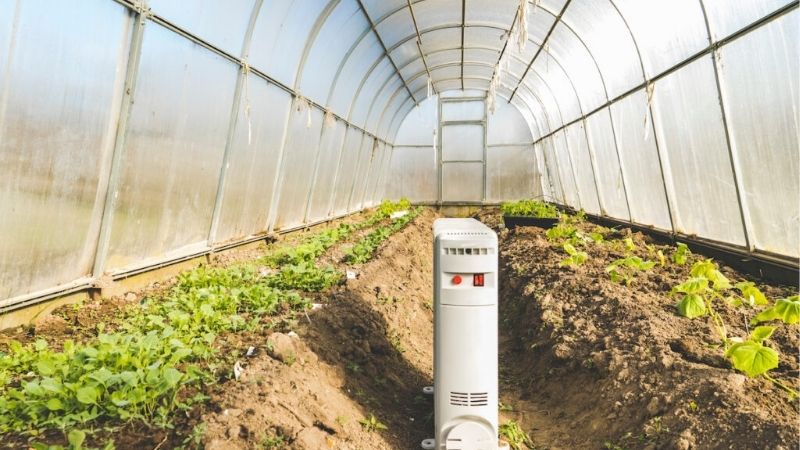
Plants do not care how large a heater’s advertised coverage sounds. They need enough heat to offset the cold escaping through glazing, gaps, and the door. A purpose-built greenhouse heater should also tolerate a humid growing space, offer usable temperature control, and work with the electrical circuit already available. This guide compares five real electric models, from a compact manual unit to a 240-volt heater for more demanding structures. Treat splash resistance and a safe power connection as requirements, not upgrades.
Quick Verdict: The Bio Green Palma PAL 2.0/USDT is our Best Overall choice for a modest hobby greenhouse because it combines 1,500 watts, an external digital thermostat, and manufacturer-stated IPX4 splash protection. For stronger heating with suitable 240-volt power, consider the Bio Green Phoenix PHX2.8/US. These are editorial picks based on manufacturer documentation as of October 2026, not hands-on tests. Check current prices and verify the model’s electrical requirements before ordering.
As an Amazon Associate we earn from qualifying purchases.
By DIY Ideas 4 Home Editorial Team
5 Best Greenhouse Heaters Reviewed
We compared published output, power requirements, temperature-control method, splash-resistance claims, construction, and U.S. seller pricing in October 2026. Our shortlist uses manufacturers’ product pages and model-specific specifications rather than simulated performance tests. The listed prices ranged from $59.90 for the manual VEVOR to $344.99 for the 240-volt Phoenix when checked; prices and stock can change. All five candidates are marketed for greenhouse use, but their electrical installation and heating patterns differ substantially.
| Product | Best For | Key Spec | Listed Price (as of October 2026) | Watch Out For |
|---|---|---|---|---|
| Bio Green Palma PAL 2.0/USDT | Best Overall | 1,500 W, 120 V; IPX4 claimed; digital probe | $229.99 | Cannot offset unlimited glazing heat loss |
| VEVOR BG-E2A-15 | Best For Manual Heating | 1,500 W, 120 V; IPX4 claimed; 152 CFM | $59.90 | No included digital remote thermostat |
| Dr. Infrared Heater DR218-1500W | Best For Dial Control | 1,500 W, 120 V; IPX4 claimed; thermostat | $119.99 | 13 lb steel body takes floor space |
| Dr. Infrared Heater DR-268 | Best For Mounted Infrared Heat | 1,000/1,500 W, 120 V; IPX5 claimed | $169.90 | Infrared aim matters more than airflow |
| Bio Green Phoenix PHX2.8/US | Best For 240-Volt Power | Up to 2,800 W, 240 V; IPX4 claimed | $344.99 | Requires compatible dedicated power |
Bio Green Palma PAL 2.0/USDT: Best Overall
Best For: Growers protecting a compact greenhouse who want an adjustable crop-level sensor rather than an approximate heat dial.
The Palma earns the top position because its separate digital control makes it easier to establish a repeatable temperature at the growing bench. The fan circulates warmth instead of relying on a hot spot next to the heater, while the stainless housing and claimed splash resistance address greenhouse moisture better than an ordinary living-room tower heater. Its limitation is capacity: even a carefully controlled 1,500-watt appliance cannot maintain tropical temperatures through large single-pane walls in deep winter.
Bio Green’s product page for the PAL 2.0/USDT confirms 750-watt and 1,500-watt output selections on a standard 120-volt supply, with approximately 5,120 BTU per hour at full output. Its included Thermo 2 digital controller uses a movable sensor and a heating or ventilation setting; the manufacturer specifies IPX4 protection for the heater. The U.S. product page showed $229.99 in October 2026. That is a premium to the VEVOR’s simpler controls, not a claim that equal wattage produces more heat.
The cabinet weighs 4.5 pounds and measures 11 inches high, 8 inches wide, and 12.5 inches deep. Bio Green’s Palma documentation also describes a roughly 6.2-foot power cable and a separate sensor lead. Arrange the controller outside direct sun, protect connections from irrigation, and check that the seller supplies the U.S. plug version. Bio Green states a two-year replacement warranty; the fan and sensor are additional components worth inspecting before each heating season.
Pros:
- Selectable 750-watt stage helps temper milder nights without full output.
- Movable digital sensor measures temperature near the crop rather than heater.
- Manufacturer lists IPX4 protection and two-year replacement warranty coverage.
Cons:
- $229.99 manufacturer’s price is steep for 1,500-watt heat delivery.
- The separate controller and sensor need thoughtful protection from watering.
Who Should Buy It: Choose the PAL 2.0/USDT for everyday temperature management; if your glazing losses demand a 240-volt heater, choose the Bio Green Phoenix PHX2.8/US instead.
VEVOR BG-E2A-15: Best For Manual Heating
Best For: Gardeners who already have a compatible heating-control plan and prefer lower purchase cost over programmable precision.
VEVOR makes sense where spending almost four times as much on the Palma would leave less money for weatherstripping and glazing repairs. It supplies the familiar fan-forced heat and aims the stream through a tilting housing, so you can direct the outlet down a narrow plant aisle. This specific listing is the manual version, however. It is not a substitute for a correctly rated remote thermostat when a precise minimum temperature must be held while the greenhouse is empty.
VEVOR’s product page for SKU WSJRQDRGWDLWH047R002V1 identifies item model BG-E2A-15, rated at 1,500 watts on 120-volt AC, with manufacturer-stated IPX4 splash resistance and overheat shutoff. The same specification table quotes 152 cubic feet per minute of airflow. The current direct price shown was $59.90 in October 2026. Do not confuse it with VEVOR’s separate thermostat-equipped listing: some pages reuse the BG-E2A-15 identifier despite different weights and housings, so check the exact seller SKU before checkout.
It weighs 6.4 pounds and has an 8.35-inch by 9.8-inch by 12.8-inch body, this model suits a stable surface that is not exposed to pooling water. A metal housing helps with daily handling but does not make the cord connection waterproof. Clean dust from the air intake with the unit unplugged and cool; blocked airflow can trigger the overheat protection. If the controls or plug specification on the received product do not match its own manual, do not improvise an external controller.
Pros:
- Its $59.90 direct price leaves room in the frost-protection budget.
- VEVOR publishes 152 CFM airflow for its specific manual model.
- Manufacturer claims IPX4 splash protection plus automatic overheat cutoff.
Cons:
- Manual version lacks the Palma’s separate digital temperature sensing probe.
- Confusing cross-listing of model numbers demands careful SKU matching.
Who Should Buy It: Buy BG-E2A-15 for supervised, simple heat delivery; select the Dr. Infrared Heater DR218-1500W if you need an integrated thermostat dial.
Dr. Infrared DR218-1500W: Best For Dial Control
Best For: Owners who prefer a rugged metal floor heater with an onboard thermostat and a conventional 120-volt plug.
The DR218-1500W occupies a useful middle ground between the low-priced manual VEVOR and the digital Bio Green. Its thermostatic dial is built into the heater, so there is no loose probe wire to manage around potting benches. A thermally protected fan motor and steel case are sensible features for a working greenhouse where equipment is carried in and out. The compromise is less precise control at a remote plant tray than the Palma’s independent sensor can provide.
Dr. Infrared Heater’s DR-218 product page specifies 1,500 watts at 120 volts for the DR218-1500W variant, with IPX4 splash protection, adjustable thermostat control, and built-in overheat protection. Greenhouse Megastore’s DR-218 specification page gives a 32 to 104 degree F thermostat range for the 1,500-watt option and links the DR-218 owner’s manual. The maker’s page displayed $119.99 for the product line in October 2026; confirm that the selected 120-volt variant is priced at that amount before paying, since the listing also carries a separate 3,000-watt variant.
Its published weight is 13 pounds, and Greenhouse Megastore lists a six-foot cord. The substantial metal case is less convenient to move over raised thresholds than the 4.5-pound Palma, but its enclosed motor design is intended for workshop and growing-space use. Keep the intake free of seed-starting mix, leaf litter, and potting dust. An unattended crop-protection strategy should include an independent low-temperature alarm rather than relying on any one heater’s dial alone.
Pros:
- Integrated thermostat spans the maker-listed 32 to 104 degree F range.
- Dr. Infrared specifies a heavy-duty motor with thermal protection.
- IPX4-rated housing is marketed specifically for damp growing spaces.
Cons:
- Its 13-pound body is heavier than the other 120-volt fan picks.
- Thermostat senses near the unit, not at a distant seedling shelf.
Who Should Buy It: The DR218-1500W suits gardeners who want uncomplicated dial control; choose the Dr. Infrared Heater DR-268 when floor space is more valuable than circulating airflow.
Dr. Infrared DR-268: Best For Mounted Infrared Heat
Best For: Growers with crowded floors who can safely mount a heater above or beside a defined plant zone.
The DR-268 takes a different approach from the fan heaters: it delivers radiant warmth toward surfaces in its path. That can be useful for a long workbench or a designated section of a greenhouse where pots occupy nearly every square foot of floor. It is not automatically cheaper to run than a resistive fan unit at the same wattage, and leaves or trays hidden behind other objects may receive less direct warmth. Placement, beam direction, and mounting clearances therefore determine whether its shape solves your problem.
Dr. Infrared Heater’s DR-268 product page specifies selectable 1,000-watt and 1,500-watt heat, built-in digital temperature regulation, a corded sensor probe, and wall, ceiling, or suspended mounting options. The manufacturer describes IPX5 water resistance and also references IP55 on the same page; those codes are not interchangeable, so verify the labeling on the shipped unit and its owner’s manual. The manufacturer says it is ETL listed, but this comparison does not independently confirm the specific listing in the laboratory database. Its maker price was $169.90 in October 2026.
Wayfair’s DR-268 listing gives dimensions of 34.6 inches wide, 7.69 inches high, and 3.33 inches deep, with an 8.6-pound overall weight and 72-inch cord. That slim but long body needs sound supports above vegetation, and installation must respect the manufacturer’s minimum distances from flammable covering, shelves, or anything that could touch the heating face. The retailer lists a one-year limited warranty. Check the bracket hardware and probe routing before buying, particularly if the ceiling frame is lightweight aluminum.
Pros:
- Choice of 1,000-watt and 1,500-watt settings suits a focused area.
- Wall, ceiling, or chain mounting frees valuable greenhouse floor space.
- Separate temperature probe works with the built-in digital control display.
Cons:
- Infrared line of sight leaves shadowed pots less directly heated.
- Mounting on lightweight greenhouse framing may require professional reinforcement.
Who Should Buy It: Pick the DR-268 for a mounted crop zone; buy the Bio Green Palma PAL 2.0/USDT when broad air circulation matters more than radiant direction.
Bio Green Phoenix PHX2.8/US: Best For 240-Volt Power
Best For: Owners of larger, insulated hobby greenhouses with a suitable 240-volt circuit and a heat-loss calculation.
The Phoenix addresses a problem none of the standard 120-volt choices can fix: a cold greenhouse may lose heat faster than 1,500 watts can replace it. Higher output makes sense only when the wiring can supply it, and that should be settled before the heater is ordered. Its fan also works without active heating, which can help distribute temperature more evenly through a longer structure. The premium here buys additional heating capacity, not a magical efficiency advantage over other resistance heaters.
Bio Green’s product page for the Phoenix PHX2.8/US describes three selectable capacities of 1,000, 1,800, and 2,800 watts, delivering up to approximately 9,554 BTU per hour at the maximum setting. It specifies 240-volt, 60-hertz power, a mechanical thermostat marked from 32 to 79 degrees F, and manufacturer-stated IPX4 splash protection. The currently displayed U.S. price was $344.99 in October 2026, higher than some older cached prices. The company advertises a two-year product warranty, though a licensed electrician may add a separate installation cost.
The heater weighs 5.5 pounds and measures 16 inches tall, 8.7 inches wide, and 13 inches deep according to the Phoenix technical-data table. Its floor-standing or hanging arrangement gives room for an aisle, but the 240-volt supply must use an appropriate dedicated circuit and matching receptacle; a 120-volt adapter is not a solution. Inspect the unit’s manual for the actual plug configuration and mounting allowances. If humidity, condensation, or plant debris has damaged the housing, seek repair service rather than continuing operation.
Pros:
- Maximum 2,800-watt output exceeds every 120-volt pick in this guide.
- Three heating capacities allow smaller loads before full winter operation.
- Manufacturer specifies IPX4 resistance and two-year replacement warranty terms.
Cons:
- A compatible 240-volt receptacle may require electrician-installed infrastructure.
- Mechanical thermostat gives less readable temperature selection than a digital probe.
Who Should Buy It: Buy the PHX2.8/US only after confirming the circuit and heating load; for a 120-volt structure choose the Dr. Infrared Heater DR218-1500W instead.
How to Choose a Greenhouse Heater
Start with the temperature your plants actually require, the expected outdoor low, and the square footage of exposed roof and wall material. North Carolina State Extension explains that heat demand depends on the target indoor temperature, climate, greenhouse construction, and total exposed surface area. That is why the same heater may protect seedlings in one insulated 6-by-8-foot house yet struggle in a drafty structure of identical floor area. Once the load is understood, match that requirement to a safe electrical supply rather than relying on box-advertised coverage alone.
Calculate Heating Capacity From Heat Loss
All five products have manufacturer-published maximum outputs, making wattage the cleanest first comparison. The Palma, VEVOR, DR218-1500W, and DR-268 top out at 1,500 watts, roughly 5,100 BTU per hour for electric resistance heating. The Phoenix reaches 2,800 watts and about 9,550 BTU per hour. Larger numbers mean more available heat, but not a promise that a particular greenhouse will reach a specified indoor temperature. A heated greenhouse with a leaky door can lose much of its advantage on a windy night.
Oklahoma State University’s Hobby Greenhouse guidance bases heater sizing on the glazing’s exposed area, the indoor-to-outdoor temperature difference, and the covering construction. Ask a greenhouse supplier to calculate the winter heat load for your actual panel type and local design temperature, then check whether the heater can cover that load with some margin. A maker’s suggested area, such as Bio Green’s Palma estimate around 130 square feet, is a conditional marketing guide rather than a climate-independent engineering rating.
Check Water Protection and Electrical Supply
These electric models are marketed for damp growing spaces, but splash resistance has limits. Bio Green, Dr. Infrared Heater, and VEVOR state IPX4 for their selected fan models; the DR-268 product page claims IPX5 while also mentioning IP55. Those are manufacturer statements rather than independent certification checks. Neither rating means that a plug, switch, controller, or connector may sit in standing water. Match the precise U.S. variant’s label and manual to your greenhouse watering patterns.
The Electrical Safety Foundation International’s 2026 GFCI guidance explains that damp and outdoor locations need ground-fault protection. Have a qualified electrician install and test a suitable receptacle if one is missing. The U.S. Consumer Product Safety Commission’s 2026 heater guidance also says to plug portable electric space heaters directly into the wall, not into extension cords or power strips, and maintain at least three feet from combustible materials. Greenhouse plastic film, cardboard flats, plant ties, and dry mulch can create hazards; follow the model’s specified clearances if more restrictive. A 1,500-watt heater draws about 12.5 amps at 120 volts, so do not assume the same circuit can run another high-load appliance.
Choose Control Where the Plants Grow
A thermostat reading air by the heater may not reflect the temperature at the coldest leaf or pot. UC Davis greenhouse-climate guidance recommends keeping temperature sensing in a representative location at crop height and out of direct sunlight. That is why the Palma’s remote digital sensor is persuasive for a seed-starting bench, while the DR-268’s probe can support a defined radiant zone. The DR218-1500W’s integral dial is simple to operate, but growers should confirm what actually happens at a distant shelf with an independent min-max thermometer.
Temperature control is particularly relevant in October and November when days may be mild but clear nights cool rapidly. Set the target for the species you grow rather than picking a generic greenhouse number. Test the heater during a supervised cold evening, then inspect morning minimum temperatures at the most vulnerable containers. A backup alarm and a sensible frost-management plan matter more than any manufacturer’s unverified claim that a product covers a set floor area.
Budget for Electricity and Seasonal Upkeep
Purchase price is only the beginning. At an illustrative electricity rate of 18 cents per kilowatt-hour, a 1,500-watt unit running at full output for eight hours each day for 30 days costs roughly $65. That example is not a predicted bill: weather, glazing, the chosen temperature, and thermostat cycling can change actual hours dramatically. A 2,800-watt heater uses more electricity whenever its full stage is energized, though it may run fewer hours if correctly sized. Insulation improvements often deserve priority before buying a larger machine.
For ongoing ownership, clear dust and dead leaves from fan inlets, check for corrosion, inspect cords, and confirm that thermostat sensors have not been knocked into direct sunlight or a watering spray. Do all cleaning only after disconnecting power and allowing the heater to cool. Bio Green currently advertises two-year coverage for its two picks; Wayfair lists one-year limited coverage for the DR-268, while other warranty terms should be confirmed on the precise seller listing before purchase. Compare total installed cost, including a properly protected receptacle, not the sticker price alone.
Frequently Asked Questions
Even a well-specified heater is only one part of protecting crops through a cold season. These questions cover the fuel choices and operating situations that do not appear in a simple wattage comparison.
Can I Use a Propane Heater in a Greenhouse?
Not an unvented portable propane heater as a routine crop-heating solution. North Carolina State Extension advises that combustion systems in greenhouses be vented outdoors and explicitly discourages unvented propane and kerosene units. Alabama Cooperative Extension warns that combustion byproducts including ethylene can damage sensitive greenhouse plants. For a large structure without practical electric capacity, discuss a properly vented, professionally installed greenhouse heating system and carbon monoxide protection with a qualified contractor.
Can a Heater Stay On Overnight in a Greenhouse?
Only when its manufacturer’s instructions specifically permit the intended unattended operation and the installation meets applicable electrical and fire-safety requirements. CPSC’s 2026 consumer guidance says portable space heaters should be turned off while sleeping. Do not interpret a thermostat or overheat cutoff as permission to ignore that warning. If crops require reliable unattended overnight heating, ask a qualified installer about permanently installed greenhouse-rated equipment, monitoring, and backup protection rather than treating a portable model as fail-safe.
Will a Seedling Heat Mat Replace an Air Heater?
No. A seedling heat mat targets the root-zone environment of trays, while the models compared here add heat to air or exposed surfaces over a larger portion of the greenhouse. Root warming can be useful for propagation when the surrounding space is cool, but it does not protect foliage, irrigation lines, or other plants from freezing air. Choose the protection based on the crops’ root and leaf temperature needs, and use a mat only as its manufacturer directs.
Is a Solar-Powered Heater Practical for Winter?
Usually not as a simple panel-to-heater arrangement for overnight frost protection. Solar panels make power when the sun is available, while the greatest heating demand often arrives after dark. A battery, inverter, charge controller, and adequately sized solar array may be needed, and the cost can exceed that of a correctly installed electric circuit. For a small greenhouse, start with reducing heat loss and consider passive daytime heat storage before buying a product that promises free nighttime warmth.
Final Thoughts
For a modest, wired growing space, the Bio Green Palma PAL 2.0/USDT remains our Best Overall greenhouse heater because the remote digital thermostat, manufacturer-stated IPX4 protection, and 1,500-watt output form a useful combination without changing to 240-volt power. The deciding exception is a calculated heating load beyond that capacity: then the Bio Green Phoenix PHX2.8/US may be a better purchase, provided a qualified electrician confirms its supply and clearances. Before ordering either one, identify the coldest plant location, document the glazing heat-loss requirement, check the CPSC recall database by exact model, and confirm today’s price and safety labeling on the seller’s listing.