Key takeaways
- Slat spacing and thickness: Look for slats no more than 3 inches apart with a center support rail. Wide-spaced thin slats sag first, and a sagging top bunk pushes uneven load onto the side rails. If yours ship thin, adding a plywood deck cut to size is a 20-minute fix.
- Fastener type over fastener count: Machine bolts threading into steel barrel nuts or metal inserts will stay tight far longer than screws biting bare particleboard. Check the parts diagram before you buy and keep the supplied hex key taped inside the frame for retorquing.
- Stairs versus ladder: Stairs with storage drawers eat floor space but are dramatically easier for young kids and let you skip the nightly hand-over-hand climb. Ladders keep the footprint tight and usually detach, which makes moving the bed a two-person job instead of four.
- Ceiling and mattress math: Measure from floor to ceiling, subtract the top deck height, then subtract your mattress thickness. You want at least 30 inches of sitting clearance above the top mattress, and the mattress should sit below the guardrail top edge by 5 inches minimum.
- Convertibility: Frames that split into two standalone beds or add a trundle stretch the useful life of the purchase by years. Confirm both halves get their own legs and rails rather than borrowing parts from each other.
What's inside
Anyone who has assembled a bunk bed on a Saturday morning knows the real test comes six months later. The frame that felt rock-solid on assembly day starts announcing every roll-over with a creak, the ladder rungs develop a little flex, and the guardrail bolts have quietly backed off a quarter turn. Bunk beds live under load, in motion, in a room where two kids treat the bottom bunk like a trampoline. Most of the complaints people post are not about looks or price. They are about hardware quality, slat support, and whether the thing stays tight.
This guide looks at bunk beds the way you would size up a project on the bench: joint design, fastener count, how the load travels down the posts, and how much of the assembly you can actually service later with a hex key. I have flagged which models reward a careful build, which ones benefit from a few cheap upgrades, and which layouts genuinely convert into separate beds when the kids outgrow the stack.
As an Amazon Associate we earn from qualifying purchases.



How to Choose a Bunk Bed Best (2026)
- Slat spacing and thickness: Look for slats no more than 3 inches apart with a center support rail. Wide-spaced thin slats sag first, and a sagging top bunk pushes uneven load onto the side rails. If yours ship thin, adding a plywood deck cut to size is a 20-minute fix.
- Fastener type over fastener count: Machine bolts threading into steel barrel nuts or metal inserts will stay tight far longer than screws biting bare particleboard. Check the parts diagram before you buy and keep the supplied hex key taped inside the frame for retorquing.
- Stairs versus ladder: Stairs with storage drawers eat floor space but are dramatically easier for young kids and let you skip the nightly hand-over-hand climb. Ladders keep the footprint tight and usually detach, which makes moving the bed a two-person job instead of four.
- Ceiling and mattress math: Measure from floor to ceiling, subtract the top deck height, then subtract your mattress thickness. You want at least 30 inches of sitting clearance above the top mattress, and the mattress should sit below the guardrail top edge by 5 inches minimum.
- Convertibility: Frames that split into two standalone beds or add a trundle stretch the useful life of the purchase by years. Confirm both halves get their own legs and rails rather than borrowing parts from each other.
The Best Bunk Bed Best (2026)s Reviewed
Twin Over Twin with Stairs, Storage Drawers and LED Lights
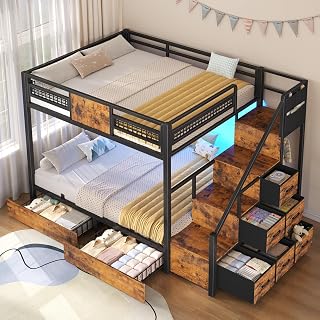
The eight-drawer staircase and hanging area do the work of a dresser and a small closet, which makes this the pick for a shared room with no storage to spare. The steel frame goes together with bolts rather than cam locks, so a seasonal retorque with a hex key keeps it silent.
Max & Lily Fundamental Twin Low Bunk
Solid pine, thick slats, and a low overall height make this the most forgiving build on the list, both for younger kids and for anyone assembling alone. The non-toxic finish takes paint or stain well if you want to match existing furniture, and the chunky posts leave room to add corner blocks later.
Full Over Full Bunk Bed with Trundle
Two full mattresses plus a trundle gives you three sleeping spots in one footprint, and the frame separates into a pair of platform beds when the sleepover phase ends. Worth the extra assembly time for guest rooms and teen shares.
Merax Twin Over Full with Removable Ladders
The twin-over-full layout handles the common sibling age gap well, and the two under-bed drawers ride on the frame rather than the floor. Removable ladders and true convertibility mean you are not rebuying a bed in four years.
Full Size Bunk Bed with Desk and Charging Station
A built-in desk, five drawers, and USB charging turn this into a complete study setup for a small bedroom. Route the charging cable along the interior post with a couple of adhesive clips so nothing dangles near the ladder.
Frequently Asked Questions
How often should I retighten the hardware?
Check every bolt after the first two weeks, then every three to four months. Wood frames move with seasonal humidity and steel frames settle under repeated load, so a five-minute pass with the hex key prevents most creaking and wobble.
Can I add plywood under the mattress?
Yes, and a 1/2-inch plywood deck cut to the interior rail dimensions is a solid upgrade for thin slat systems. Drill a few 2-inch vent holes so the mattress can still breathe.
What age is safe for the top bunk?
The CPSC recommends children be at least 6 years old before sleeping on an upper bunk, with full-length guardrails on both sides and a securely fastened ladder or stairs.
Do metal or wood bunk beds hold up better?
Metal frames with bolted joints resist racking and usually carry higher weight ratings. Solid wood is quieter, easier to repair, and more forgiving if you want to refinish it down the road.
Final Thoughts
For a shared kids’ room where storage is the real constraint, the Twin Over Twin with Stairs and eight drawers earns its footprint. The Max & Lily Fundamental Low Bunk is the one I would hand to a first-time builder or a younger sleeper, and the Full Over Full with Trundle is the smart long-game buy for teens and guest rooms. Whichever you pick, budget an extra hour for a careful build and keep that hex key handy.