Key takeaways
- A 40 millimeter M2 conical steel burr rated by the maker.
- Forty stepped positions split for espresso and for filter.
- Ships with a 54 millimeter dosing cup and a 58 millimeter adapter.
A burr coffee grinder decides more about your cup than the brewer does, because it sets how evenly the coffee is cut before water ever touches it. The six machines here are all electric burr models aimed at filter, espresso, or both, which rules out blade choppers and hand cranks. Keep fingers and utensils away from moving burrs, and unplug any grinder before you open it for cleaning or burr removal.
Quick Verdict: The Baratza Encore ESP is our Best Overall choice because its 40 millimeter conical steel burr offers 40 stepped positions split at 1 to 20 for espresso and 21 to 40 for filter, with a dosing cup in the box. This is an editorial pick based on published specs as of October 2026, not in-house testing. Check the current price and confirm the white variant is in stock before you buy.
As an Amazon Associate we earn from qualifying purchases.
By DIY Ideas 4 Home Editorial Team
The Best Burr Coffee Grinders Reviewed
We compared currently listed US grinders using each maker’s product page, the model instruction guide where it was reachable, and retailer listings for the exact color. The measures that count are the burr type and size, the adjustment method and range, whether the maker supports espresso, the dosing workflow, and the footprint. Listed prices here span about $74.95 to $199.95 as of October 2026. A step count cannot be a single ranking number, since a stepless dial and a 40 click collar describe different systems, so we compare fit rather than invent a precision score.
| Product | Best For | Key Spec | Listed Price (as of October 2026) | Watch Out For |
|---|---|---|---|---|
| Baratza Encore ESP (White) | Best Overall | 40 mm conical; 40 positions; dosing cup | $199.95 | Fine espresso steps are not stepless |
| OXO Brew 8717000 | Best for Filter Coffee | Conical burrs; 15 settings plus micro | $109.99 | Not built for fine espresso micro-tuning |
| Cuisinart Supreme Grind DBM-8P1 | Best Budget | Burr mill; 18 settings; 4 to 18 cup dial | $74.95 | Exact burr geometry not documented |
| Fellow Opus 2 (Matte Black) | Best for Stepless Tuning | 48 mm conical; stepless adjustment | $199.95 | No click count to compare numerically |
| Breville Smart Grinder Pro BCG820BSSXL | Best for Timed Dosing | Conical; 60 settings; 1 lb hopper | $199.95 | Timer is not a built-in scale |
| Baratza Encore ZCG485 (Black) | Best for Repairability | Conical; 40 positions; filter-first | $149.95 | Less suited to fine espresso dialing |
Baratza Encore ESP: Best Overall for Espresso and Filter
Best For: Home brewers who want one grinder that dials in espresso and still handles pour-over without a second machine.
The reason the Encore ESP leads is balance rather than a single standout number. It covers espresso and filter from one collar, and it ships with a dosing cup and a 58 millimeter adapter so grounds go where you want them. Against the stepless Fellow it trades continuous adjustment for defined clicks, which some tinkerers will miss, but those steps make a repeatable recipe easy to return to. Pure filter drinkers can save money with a simpler machine.
Baratza’s product page for the Encore ESP lists a manufacturer-stated 40 millimeter M2 conical steel burr and 40 stepped positions, divided at 1 to 20 for espresso and 21 to 40 for filter, plus a 54 millimeter dosing cup and quick-release burr. The maker quotes a 100 to 120 volt US model drawing 70 watts, with a one-year warranty, at a listed $199.95 as of October 2026. Choose the white variant, since a black version showed out of stock in one brand result.
By the maker’s figures the grinder stands about 13.4 inches tall and 5.1 inches wide, a labeled conversion from Baratza’s metric dimensions, with a modest 10.6 ounce hopper. That smaller hopper and manual dosing mean it suits brew-by-brew grinding rather than storing a week of beans. The quick-release burr is the part that makes cleaning realistic, and Baratza sells first-party replacement components, which is the quiet case for buying into its ecosystem.
Pros:
- A 40 millimeter M2 conical steel burr rated by the maker.
- Forty stepped positions split for espresso and for filter.
- Ships with a 54 millimeter dosing cup and a 58 millimeter adapter.
Cons:
- Fine espresso steps are defined clicks, not continuous adjustment.
- Smaller hopper and manual dosing than large timed grinders.
Who Should Buy It: Buy the Encore ESP for one grinder that spans espresso and filter; pick the OXO Brew 8717000 if you only brew filter and want a lower price.
OXO Brew 8717000: Best for Filter Coffee
Best For: Drip, pour-over, and press drinkers who want repeatable filter grinds with a simple timed button.
The OXO earns its place as the filter specialist, not an espresso contender. Its one-touch grind-time memory means you press once and get the same dose each morning, which is exactly what a filter routine wants and a world away from the espresso-first Encore ESP. The honest limit is range: this grinder is not meant for the fine, pressurized espresso micro-tuning that the Fellow or Breville chase, and marketing a fine mark does not change that.
OXO’s product page lists manufacturer-stated stainless steel conical burrs with 15 major settings plus microsettings, a 12 ounce UV-tinted bean hopper, a DC motor, and a two-year limited warranty, at a listed $109.99 as of October 2026. The maker describes its range broadly rather than claiming espresso optimization, so treat the microsettings as fine-tuning within filter territory rather than proof of true espresso capability.
The 8717000 measures 6.8 inches wide, 11.8 inches deep, and 14.8 inches tall, and weighs about 5.6 pounds, so it is taller than it looks and wants cabinet clearance for the hopper lid. The 0.75 pound hopper stores beans between sessions, which also means some grounds retain in the path and need an occasional brush-out. Keep the burrs dry, empty the hopper before deep cleaning, and never rinse the motor base.
Pros:
- One-touch grind-time memory repeats the same filter dose.
- 15 settings plus microsettings cover drip, pour-over, and press.
- A 12 ounce hopper with a two-year limited warranty.
Cons:
- Not built for fine, pressurized espresso micro-tuning.
- A hopper workflow retains some beans between drinks.
Who Should Buy It: Choose the OXO for a tidy filter routine; move to the Baratza Encore ESP if espresso is part of your week.
Cuisinart Supreme Grind DBM-8P1: Best Budget
Best For: New grinders on a tight budget who brew drip coffee and want automatic dosing by the cup.
The DBM-8P1 is the value entry, and it keeps things conventional. A cup-count dial and automatic stop let you set how many cups you want and walk away, which is friendlier for a drip household than any espresso collar. It is the clear price leader against the premium Fellow and Breville, but it asks for a tradeoff in detail: the exact burr geometry is not documented in the maker copy we reviewed, so we describe it plainly rather than claim a flat burr it may not have.
Cuisinart’s product page lists a manufacturer-stated burr mill with 18 grind settings, a 4 to 18 cup selector, automatic stop, and an 18-month limited warranty, at a listed $74.95 as of October 2026. The cup dial doses by volume rather than by weight, so it is a convenience proxy, not a scale. Because the brand does not confirm whether the burr is flat or conical in the copy we saw, we leave that claim open until an exploded diagram settles it.
Retail specifications place the DBM-8P1 at about 12.2 inches high and 8.7 inches wide, a compact tower that fits most counters without fuss. The hopper and grounds bin lift out for emptying, and the burrs should be brushed clean between beans so old oils do not taint fresh coffee. As with every grinder here, unplug it before opening the burr chamber and keep the motor base away from water.
Pros:
- Lowest price here at $74.95 as of October 2026.
- Automatic stop with a 4 to 18 cup quantity dial.
- 18 advertised grind levels for everyday drip coffee.
Cons:
- Exact burr geometry is not documented by the maker copy.
- Doses by cup volume, with no weight-based control.
Who Should Buy It: Pick the DBM-8P1 to start grinding cheaply; choose the Fellow Opus 2 when you want stepless control to experiment.
Fellow Opus 2: Best for Stepless Tuning
Best For: Hobbyists who like to chase a dial-in and want continuous adjustment from espresso to cold brew.
The Opus 2 is built for experimentation, which is a different mindset from the stepped Encore ESP. Its side dial moves without clicks, so you can nudge the grind by the smallest amount rather than jumping a full position, and an anti-static ionizer helps keep fine grounds from scattering. The flip side is that there is no click number to compare against a 40 step rival, so you learn the feel of the dial rather than reading off a scale.
Fellow’s product page for the Opus 2 lists a manufacturer-stated 48 millimeter stainless steel conical burr, stepless side adjustment spanning espresso through cold brew, an integrated ionizer, and a catch cup compatible with 54 and 58 millimeter baskets, at a listed $199.95 as of October 2026. This is the second-generation Opus with a larger burr than the original, so older position counts from the first Opus should not be carried over to it.
The Opus 2 measures 8.1 inches deep, 5.1 inches wide, and 10.5 inches tall, and weighs about 5.1 pounds, drawing 300 watts, so it is a slim machine that disappears on a counter. Single dosing suits it, since it is designed to grind what you weigh out rather than store a hopper for days. Brush the burrs regularly, and remember that a stepless dial rewards notes: write down the setting that worked so you can return to it.
Pros:
- A 48 millimeter conical burr larger than the first Opus.
- Stepless adjustment spans espresso through cold brew.
- Anti-static ionizer with a 54 and 58 millimeter catch cup.
Cons:
- No numeric click count to compare with stepped models.
- The $199.95 price is premium against basic filter grinders.
Who Should Buy It: Choose the Opus 2 to tune grind by feel; pick the Breville Smart Grinder Pro if you prefer a timed dose straight into a portafilter.
Breville Smart Grinder Pro BCG820BSSXL: Best for Timed Dosing
Best For: Espresso-to-press drinkers who want a timed dose dropped straight into a portafilter cradle.
The Smart Grinder Pro is the dosing workhorse here. Its grind timer and portafilter cradle let you dose by time into the basket, which is a hands-free convenience the single-dose Fellow does not chase. The caveat is to read the timer for what it is: a repeatable time setting, not a scale, so weight can drift as beans age or the hopper empties. Buyers chasing a built-in weight readout will not find one on this model.
Breville’s instruction manual for the BCG820 lists a manufacturer-stated conical burr with 60 grind settings from espresso to press, a Dosing IQ grind timer, a 1 pound locking hopper for longer batches, and included 50 to 54 and 58 millimeter cradle attachments, at a listed $199.95 as of October 2026 from the brand color catalog. Confirm the brushed steel BCG820BSSXL option is the one selected at checkout, since finishes carry different SKUs.
Retail specifications put the grinder at about 15.25 inches tall, 6.25 inches wide, and 8.5 inches deep, so the 1 pound hopper makes it the tallest machine here and demands cabinet clearance. That larger hopper favors households grinding many drinks, with the tradeoff of more retained beans than a single-dose design. Lock the hopper before removal, brush the burrs and chute regularly, and keep the base dry as the manual directs.
Pros:
- 60 settings from espresso to press per the official manual.
- A 1 pound locking hopper suited to extended batches.
- Timed dosing into 50 to 54 and 58 millimeter cradles.
Cons:
- The grind timer is not a built-in weighing scale.
- Bigger hopper workflow retains more than a single-dose unit.
Who Should Buy It: Pick the Smart Grinder Pro for timed portafilter dosing; choose the OXO Brew 8717000 if a simpler filter-only grinder is all you need.
Baratza Encore ZCG485: Best for Repairability
Best For: Filter drinkers who value a fixable, long-lived machine over fine espresso precision.
The standard Encore is the filter-first sibling of the ESP, and its appeal is longevity. Baratza supports it with first-party replacement parts and service, so a worn component means a repair rather than a landfill, which sets it apart from cheaper disposable grinders. It is not the one to pick if espresso is your focus, since it lacks the ESP dosing cup and fine low-number steps, and it costs less precisely because it skips that espresso tuning.
Baratza’s product page for the Encore ZCG485 lists a manufacturer-stated 40-position electric conical burr grinder described as a filter-first machine, with pulse operation and an official replacement-part catalog, at a listed $149.95 as of October 2026. That is $50 below the Encore ESP, and the gap buys the ESP its espresso-oriented fine adjustment and dosing cup, so the plain Encore makes sense only when espresso is not on your list.
Retail specifications place the ZCG485 at roughly 13 inches tall, 5 inches wide, and 6 inches deep, the familiar slim Encore tower. Pulse grinding lets you add a short burst for a single dose, and the serviceable design means burrs and gears can be swapped rather than the whole unit replaced. Keep the burrs clean and dry, unplug before opening, and lean on Baratza’s parts program when something eventually wears.
Pros:
- 40 stepped settings documented for filter brewing.
- First-party replacement parts and service from Baratza.
- Listed at $149.95, below the Encore ESP price.
Cons:
- Less suited to fine espresso dialing than the Encore ESP.
- No dedicated dosing cup for guided portafilter dosing.
Who Should Buy It: Choose the ZCG485 for a repairable filter routine; pick the OXO Brew 8717000 if a timed button matters more than a parts program.
How to Choose a Burr Coffee Grinder
A grinder is a long-term purchase, so match it to the coffee you actually brew rather than the highest setting count. Before choosing from these six, decide whether you need espresso fineness or only filter range, how much adjustment control you want, and how much counter height you can give a hopper. Watts and settings describe the machine, not the taste, so read them as features and not scores.
Confirm a True Burr Mechanism
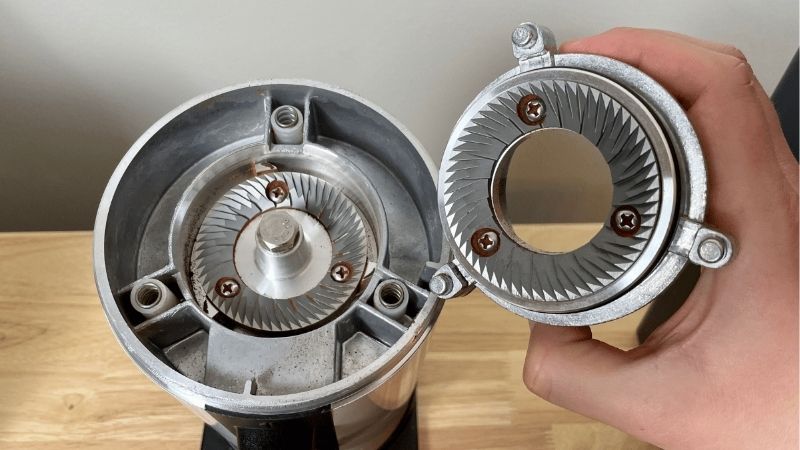
Every pick here uses burrs, which crush beans between two surfaces for a more even cut than a blade’s random chop. Most are conical steel, like the Baratza and Fellow burrs, and burr geometry affects feel more than a raw diameter does. Where a maker does not document the burr, as with the Cuisinart, it is fair to note the gap rather than assume a flat or conical shape.
Burr size is one input, not a verdict. The Fellow’s 48 millimeter burr is larger than the Baratza ESP’s 40 millimeter burr, but a bigger diameter does not translate directly into better coffee or more throughput. Look at the whole system, the burr type, the adjustment, and the motor, rather than fixating on a single millimeter figure on the box.
Match Adjustment to Espresso or Filter
Adjustment style shapes how you dial in. Stepped collars, like the Baratza 40 positions or the Breville 60 settings, click into repeatable spots that are easy to note and return to. A stepless dial, like the Fellow, moves continuously for the finest nudges but gives you no number to read, so the two approaches cannot be ranked by count against each other.
Espresso asks more of a grinder than filter does, because small changes near the fine end shift extraction sharply. The Encore ESP and Breville are built with espresso in mind, while the OXO and standard Encore lean filter. Decide which drinks you make most, then favor the adjustment style that makes those drinks repeatable rather than the one with the biggest spec.
Weigh Espresso Focus Against Convenience
Dosing workflow is where daily life happens. The Breville doses by timer into a portafilter cradle, the Encore ESP uses a dosing cup, and the Fellow expects you to weigh a single dose. None of these is a scale, so if you want exact weight you will still reach for one separately.
Think about retention and tidiness too. A hopper grinder stores beans but keeps some grounds in the path between drinks, while a single-dose machine grinds only what you weigh in. A household running many cups a day may prefer the hopper convenience of the Breville or OXO, while a precise espresso hobbyist often prefers the lower retention of a single-dose approach.
Plan for Footprint and Cleaning
Height is the sneaky dimension with grinders. The Breville stands around 15.25 inches tall with its 1 pound hopper, so measure the space under your cabinets, including room to lift the hopper lid and remove the catch. A slim machine like the Fellow or Encore fits where a tall hopper grinder cannot.
Cleaning keeps a grinder tasting right. Brush the burrs and chute on a regular schedule so old oils do not sour fresh beans, and follow each maker guide for how far to disassemble. Always unplug before opening the burr chamber, keep fingers clear of the burrs, and never run the motor base under water, which is the fastest way to ruin a grinder.
Frequently Asked Questions
These questions address the choices that specs alone do not resolve, from blade comparisons to cleaning habits, so you can match a grinder to your real routine.
Is a burr coffee grinder better than a blade grinder?
For consistency, yes. A burr grinder cuts beans to a more uniform size between two burrs, while a blade grinder chops randomly and produces a mix of dust and chunks that extract unevenly. Every machine in this roundup uses burrs for that reason. A blade grinder can still make a quick cup, but it cannot deliver the repeatable grind that pour-over and especially espresso rely on, which is why burr models dominate serious home setups.
Do I need an espresso-specific burr grinder?
Only if you pull espresso. Espresso needs a fine, precisely adjustable grind, which is why the Baratza Encore ESP, the Fellow Opus 2, and the Breville Smart Grinder Pro emphasize low-end control. If you brew only drip, pour-over, or press, a filter-focused grinder like the OXO or standard Encore is plenty and usually cheaper. Buying espresso precision you never use is wasted money, so match the grinder to the drinks you actually make.
How often should I clean a burr grinder?
Brush out grounds regularly and do a deeper clean on the schedule your model guide names, more often if you grind oily dark roasts that leave residue. Oils and fines build up in the burrs and chute over time and dull the flavor of fresh coffee. Always unplug the grinder before opening the burr chamber, keep your fingers and any tools away from the burrs, and never rinse the motor base under running water.
Are 15 grind settings enough for espresso?
For filter they are plenty, but for espresso it depends on the machine, not the number alone. The OXO pairs 15 major settings with microsettings aimed at filter range, while the Baratza ESP splits 40 positions with the low half reserved for espresso. A stepless grinder like the Fellow sidesteps the count entirely. Judge a grinder by whether its fine end is designed for espresso, not by the raw setting total on the box.
Final Thoughts
For one grinder that genuinely covers both espresso and filter, the Baratza Encore ESP remains our Best Overall pick thanks to its 40 millimeter conical burr, 40 positions split across the two brewing ranges, and an included dosing cup. One preference can change the answer: if you love to tweak a grind by the smallest amount, the stepless Fellow Opus 2 suits you better, while a pure filter household can save money with the OXO. Measure your counter height for the hopper, decide whether espresso is really on your menu, and confirm the live price and the exact color variant before you order a burr coffee grinder.