
Key takeaways
- 2-1/2-inch square-cut depth with 7-1/4-inch blade
- Positive bevel stops and sightline LED lights
- Rip fence and case included
A circular saw is usually the first power saw homeowners buy for cutting plywood and framing lumber, but blade diameter alone will not tell you whether it fits your work. The important checks are cutting depth at 90 and 45 degrees, power source, handling and the guard. For every model here, disconnect the plug or remove the battery before changing a blade, wear eye protection and keep the lower guard working as designed.
Quick Verdict: The Makita 5007MG is our Best Overall choice for regular wood-cutting work: its 15-amp motor drives a 7-1/4-inch blade with 2-1/2 inches of cutting depth at 90 degrees. The SKIL 5280-01 saves money for occasional work at $69.99. Confirm whether you need a cord or an included battery before checking the current price.
As an Amazon Associate we earn from qualifying purchases.
By DIY Ideas 4 Home Editorial Team
The Best Circular Saws Reviewed
The four saws represent full-size corded capability, entry-level corded cost, a complete cordless kit and a tool-only cordless upgrade. Listed capacities are manufacturer figures; the buying advice is based on differences that matter for common home wood projects rather than claimed personal testing.
| Product | Best For | Key Spec | Listed Price (as of October 2026) | Watch Out For |
|---|---|---|---|---|
| Makita 5007MG | Best Overall for repeat wood projects | 15 A; 7-1/4-in blade; 2-1/2-in depth at 90° | $219, Home Depot | Corded; about 10.6 lbs |
| SKIL 5280-01 | Best budget corded saw | 15 A; 7-1/4-in blade; 2-7/16-in depth at 90° | $69.99, SKIL | Laser depends on setup and cutline conditions |
| SKIL CR540602 | Best entry cordless kit | 20 V kit; 6-1/2-in blade; 2-1/8-in depth at 90° | $99.99, SKIL | 2.0 Ah pack may limit long cutting sessions |
| DEWALT DCS565B | Best cordless upgrade for DEWALT owners | 20V MAX XR; 6-1/2-in blade; 2-1/8-in depth | $199, Home Depot | Tool only; battery and charger cost extra |
Makita 5007MG
Best For: Best Overall for repeat wood projects. Its deeper cut and adjustable bevel range make it versatile when projects move beyond a few straight sheets.
Makita 5007MG fits a workshop where dimensional lumber and plywood need to be cut regularly rather than a quick once-a-year shelf repair. The 7-1/4-inch blade and 2-1/2-inch maximum depth at a square setting give comfortable capacity for common framing stock. Its magnesium components, built-in LED lights and dust blower support practical alignment, although none of those features can correct a poorly supported board or an operator forcing the cut. This is a full-size corded saw for people willing to manage a cable in exchange for sustained power.
Home Depot listed the 5007MG at $219 in its US listing as of October 2026. Makita’s product page for 5007MG documents a 15-amp motor, 5,800 no-load RPM and bevel adjustment to 56 degrees. At 45 degrees, the stated maximum cut depth is 1-3/4 inches. Those figures should be assessed together: a larger no-load speed does not mean every blade will cut every board faster. Choose a blade suited to the material and the finish you want; the included 24-tooth framing blade emphasizes general framing cuts rather than cabinet-grade edges.
The official Makita page identifies a tool length of about 12-1/2 inches and a weight of 10.6 lbs. That is manageable for supported bench work but can feel substantial during repeated overhead or awkward-position cuts. Makita provides a rip fence and a carrying case, which give this package more value if you need both. Verify that the lower blade guard moves freely before each use and route the cord away from the blade path. For a lighter initial financial commitment, SKIL 5280-01 covers many basic homeowner cuts.
Pros:
- 2-1/2-inch square-cut depth with 7-1/4-inch blade
- Positive bevel stops and sightline LED lights
- Rip fence and case included
Cons:
- More expensive than starter corded saws
- 10.6-pound body is not ideal for prolonged awkward cuts
Who Should Buy It: Choose Makita 5007MG for recurring stock and sheet cuts; select the SKIL 5280-01 if the tool will mainly handle occasional straight DIY projects.
SKIL 5280-01
Best For: Best budget corded saw. It preserves familiar full-size blade capacity at a fraction of the Makita price.
The SKIL 5280-01 makes a persuasive entry saw because it avoids the expense of a battery ecosystem while retaining the 7-1/4-inch blade size common for framing work. A 15-amp motor and published 2-7/16-inch cutting depth at 90 degrees cover many household boards. The laser guide may help a beginner see an intended line, but it should not replace a square, a straightedge or checking that the blade itself is properly aligned. For cuts that must match cabinetry, technique and blade choice still determine the result.
SKIL’s product page for 5280-01 has shown a $69.99 US listed price as of October 2026. It states 5,300 RPM no-load speed and a 45-degree depth of approximately 1-15/16 inches. The quoted capacities make its limitations clear without calling the tool weak because it costs less. This is a corded unit; unlike SKIL CR540602, it does not include the freedom to work without a nearby outlet. A homeowner making a few deck-board cuts each year may prefer to spend the difference on a good replacement blade and stable supports.
The 5280-01 weighs approximately 8.7 lbs according to SKIL’s technical information, and the manufacturer specifies a six-foot cord. A longer work area may therefore require safe electrical planning rather than simply stretching the short cable across the work. Before cutting, confirm the lower guard closes promptly, secure the workpiece and keep the offcut from pinching the blade. The saw’s laser does not prevent kickback or substitute for a straight guide. Buyers who will use the tool outside the reach of power can look at the SKIL cordless kit instead.
Pros:
- Full-size 7-1/4-inch blade at a low posted price
- 15-amp corded motor without batteries to maintain
- Depth and angle adjustment for household stock
Cons:
- Shorter power cord limits placement
- Guide laser is not a guarantee of cut accuracy
Who Should Buy It: Buy SKIL 5280-01 for limited-budget, corded work; choose Makita 5007MG if wider bevel range and included accessories justify spending more.
SKIL CR540602
Best For: Best entry cordless kit. A supplied battery and charger remove the hidden startup expense of many tool-only cordless saws.
The CR540602 is appealing when a shopper owns no cordless platform and wants a working saw without piecing together a charger and pack separately. SKIL packages the 20V circular saw with its 2.0Ah PWRCORE 20 battery, a charger, a 24-tooth blade and a dust-extraction accessory. This setup suits short cutting sessions outdoors, repair work around the home and construction of simple shelves. Cordless convenience does not remove the need for a stable base under the board, and a partially discharged battery can interrupt an otherwise easy job.
SKIL’s product page for CR540602 lists this complete kit at $99.99 in October 2026, which compares favorably with buying the DEWALT DCS565B body before its battery and charger. Its product specification gives 4,500 no-load RPM and a square cutting depth of 2-1/8 inches, dropping to 1-3/4 inches at 45 degrees. The stated 50-degree bevel adjustment offers scope for angled cuts. For higher-duty repetitive ripping, the included 2.0Ah battery will eventually need recharging; do not assume an advertised runtime applies equally to thin plywood and wet, dense lumber.
The CR540602 uses a 6-1/2-inch blade rather than the Makita’s 7-1/4-inch diameter, and the model sheet identifies the exact 2-1/8-inch maximum cutting depth. The CR540602 carries a 6-1/2-inch saw blade and a steel shoe. Lowe’s US listing reports a bare-tool weight of 2.94 lbs; confirm the physical weight and battery configuration at checkout because different listings can describe the entire kit instead. The lock-off lever is an extra handling control, not a license to handle the blade while power is connected. For a user already invested in DEWALT batteries, the DCS565B body may fit the existing collection better.
Pros:
- Battery, charger and blade supplied together
- 2-1/8-inch maximum square-cut capacity
- Integrated LED and lock-off control
Cons:
- Smaller included battery can need frequent charging
- 6-1/2-inch blade gives less cut depth than Makita 5007MG
Who Should Buy It: Choose SKIL CR540602 when starting cordless from scratch; choose DEWALT DCS565B if you already own compatible DEWALT 20V batteries.
DEWALT DCS565B
Best For: Best cordless upgrade for DEWALT owners. An electric brake and brushless drive make more sense for owners of the compatible battery system.
DCS565B is a better fit for an existing DEWALT 20V shop than for someone shopping for a first battery-powered tool. Its brushless motor delivers a published 4,950 RPM with an integrated electric blade brake, bright sightline LED and a rafter hook. The brake is a useful stopping feature but does not replace a functioning guard or careful blade clearance. Working without a cable is helpful on a ladder-height work platform or outdoor jobsite only when the surface, stance and work support are otherwise safe.
Home Depot’s US DCS565B listing showed $199 in October 2026, and the official DEWALT product page calls this the tool-only version. That distinction is more important to cost than an attractive power-tool slogan: without an already compatible battery and charger, the true checkout expense rises. DEWALT specifies a 50-degree bevel range and a 2-1/8-inch cutting depth at 90 degrees. An optional dust chute can connect with suitable collection equipment, a feature to consider for indoor renovations where scattered dust becomes a second project.
This saw takes a 6-1/2-inch blade and comes with the blade and change wrench rather than a battery pack. Northern Tool specifies the DCS565B at around 6.3 lbs and 15.25 by 9.37 by 8.5 inches; its 2-1/8-inch depth should be checked against your stock, especially if switching from a full-size 7-1/4-inch saw. The DEWALT DCS565B user manual details brake and guard operation for the precise model; read it before initial use. For a buyer not already committed to DEWALT, the SKIL CR540602 kit offers a more transparent entry price and everything needed to power the saw.
Pros:
- Electric brake and brushless 20V platform
- Built-in rafter hook and LED cut illumination
- Useful for users with compatible DEWALT packs
Cons:
- Battery and charger are excluded at $199
- Less maximum blade depth than the Makita corded pick
Who Should Buy It: Buy DCS565B to extend an existing DEWALT 20V system; buy the SKIL CR540602 kit if you need the battery and charger in the box.
How to Choose a Circular Saw
A circular saw becomes an easier purchase when you start with the wood thickness and worksite rather than a brand preference. Three checks will prevent most disappointing purchases: real depth at your cut angle, complete power-system cost and safe handling in your workspace.
Match blade diameter to actual cutting depth
A circular saw’s blade diameter does not equal the thickness it will cut. The housing, shoe and bevel setting determine how much of the blade extends below the base. In this group, the Makita 5007MG offers 2-1/2 inches at 90 degrees, SKIL 5280-01 gives 2-7/16 inches, while both 6-1/2-inch cordless models top out at 2-1/8 inches. All are described by the manufacturer’s capacities, not a claim that the tools were independently researched. If you frequently cut thicker material, that distinction is worth more than a comparison of no-load motor speeds alone.
Angle settings also reduce available depth. The Makita’s capacity at 45 degrees is 1-3/4 inches, as is the SKIL cordless kit’s stated limit at that angle. Before choosing a saw for deck joists or angled framing, measure the real material thickness and confirm the depth at the planned bevel, not just at zero degrees. Blade tooth count affects how aggressively the saw cuts and the finish left behind. A coarse framing blade may move through construction lumber efficiently while a higher-tooth-count, compatible blade is more appropriate for a cleaner plywood edge. Keep the blade type within the saw and material instructions.
Calculate the complete power-platform cost
With corded saws, purchase price mainly buys the saw plus any included accessories. The SKIL 5280-01 lists $69.99 and the Makita 5007MG lists $219, illustrating how a more elaborate base, cut capacity and accessories may change the offer. Cordless pricing is less straightforward: the SKIL CR540602 is a $99.99 kit with a battery and charger, whereas DEWALT DCS565B at $199 is explicitly a bare-tool purchase. Comparing those two sticker prices without the box contents would mislead a first-time buyer.
A 2.0Ah battery tells you something about stored charge capacity, not blade torque. Actual cuts per charge change with material density, blade sharpness, cut depth and how hard the motor is loaded. If the saw will be used for occasional fast repairs, a compact pack can be reasonable. For hours of repetitive sheet cutting, avoid promising an exact runtime without a manufacturer’s workload and battery test condition. If you already own compatible batteries, the total acquisition cost and storage convenience may favor the tool-only model despite its higher list price.
Use the right guard, guides and work support
The Occupational Safety and Health Administration’s power-saw guidance emphasizes guarding and safe operation. Confirm that the retractable lower guard operates freely, keep hands out of the cutline and never defeat the guard to make a difficult cut. Unplug a corded tool or remove a battery before handling or changing the blade. Safety glasses meeting appropriate impact protection standards, hearing protection, secured material and a clear space below the blade are basic requirements. The blade must not contact a hidden sawhorse or a dangling offcut.
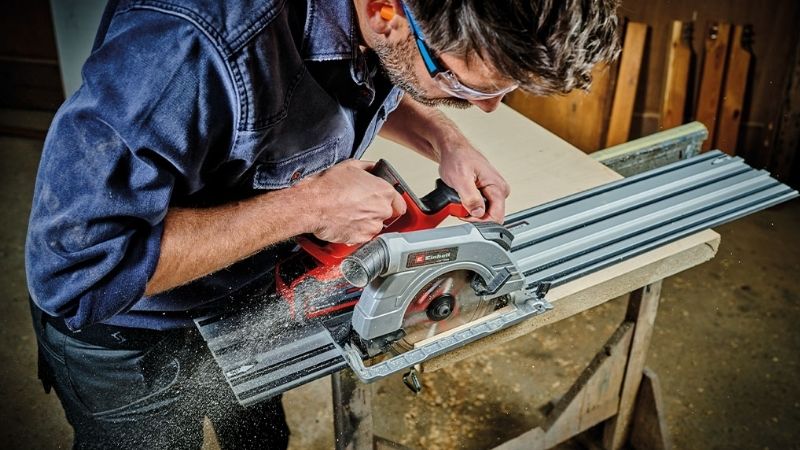
For straight plywood ripping, clamp a straightedge or use a compatible track-style guide if the model permits it. Support both the main workpiece and the cut-off in a way that prevents pinching, twisting or a falling piece pulling the saw. A narrow cut at the edge of a sheet may call for a different support method from cutting a two-by-four. Keep cords routed behind a corded saw and outside the cut. Stop immediately if the guard sticks, the blade binds or the tool vibrates abnormally; repair the cause rather than forcing the material through.
Frequently Asked Questions
Blade compatibility and technique vary by model. Use the owner’s manual for setup and verify work support before treating any speed or depth number as a guarantee of safe performance.
Is a 6-1/2-inch circular saw enough for 2x lumber?
Often yes for a straight cut, but verify the actual stock thickness and the model’s 90-degree cutting depth. The SKIL CR540602 and DEWALT DCS565B are each specified at 2-1/8 inches at 90 degrees. That differs from the larger Makita 5007MG at 2-1/2 inches. At a bevel, available depth decreases. For thicker stock or specialty cuts, use the precise depth specification rather than judging from nominal board names alone.
What is the main difference between a circular saw and a miter saw?
A portable circular saw moves across the material and is particularly useful for breaking down plywood, trimming boards and work that must be done near the installation site. A miter saw brings a fixed blade down into stock against a fence, which is useful for repetitive lengths and compound angles. A circular saw can make angled cuts with care and an appropriate guide, but it is not a replacement for the repeated stop-block cuts that make a miter station efficient.
Should I get a corded or cordless saw?
Choose corded if you work mostly near outlets and expect long uninterrupted cutting sessions. Choose cordless when the project spans a yard or jobsite and you are willing to manage charging. Compare the complete package: the DEWALT DCS565B does not include a battery, while SKIL CR540602 does. Cordless voltage labels are not a direct ranking of cutting power, and runtime claims need a stated battery size and workload.
How do I prevent circular-saw kickback?
Keep the blade sharp and appropriate for the material, adjust depth as the manual directs, support the work to avoid pinching and never twist the running tool through a cut. Let the guard retract and close normally and maintain a stable two-handed grip where the manufacturer provides one. If the blade binds, release the trigger, keep the saw steady until motion stops and disconnect power before investigating. Avoid cutting unsupported boards or reaching under the shoe.
Final Thoughts
For consistent workshop and remodeling work, the Makita 5007MG is the best purchase of this group because its 15-amp motor, useful 2-1/2-inch cutting depth and supplied accessories suit multiple wood-cutting jobs. Occasional DIY users can save substantially with the SKIL 5280-01; first-time cordless users should compare the complete SKIL CR540602 kit rather than the bare DEWALT DCS565B.
Check the live retailer price, the exact blade diameter, the cutting depth at your intended angle and battery inclusion before ordering. Use an appropriate blade and proper work support from the first cut onward.
