Key takeaways
- Boost output reaches a manufacturer-stated 765 CFM for heavier debris.
- Tapered nozzle raises maximum published airspeed to 200 MPH.
- Five-year limited tool coverage exceeds the battery’s three-year term.
Wet maple leaves packed along a fence need a different kind of airflow from dry grass clippings on a sidewalk. A cordless leaf blower is worth buying for the work you actually do, not simply for the largest number printed on its box. This comparison concentrates on six battery-powered handheld models with published air-volume and air-speed figures. It also separates the price of a complete battery-and-charger kit from a tool-only purchase, which can change the cost dramatically.
Quick Verdict: For most homeowners clearing mixed leaves and driveway debris, the EGO POWER+ LB7654 is our Best Overall pick: its published 765 CFM and 200 MPH, measured as manufacturer maximums with the specified nozzle, give it more headroom than the other five choices. This editorial selection uses published specifications and product documentation as of October 2026, not in-house testing. Check the current kit listing before buying because battery bundles change.
As an Amazon Associate we earn from qualifying purchases.
By DIY Ideas 4 Home Editorial Team
The Best Cordless Leaf Blowers Reviewed
We selected six individually identified US-market SKUs and checked manufacturer product pages, model documentation and active retailer listings in October 2026. Maximum CFM measures air volume, while MPH describes its speed; both matter, particularly with damp leaves. Listed prices in this selection range from $149 for a bare tool to about $239 to $329 for complete kits, so comparing sticker prices without checking batteries would be misleading. The published specifications support a buying comparison, not a claim that our team operated these machines.
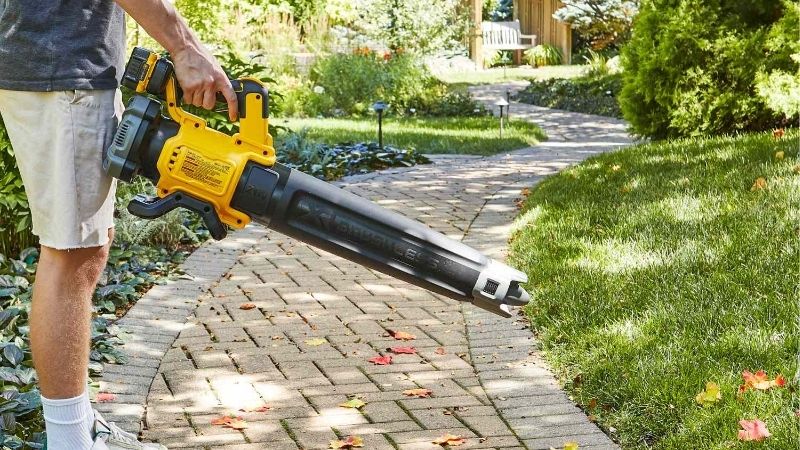
| Product | Best For | Key Spec | Listed Price (October 2026) | Watch Out For |
|---|---|---|---|---|
| EGO POWER+ LB7654 | Best Overall | 765 CFM; 200 MPH with tapered nozzle; 5.0Ah kit | $299.00 | Substantial battery weight during longer passes |
| RYOBI RY404100 | Two-Battery Yard Work | 730 CFM; 190 MPH; two 4.0Ah batteries | $329.00 | Two packs do not mean two hours at maximum power |
| Toro 51820 | Best Value | 605 CFM; 120 MPH; 2.5Ah kit | $239.99 | Manufacturer lists 11 lb; one smaller battery |
| Milwaukee M18 FUEL 3017-20 | Existing M18 Owners | 500 CFM; 120 MPH; tool only | $149.00 | Battery and charger are not in the price |
| Makita XBU03SM1 | Controlled Walkway Clearing | 459 CFM; 116 MPH; 4.0Ah kit | $269.00 | Less air-volume reserve for heavy leaf drifts |
| DEWALT DCBL722P1 | 20V MAX Households | 450 CFM; 125 MPH with concentrator; 5.0Ah kit | $239.00 | Not a substitute for high-volume wet-leaf clearing |
EGO LB7654: Best Overall
Best For: Homeowners clearing both scattered lawn debris and stubborn leaf mats who want strong handheld airflow in one kit.
The LB7654 earns the first position because it combines the highest manufacturer-published air volume in this group with a high-speed tapered nozzle. That pairing is useful when a broad row of leaves must be gathered quickly, then redirected from a curb or shrub edge. There is a real trade-off: the included battery adds enough mass that a shorter, lighter blower may be more pleasant for a five-minute cleanup. Owners of smaller paved lots need not pay for maximum output they rarely use.
EGO’s product documentation, its 2026 Product Catalog, identifies the LB7654 as a 56V kit containing one 5.0Ah battery and a 320W charger. It lists up to 765 CFM in boost and 200 MPH with the tapered nozzle, rather than promising those readings for every trigger setting. Lowe’s displayed $299.00 for the specified kit in October 2026, putting it in the upper portion of this particular complete-kit group. The advertised 90-minute running figure depends on operating conditions and should not be treated as 90 minutes of full-speed blowing.
The same EGO catalog puts the blower’s weight at 4.6 pounds without its battery and lists IPX4 weather resistance; the equipped weight is higher. Its published five-year tool and three-year battery limited warranties are meaningful because a battery pack will eventually be a replacement purchase, not a permanent consumable-free feature. For users moving from driveway to gravel borders, the separate speed dial makes it easier to back off before kicking small stones toward cars or windows. Remove the pack before cleaning a clogged air inlet, and check the current manual for operating precautions.
Pros:
- Boost output reaches a manufacturer-stated 765 CFM for heavier debris.
- Tapered nozzle raises maximum published airspeed to 200 MPH.
- Five-year limited tool coverage exceeds the battery’s three-year term.
Cons:
- The 5.0Ah battery increases hand-carried mass during a long session.
- Buyers with short sidewalks may never need its boost capability.
Who Should Buy It: Choose the LB7654 when wet leaves are a recurring problem; take the Makita XBU03SM1 instead if gentle, locked-in airflow matters more than sheer volume.
RYOBI RY404100: Best for Two-Battery Yard Work
Best For: Owners tackling repeated leaf piles who need another charged battery ready without making a second kit purchase.
RYOBI’s approach is different from EGO’s peak-output emphasis: the RY404100 supplies two interchangeable packs from the start. That makes it an attractive option for clearing opposite ends of a property or completing several short fall sessions in one afternoon. Its nominal airflow remains close to EGO’s, although published maximums are not a direct substitute for a same-day field comparison. The drawback is extra equipment to charge and store, and the second pack does not make a single handheld tool any lighter.
RYOBI’s product page for the RY404100 lists the $329.00 kit with two 40V 4.0Ah batteries and a charger. Its matching Home Depot product listing identifies 730 CFM and 190 MPH. The advertised two-hour operating figure refers to using both batteries under the manufacturer’s usage conditions; maximum turbo operation will shorten each session. The kit therefore costs $30 more than the EGO LB7654 price captured here, but contains a second battery that might otherwise require a separate purchase. Compare what actually ships, not only the claimed operating-time banner.
For the handling calculation, Pro Tool Reviews’ published specification summary for this exact model reports about 9.7 pounds with a 4.0Ah battery installed and an approximately 40.75-inch assembled length. That is a meaningful lever to guide with one hand around flower beds, especially when the tube is extended toward a corner. RYOBI’s support page offers the model’s documentation and replacement-parts route; keep the second pack clean and dry while it waits on the charger. Do not confuse the two included batteries with a backpack supply or a simultaneous dual-battery motor arrangement.
Pros:
- Two 4.0Ah packs come with the RY404100 kit.
- Published output pairs 730 CFM with 190 MPH maximum speed.
- A spare battery is ready when the installed pack runs down.
Cons:
- The $329 kit costs more up front than the EGO package.
- The long assembled tube is less convenient in crowded storage.
Who Should Buy It: Buy RY404100 for staggered work sessions where a second pack is valuable; select Toro 51820 when a single included battery and lower purchase price are enough.
Toro 51820: Best Value
Best For: Households needing a complete 60V blower for patios and medium leaf piles without the largest battery bundle.
Toro lands in a sensible middle ground on airflow while providing everything required for a first use. Its value case is not that it beats the fastest machines: rather, 605 CFM makes it more capable on paper than several similarly priced kits in this roundup, without charging for a second battery. The familiar trigger, boost button and cruise feature suit a user who moves between a paved patio and an open stretch of lawn. Because its battery is smaller than the EGO or DEWALT packs listed here, longer high-output jobs may require a charging break.
Toro’s product page for US model 51820 publishes 605 CFM, up to 120 MPH and a 60V Max 2.5Ah battery rated at 135Wh. It shows an October 2026 direct price of $239.99 with one battery and one charger. Toro lists a 64-minute battery charge time and an up-to-90-minute running claim, but that latter figure is not a supported promise for nonstop turbo use. The approximately $239 price also appeared at a US farm-and-ranch retailer, supporting this as an actual complete-kit offer rather than a tool-only teaser.
Toro’s official 51820 specifications give a weight of 11 pounds without explaining the measurement configuration. Do not compare it directly against a competing bare-tool weight and conclude which unit will feel lighter with batteries fitted. The company also describes a brushless motor and the 60V Flex-Force platform, helpful if a future mower or trimmer uses that family. Toro’s manufacturer response to a customer says this model does not accept auxiliary blower attachments, an important restriction for shoppers thinking about buying a gutter-cleaning tube later.
Pros:
- The $239.99 manufacturer price includes battery and charging equipment.
- Manufacturer-listed 605 CFM exceeds the output of three other picks.
- Cruise control and a turbo button offer separate clearing modes.
Cons:
- Toro’s published 11-pound weight deserves a careful handling check.
- Dedicated nozzle design limits the attachments this model can accept.
Who Should Buy It: Choose the 51820 for a balanced first blower purchase; the Milwaukee 3017-20 is a cheaper tool-only path when compatible M18 batteries are already owned.
Milwaukee 3017-20: Best for M18 Owners
Best For: M18 battery users who make quick professional-style passes and do not need another charger in the box.
For someone who already owns suitable Milwaukee batteries, the 3017-20 makes a convincing lower-cash addition rather than another battery-system commitment. The blower responds quickly, and its variable-speed sliding lock reduces the need to keep squeezing a trigger across a long driveway. The important catch sits in the price, not the airflow: this SKU is the bare machine. A new buyer who must purchase a battery and charger separately should calculate the full bill before calling it a budget option.
Milwaukee’s 3017-20 product page specifies 500 CFM, 120 MPH and 12.2 newtons of blowing force, alongside a published 54 dB(A) figure. The manufacturer’s press release identifies the acoustic figure as measured to ANSI B175.2, which makes the context clearer than an unqualified loudness claim. The Home Depot tool-only listing displayed $149.00 in October 2026; Milwaukee recommends its M18 HIGH OUTPUT battery family for this motor. No running time for an unspecified battery should be inferred from the 500 CFM maximum.
Milwaukee’s product announcement gives a 5.1-pound bare-tool weight and 33.7-inch length, both useful before planning a pegboard or a crowded work-van compartment. Milwaukee backs the blower with a three-year warranty according to the same product announcement, while separately purchased battery coverage depends on the pack. Its fast throttle response can help shift sand and small leaves from a work area, but operators should lower speed around loose gravel rather than using the highest setting as a default. Removing the battery is also the first step before examining the fan housing.
Pros:
- Tool-only pricing was $149.00 on the cited US listing.
- Published 54 dB(A) follows the ANSI B175.2 reference.
- The 33.7-inch format works with Milwaukee’s optional nozzle accessories.
Cons:
- A buyer starting from zero must add M18 battery and charger costs.
- Its 500 CFM ceiling falls below Toro’s 605 CFM specification.
Who Should Buy It: Choose 3017-20 if M18 charging gear is already on your shelf; the DEWALT DCBL722P1 includes a battery and charger for someone building a first kit.
Makita XBU03SM1: Best for Controlled Walkway Clearing
Best For: LXT tool owners and careful gardeners who prefer maintained moderate airflow over repeated bursts of maximum force.
Makita’s strongest argument here is its cruise-control lever and straightforward one-battery design. For edging a landscaped path, stopping every few seconds to rebuild a leaf pile can be more annoying than using a modest, consistent air stream. The XBU03SM1 provides that kind of control without stepping up to a large, heavy dual-battery platform. Its 459 CFM rating is not a match for EGO’s deep-leaf reserve, so it is a poor choice when the main task is repeatedly moving wet piles across a large yard.
Makita’s product page for XBU03SM1 specifies 459 CFM, 116 MPH and an 18V LXT brushless blower, with a BL1840B 4.0Ah battery and DC18SD charger supplied. It also lists a sound-pressure figure of 60 dB(A) using ANSI B175.2 and describes Star Protection communication between compatible battery and tool. A Home Depot listing showed $269.00 for the exact XBU03SM1 kit in October 2026. Makita offers a three-year limited warranty for the tool, battery and charger, a straightforward coverage policy for a bundled purchase.
The same manufacturer’s current spec table records a 32.5-inch overall length, 4.6-pound net tool-only weight and 6.0-pound weight with battery; other Makita promotional copy reports a slightly different assembled figure, so use the specification table as the consistent reference. Makita’s XPT features are intended to improve dust and water resistance, not make the machine suitable for washing under a hose. The variable trigger is useful near mulch borders where a sudden concentrated jet can scatter landscaping. Its blower-and-battery layout is particularly convenient if the household already charges LXT drills or saws.
Pros:
- The cruise lever holds a selected airflow without continuous trigger pressure.
- Manufacturer dimensions list a 32.5-inch long blower housing.
- The supplied 4.0Ah pack fits Makita’s LXT battery ecosystem.
Cons:
- Its 459 CFM volume provides less reserve for rain-soaked piles.
- The $269 kit is costlier than Toro despite lower claimed airflow.
Who Should Buy It: Select the XBU03SM1 for measured airflow near beds and shrubs; choose RYOBI RY404100 for a broader clearing job where rotating two batteries matters.
DEWALT DCBL722P1: Best for 20V MAX Households
Best For: DEWALT tool users who want a familiar battery platform and a complete blower kit for ordinary hardscapes.
DEWALT’s DCBL722P1 is the practical alternative when a homeowner values a widely used tool battery more than an impressive maximum CFM. Its concentrator focuses air when pushing dirt out of joints and corners, while the variable trigger makes it manageable on porches and short paved approaches. Compared with the Toro, it moves a smaller published air volume despite costing almost the same for a complete kit. On a yard filled with heavy wet leaves, that difference is more significant than a little extra air speed at the nozzle.
DEWALT’s product page for DCBL722P1 specifies up to 450 CFM and up to 125 MPH with its concentrator nozzle, plus a trigger-controlled brushless motor and speed lock. The kit contains one DCB205 5.0Ah 20V MAX battery and a DCB115 charger. The October 2026 Home Depot listing for this exact kit showed $239.00, not the lower price of the bare DCBL722B variation. DEWALT lists a three-year limited tool warranty, along with specific service terms; keep the receipt to match the policy to the purchased package.
DEWALT’s published 20V MAX blower product catalog identifies the underlying DCBL722 machine weighing 5.3 pounds without the battery. Its stated 62 dB(A) sound figure should not be treated as a directly comparable ear-level reading against different manufacturers’ marketing numbers. The blower is designed for quick outdoor debris clearing and has no leaf-vacuum function; readers who actually need bagged collection should shop a dedicated vacuum or mulcher rather than expect an accessory to transform this kit. The concentrator is useful along curb seams, but never aim the high-speed jet toward people, vehicles or exposed windows.
Pros:
- Its kit includes a named DCB205 5.0Ah battery and charger.
- Concentrator nozzle supports a manufacturer-rated 125 MPH top speed.
- The bare DCBL722 blower is listed at 5.3 pounds.
Cons:
- 450 CFM offers less high-volume output than the 605 CFM Toro.
- It cannot vacuum or mulch the leaves it gathers into piles.
Who Should Buy It: The DCBL722P1 suits modest driveways and existing 20V MAX households; move to EGO POWER+ LB7654 when you regularly need stronger broad-area leaf movement.
How to Choose a Cordless Leaf Blower
Buying decisions become clearer once the task and battery purchase are separated. A narrow paved walk can be handled by a smaller machine, while wet autumn leaves demand both sufficient air volume to move a pile and speed to dislodge stuck debris. On this shortlist, published output spans 450 to 765 CFM and 116 to 200 MPH. The endpoints apply to different models and sometimes specific nozzles or boost settings, so neither figure alone predicts an identical result in your yard.
Match Air Volume and Speed to the Debris
CFM is the amount of air the fan moves, making it especially relevant when consolidating a wide spread of dry leaves. MPH describes air velocity and can help loosen material caught along a curb or between paving joints. A blower with 125 MPH but 450 CFM is not automatically stronger in every task than one with 120 MPH and 605 CFM. Use both ratings for the same model, then consider nozzle shape, how often you need boost and whether the leaves are wet or dry.
For example, the EGO’s 765 CFM and nozzle-dependent 200 MPH justify its all-round choice for heavier seasonal work, while the DEWALT’s 450 CFM/125 MPH pairing is more appropriate for small jobs. The Milwaukee’s manufacturer lists not just 500 CFM and 120 MPH but 12.2 newtons of blowing force, a further performance indication not supplied for all six picks. Since this comparison does not have identical newton figures for every machine, blowing force cannot fairly be the sole ranking system here. Maximum-output marketing also tells you little about how long a small battery can sustain that setting.
Price the Battery System, Not Just the Blower
The $149 Milwaukee 3017-20 was offered as a bare tool: the price does not make it the cheapest complete first-time purchase. By contrast, Toro’s $239.99 kit includes a 60V 2.5Ah pack and charger, while RYOBI’s $329 kit bundles two 40V 4.0Ah packs. Those battery configurations change how the same listed price should be interpreted. A household with multiple batteries on one platform may be better served by a lower-priced bare tool, but a first-time buyer generally needs the charger included in the cart.
Do not compare amp-hours in isolation across systems of different voltages. An 18V 4.0Ah pack, a 20V MAX 5.0Ah pack and a 60V 2.5Ah pack are not interchangeable and do not promise running times in direct proportion to their Ah labels. Manufacturers also state durations at varying speeds; RYOBI’s advertised two-hour figure uses both included batteries, and Toro’s up-to-90-minute claim is not a continuous-turbo test. Check the exact SKU, the number of packs, compatible chargers, warranty eligibility and replacement-pack pricing before deciding whether a sale really saves money.
Check Carry Weight, Controls and Job Safety
Weight figures need their battery condition attached. EGO lists 4.6 pounds without a pack, Milwaukee lists 5.1 pounds for its bare tool, and RYOBI’s independent model summary reports about 9.7 pounds with one 4.0Ah pack fitted. Toro publishes an 11-pound figure without specifying the configuration in its current specification table. Those numbers cannot form a reliable lightest-to-heaviest ranking without matching the measuring setup. If possible, handle a complete blower with the intended battery inserted, particularly when wrist strength or long reaches are concerns.
Variable-speed control matters when blowing beside plants, gravel, outdoor furniture or a parked car. Never direct the discharge toward someone, and wear protective eyewear; follow the tool manual for hearing protection and safe operating distances. NIOSH’s February 2026 account of measured landscaper exposures found noise frequently exceeded its 85 dBA recommended occupational limit, although those worksite measurements are not identical to an individual cordless tool’s published sound-pressure rating. Remove the battery before inspecting an obstructed fan or tube, avoid blowing dust toward bystanders, and look up the exact model in CPSC recall records when purchasing.
Frequently Asked Questions
Even after narrowing the models, seasonal storage and unusual cleanup jobs can alter the purchase decision. These answers address operating situations that do not show up in a maximum-airflow comparison chart.
Can a Battery Leaf Blower Clear Light Snow?
Sometimes, a blower can push a shallow layer of loose, powdery snow from a porch or walkway before it becomes packed. Wet snow, ice and hard plow ridges call for a suitable shovel or snow-removal machine instead. Check the model’s manual for permitted operating temperatures and moisture exposure before taking it outside. An advertised weather-resistance feature does not turn a battery blower into a waterproof snow-removal device.
Where Should I Keep Blower Batteries Over Winter?
Store removable lithium-ion packs in a clean, dry location within the temperature range given by the battery manufacturer, away from direct heat or water intrusion. Follow the specific instructions for storage charge level and periodic checking; rules differ between battery systems. Leaving a pack attached to a blower in a damp outdoor shed may make moisture and temperature problems harder to identify. Inspect the battery casing and contacts before returning it to service.
Why Does the Blower Shut Off While Using Boost?
It may have a depleted pack, a thermal protection event or a blocked intake, but the correct diagnosis depends on the model. Release the switch, remove the battery and follow the manufacturer’s shutdown and troubleshooting instructions. Do not reach into a fan tube while the pack is attached, even if the fan is no longer spinning. If it repeatedly stops with a charged, compatible battery and unobstructed housing, contact authorized service rather than bypassing a protective control.
Do Noise Rules Apply to Battery-Powered Blowers?
Yes, local ordinances may still restrict blower operating hours, allowable sound levels or the equipment itself, regardless of whether it burns gasoline. Some rules distinguish electric from gas equipment; others do not. Before purchasing for a noise-sensitive neighborhood, look up the current city or county ordinance and any homeowners-association restrictions. A low published dB number may be measured under a particular standard and does not automatically establish compliance at the property line.
Final Thoughts
If a cordless leaf blower will be your main fall cleanup tool, the EGO POWER+ LB7654 remains the Best Overall purchase here for its documented 765 CFM and nozzle-dependent 200 MPH ceiling. The purchase decision can flip when battery ownership or local support matters more: Milwaukee’s 3017-20 saves money for established M18 users, while Toro’s 51820 gives new buyers a lower-priced complete kit. One final pre-check can prevent a frustrating replacement later: confirm that an authorized service or battery source near you still supports the exact model and battery generation, not just the brand name. Then check the current bundle price before ordering.