Key takeaways
- Initial Investment: A high-quality benchtop drill press ranges from $120 to $320. A manual pin vise kit costs between $12 and $15, while a high-end cordless power hand drill costs between $80 and $180.
- Consumables (Drill Bits): This is where the drill press wins back its cost. Because a drill press keeps the bit perfectly perpendicular without lateral flexing, bits last up to five times longer. When hand drilling metal, minor hand movements cause the bit to bind and chip its cutting edges. Over five years, a frequent hand-driller might spend $150 to $200 replacing snapped or dulled cobalt and carbide bits, whereas a drill press user might only spend $40.
- Maintenance and Repairs: Drill presses are mechanically simple. Over five years, you may need to spend $15 on a replacement drive belt or some lubricating grease. Hand drills, especially cordless models, rely on lithium-ion batteries. These batteries degrade over time; a replacement battery pack after four years typically costs $50 to $80.
When it comes to upgrading a home workshop, few decisions cause as much hesitation as choosing between a stationary drill press and a handheld drill. If your upcoming projects involve wood, a hand drill is often more than adequate. However, the moment you transition to working with steel, aluminum, brass, or copper, the physical realities of metalwork change the equation entirely. The debate of a drill press vs hand drill for precision metal drilling is not just about convenience; it is about safety, tool longevity, and the exactness of your finished project.
Metal is an unforgiving medium. Unlike wood, which yields to slight shifts in hand angles, metal resists. A minor wobble with a hand drill can instantly snap a expensive cobalt bit, mar your workpiece, or cause the drill to kick back violently. In 2026, as home workshops become more specialized and compact, manufacturers have introduced highly precise options on both sides of the spectrum. Whether you are restoring classic car parts, building custom metal furniture, or crafting delicate jewelry, understanding how these two tool categories manage torque, speed, and alignment is key to making the right purchase.
Our top picks


As an Amazon Associate we earn from qualifying purchases at no extra cost to you.
Quick Verdict
For absolute precision, safety, and repeatability in metal thicker than 1/16 of an inch, the drill press is the undisputed winner. It provides the rigid mechanical advantage, variable speed control, and perpendicular alignment that hand drilling simply cannot replicate. However, if your work consists of ultra-fine jewelry making, working in highly confined spaces, or drilling soft metals on a micro-scale, a specialized manual pin vise hand drill is the superior choice, offering tactile feedback that prevents tiny bits from snapping.
Side by Side Comparison
| Feature | Benchtop Drill Press | Hand Drill (Power & Pin Vise) |
|---|---|---|
| Comfort | High. Lever-action quill feed minimizes physical fatigue during repetitive drilling. | Moderate to Low. Requires continuous physical pressure and manual stabilization. |
| Durability | Exceptional. Heavy cast iron construction lasts for decades with basic lubrication. | Moderate. Handheld motors wear out faster; manual pin vises are durable but fragile under lateral stress. |
| Price Range | $120 to $600+ for high-end residential benchtop models. | $10 to $30 for manual pin vises; $50 to $200 for quality cordless power drills. |
| Maintenance | Low to Moderate. Requires occasional belt tensioning, column waxing, and spindle lubrication. | Very Low. Occasional cleaning and battery care (for cordless power models). |
| Space Needed | Significant. Requires dedicated bench space (approx. 12″ x 20″ footprint, 24″ to 38″ height). | Minimal. Can be stored in a standard drawer, toolbox, or hanging pegboard. |
| Aesthetics | Industrial and functional. Cast iron, exposed metal columns, and mechanical pulley boxes. | Sleek, modern, and compact. Easily tucked away to keep a clean home environment. |
| Resale Value | High. Heavy-duty cast iron tools hold their value incredibly well on the secondhand market. | Low. Consumer electronics and small hand tools depreciate rapidly. |
| Best For | Structural steel, brackets, thick plate metal, and repetitive, identical holes. | Micro-drilling, jewelry, resin, soft metal sheets, and hard-to-reach repair areas. |
Where Drill Press Wins
The primary advantage of a drill press in the drill press vs hand drill for precision metal drilling matchup is rigid stability. When drilling metal, the drill bit must enter the material at a perfect 90-degree angle. Even a single degree of deviation creates lateral forces that can dull the cutting edges of the bit, produce oval-shaped holes, or cause the workpiece to spin dangerously. A benchtop drill press solves this by securing the spindle in a heavy-iron head casting, completely eliminating human hand wobble.
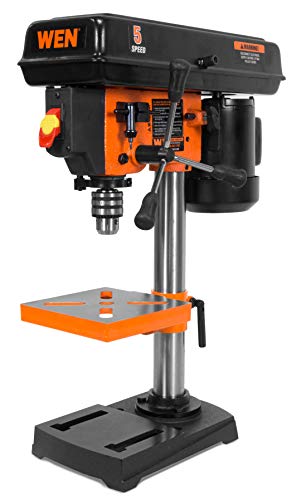
Furthermore, metal drilling requires highly specific, slow rotational speeds combined with high feed pressure. For example, drilling a 1/2-inch hole through stainless steel requires a slow speed of around 500 RPM. A entry-level model like the WEN 2.3-Amp 8-Inch 5-Speed Cast Iron Benchtop Drill Press (4206T), priced at $123.76, allows you to mechanically adjust the pulleys to hit these lower speeds while maintaining maximum motor torque. Attempting to run a standard handheld power drill at 500 RPM under load usually results in the motor stalling or overheating because handheld triggers rely on electronic speed control, which sacrifices torque at lower speeds.
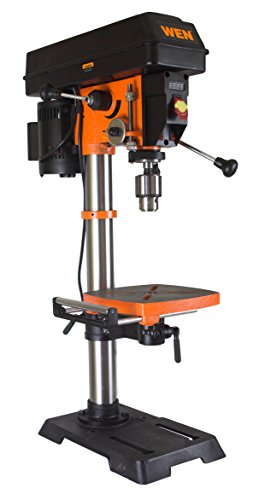
For advanced metalwork, a tool like the WEN 12-Inch Benchtop Drill Press, 6.2-Amp Variable Speed Motor with Cast Iron Construction, Laser and LED Work Light (DP1263V), priced at $313.99, offers mechanical variable speed. This allows you to fine-tune your speed on the fly with a simple lever, ensuring you do not work-harden your steel. Additionally, the massive cast iron table of a drill press allows you to bolt down a heavy drill press vise. Clamping your metal workpiece securely is a fundamental safety rule; if a drill bit catches in a piece of metal held by hand, it can instantly spin the metal like a blade, causing severe injury.
Where Hand Drill for Precision Metal Drilling Wins
While a massive drill press excels at heavy, structural metal fabrication, it fails completely when it comes to portability, delicate workpieces, and micro-scale precision. You cannot bring a 85-pound drill press to a stuck bolt on a car chassis or up a ladder to drill a mounting hole in a metal patio overhang. The hand drill is highly portable, allowing you to bring the tool to the work rather than the work to the tool.
In the realm of ultra-precision hobbyist work, such as jewelry making, watch repair, or model building, a power drill press is often too powerful and clumsy. This is where manual hand drills, specifically pin vises, dominate. For instance, the Micro Drill Bits Set with Pin Vise Hand Drill Manual, Jewelry Drill Kit ($14.99) and the Pin Vise Hand Drill Manual with Micro Drill Bits, Jewelry Drill for Resin ($11.97) are indispensable for working with delicate, soft metals like sterling silver, copper, and brass.
These manual hand drills use a knurled brass or steel chuck that you rotate entirely with your fingers. When using micro drill bits (often measuring under 1 millimeter in diameter), the slightest vibration or excess pressure from a power tool will instantly snap the bit. A manual pin vise gives the crafter direct tactile feedback. You can feel exactly how the metal is cutting, allowing you to back off the pressure when the bit is about to exit the backside of the metal sheet, resulting in a clean, burr-free hole with zero risk of material distortion.
Cost Over 5 Years
When calculating the true cost of ownership over a five-year period, the drill press often proves to be the more economical choice for serious DIYers, despite the higher initial purchase price. This is largely due to how these tools interact with consumables (drill bits).
- Initial Investment: A high-quality benchtop drill press ranges from $120 to $320. A manual pin vise kit costs between $12 and $15, while a high-end cordless power hand drill costs between $80 and $180.
- Consumables (Drill Bits): This is where the drill press wins back its cost. Because a drill press keeps the bit perfectly perpendicular without lateral flexing, bits last up to five times longer. When hand drilling metal, minor hand movements cause the bit to bind and chip its cutting edges. Over five years, a frequent hand-driller might spend $150 to $200 replacing snapped or dulled cobalt and carbide bits, whereas a drill press user might only spend $40.
- Maintenance and Repairs: Drill presses are mechanically simple. Over five years, you may need to spend $15 on a replacement drive belt or some lubricating grease. Hand drills, especially cordless models, rely on lithium-ion batteries. These batteries degrade over time; a replacement battery pack after four years typically costs $50 to $80.
Which One for Your Home?
Small Apartment
If you live in a small apartment, space and noise are your primary constraints. A heavy benchtop drill press is impractical, as it requires a dedicated, sturdy workbench and creates significant low-frequency vibration that can disturb neighbors. For apartment dwellers, a compact manual option like the Pin Vise Hand Drill Manual with Micro Drill Bits, Jewelry Drill for Resin ($11.97) is ideal for crafting and jewelry. For larger household repairs, a compact 12V cordless hand drill paired with a portable, clamp-on drill guide is the best compromise, easily fitting into a closet shelf.
Family with Kids and Pets
Safety is the paramount concern in a bustling household. A benchtop drill press is a heavy machine (the WEN DP1263V weighs approximately 85 pounds) that can cause catastrophic injury if tipped over by a curious child or pet. If you choose a drill press, it must be securely bolted to a heavy workbench in a locked garage or basement. Alternatively, a hand drill can be easily locked away in a high cabinet or tool chest, completely out of reach of children. Hand drills also feature safety lockouts on their triggers to prevent accidental activation.
Rental Properties
Renters need to consider portability and the temporary nature of their workspaces. Moving a heavy cast iron drill press during a lease transition is incredibly difficult and increases the risk of damage to rental property floors. A versatile hand drill is the logical choice here. If you occasionally need the precision of a drill press, you can pair your hand drill with a lightweight, removable drill guide stand that can be packed away into a single tote bag when it is time to move.
Long-Term Home with a Workshop
If you own your home and have a dedicated garage, basement, or backyard shed workshop, a benchtop drill press is a foundational tool that you will not regret purchasing. A model like the WEN 2.3-Amp 8-Inch 5-Speed Cast Iron Benchtop Drill Press (4206T) ($123.76) takes up very little permanent bench space but instantly elevates the quality of your home repairs, automotive projects, and fabrication tasks. Over years of home ownership, the ability to quickly, safely, and accurately drill holes through metal brackets, pipes, and plates will save you countless hours of frustration.
FAQ
Why is speed control so critical when drilling metal?
Unlike wood, which can be drilled at high speeds, metal requires slow speeds to manage heat. If a drill bit spins too fast against metal, friction creates extreme heat, which dulls the cutting edges of the bit almost instantly and can “work-harden” certain steels, making them nearly impossible to drill through. A drill press allows you to lock in slow, high-torque speeds, whereas a hand drill trigger is incredibly difficult to hold at a constant, slow speed under load.
Can I get drill-press accuracy from a hand drill using an attachment?
You can use a portable drill guide attachment with your hand drill to help maintain a 90-degree angle. While these guides are highly useful for on-site construction, they still suffer from minor play and flexing in their sliding columns. They do not offer the absolute rigidity, heavy cast iron vibration dampening, or mechanical leverage of a true benchtop drill press.
Do I always need to use cutting fluid when drilling metal?
Yes, for almost all metals except cast iron and brass, you should use a dedicated cutting fluid or light motor oil. Cutting fluid lubricates the cutting edge, reduces heat buildup, and helps flush out metal chips. This is especially true when using a drill press on thick steel plates, as it prevents the bit from binding and extends tool life significantly.
What is “runout” and how does it affect precision metal drilling?
Runout refers to the degree of wobble or deviation from the center axis of a rotating drill spindle or chuck. Even a tiny fraction of a millimeter of runout will cause the drill bit to walk, vibrate, and drill an oversized hole. High-quality drill presses have heavy-duty spindles with minimal runout (typically under 0.005 inches), whereas standard hand drills often have noticeable runout due to lighter bearings and plastic housings, making them unsuitable for high-tolerance metal machining.