Key takeaways
- 66.25-inch overall length may support a more upright raking posture.
- Teardrop shaft offers a different grip shape from round fiberglass handles.
- Twenty-four metal tines use tabs intended to resist loosening under pressure.
An ergonomic leaf rake is worth buying when the handle fits your reach and the head moves leaves without demanding a tight grip or repeated unclogging. A long shaft can make upright strokes easier; a wide fan suits open grass, but it becomes awkward between shrubs. The choices below address different sources of fatigue rather than treating a padded handle as the only comfort feature.
Quick Verdict: For general fall cleanup, the Fiskars Pro Leaf Rake 397930-1001 is our Best Overall pick for its 66.25-inch length, shaped shaft, and multi-position Softgrip area. Choose the Groundskeeper II 32230 instead if spring tines and lighter-feeling handling matter more than a cushioned grip. These are editorial choices from published specifications as of October 2026, not in-house tests. Check the current price and exact model before ordering.
As an Amazon Associate we earn from qualifying purchases.
By DIY Ideas 4 Home Editorial Team
The Best Ergonomic Leaf Rakes Reviewed
We compared manufacturer product pages, model-specific retailer listings, published dimensions, and documented tine mechanisms. In US listings checked in October 2026, these options ranged from $16.50 for a compact specialty rake to about $55 for a full-size spring-tine model. That is a range across different tool sizes, not a claim that a short garden rake replaces a full lawn rake. Bob Vila’s September 2026 hands-on leaf-rake review provides outside context on rake-head performance, while the choices here are based on documented features rather than our own testing.
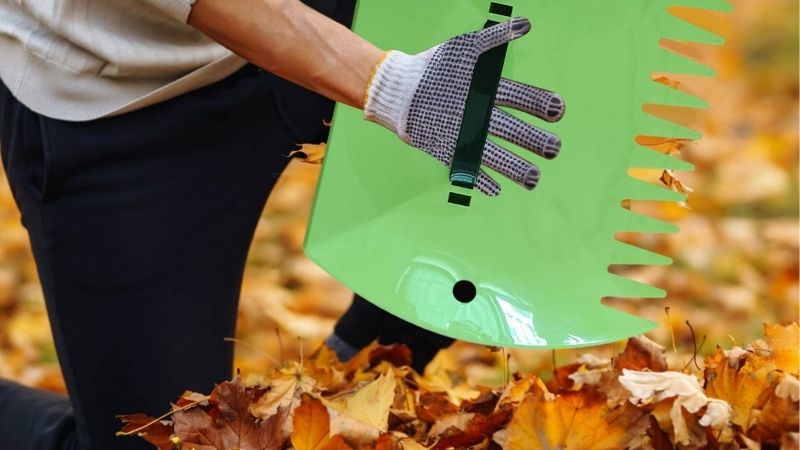
| Product | Best For | Key Spec | Listed Price (as of October 2026) | Watch Out For |
|---|---|---|---|---|
| Fiskars Pro Leaf Rake 397930-1001 | Best Overall: upright strokes and hand positions | 66.25 in overall length; 23.75 in width; 24 steel tines | $41.12 at McCoy’s | Long fixed handle needs storage clearance |
| True Temper Dual-Tine 2714000 | Best for leaves that clog ordinary tines | 26 in head; dual-tine poly design; fiberglass shaft | $30.99 at Killingworth True Value | Local order availability varies |
| The Groundskeeper II Fullsize 32230 | Best for spring-tine pickup | 21 in head; 28 steel tines; 55 in fiberglass handle | $54.99 at Tractor Supply | Angled tips may disturb loose mulch |
| Bully Tools 92630 | Best for broad open lawns | 30 in head; 68 in overall length; 3.25 lb | $44.99 at Ace Hardware | Wide fan is difficult in narrow beds |
| Razor-Back Steel Rake 2915200 | Best for a cushioned steel-tine design | 24 steel tines; 51 in fiberglass handle | $29.98 at Home Depot | Steel can catch on delicate groundcover |
| Corona ExtendaHANDLE GT 3050 | Best for raised beds and narrow borders | Handle adjusts 18 to 32 in; non-slip grip | $16.50 at Corona | Not a substitute for a full-width lawn rake |
Fiskars 397930-1001: Best Overall
Best For: Homeowners who want to stay more upright during repeated strokes across an ordinary lawn.
Hand position is the leading reason to choose this model. Fiskars shapes the aluminum shaft with a teardrop profile rather than a plain round tube, then provides a high-visibility Softgrip section that accommodates different grips. That design gives you more ways to hold and control the rake as you switch direction. It also has the longest clearly documented full-size shaft in this lineup, but its fixed length may be cumbersome for shorter users or cramped storage.
Fiskars’ product page for article 397930-1001 specifies a 66.25-inch overall length and 23.75-inch width, with an extruded aluminum handle and steel tines held by metal tabs. McCoy’s model-specific listing identifies 24 tines and showed a $41.12 price in October 2026. Double-bolted construction addresses looseness at the head connection, while the full lifetime warranty covers the manufacturer’s stated terms rather than normal wear automatically.
With a total length of more than 66 inches, this rake needs a wall hook or bay long enough for the shaft; it will not fold into a small cabinet. Steel fan tines can be useful when leaves are slightly matted, although they call for a lighter stroke around young plants. Fiskars’ published weight field uses an implausible unit, so we did not use it to rank lifting fatigue. If the weight of every stroke is your first concern, the Groundskeeper II is the more targeted alternative.
Pros:
- 66.25-inch overall length may support a more upright raking posture.
- Teardrop shaft offers a different grip shape from round fiberglass handles.
- Twenty-four metal tines use tabs intended to resist loosening under pressure.
Cons:
- Extra-long fixed shaft can feel unwieldy in tight landscaping or small sheds.
- Manufacturer’s published weight unit is inconsistent, complicating direct weight comparisons.
Who Should Buy It: Pick the Fiskars Pro for a long handled, grip-focused steel rake; choose the Corona GT 3050 when the work is confined to a raised bed.
True Temper 2714000: Best for Clog Resistance
Best For: People repeatedly stopping to clear leaves from a traditional fan rake during seasonal cleanup.
Stopping every few passes to pull trapped leaves off the head can be more annoying than the raking itself. True Temper’s dual-tine arrangement tries to keep the head moving without that interruption. The moderately wide fan suits mixed residential lawns, where a very broad 30-inch rake may be awkward at tree trunks. Unlike the Fiskars design, its comfort argument rests primarily on the head geometry and a textured grip, not an unusually long handle.
True Value’s product page for model 2714000 identifies a 26-inch dual-tine head, fiberglass construction, a comfort-grip handle, and a 15-year limited warranty. Killingworth True Value’s exact-model listing displayed $30.99 in October 2026, although it described special-order availability rather than universal nationwide stock. Bob Vila’s September 2026 leaf-rake comparison favored the True Temper dual-tine concept for comfort and reduced clogging; that reviewer result is independent of our specification-based ranking.
The Killingworth True Value model listing gives a packaged weight of 2.75 pounds. That figure describes the retailer’s packed item, not a controlled in-hand weight measurement, so treat it as a shipping reference. Check the current store listing for model 2714000 before paying: another True Temper 26-inch dual-tine rake is sold under model 2704000, and specifications should not be casually transferred between the two. Plastic tines also need a gentler touch if you plan to drag wet sticks across rough pavers.
Pros:
- Twenty-six-inch fan balances open-lawn coverage with maneuvering around established shrubs.
- Dual-tine poly head is intended to shed accumulating fallen leaves.
- Fifteen-year limited warranty is documented on the exact-model retailer product page.
Cons:
- Retailer listing may require special ordering rather than immediate local pickup.
- Stiffer poly tines are less forgiving than flexible steel around uneven surfaces.
Who Should Buy It: Choose the True Temper 2714000 when clogging breaks your rhythm; consider the Bully Tools 92630 for more head width on open turf.
Groundskeeper II 32230: Best for Spring Tines
Best For: Gardeners gathering embedded leaves or pine straw who prefer rake action without pressing hard on the handle.
The Groundskeeper II works differently from a familiar triangular poly fan. Its individual steel spring tines are angled to comb through loose debris with less deliberate downward force, making it a useful option if your typical rake skims over leaves caught within turf. That feature is not a claim that raking becomes effortless for everyone: the same digging action can disturb decorative mulch, and a light stroke remains important around shallow roots. This is a distinct tool choice rather than simply a more expensive version of the Bully rake.
The Groundskeeper II manufacturer’s Fullsize model page names a 21-inch head and 28 steel tines. A.M. Leonard’s listing for the 21-inch full-size version describes a 55-inch fiberglass handle and replaceable spring-loaded tines; its item GK2-21 is the retailer’s equivalent, while the manufacturer SKU list identifies full-size model 32230. Tractor Supply displayed $54.99 for its 21-inch model with a 55-inch green handle in October 2026. Replacement tines are an ongoing maintenance option rather than a reason to assume they will never bend.
At 55 inches, the handle is shorter than the Fiskars Pro’s 66.25-inch overall length. That can make the Groundskeeper feel more manageable for users who dislike very long shafts, but fit still depends on grip height and posture. A.M. Leonard lists a 1.8-pound shipping weight for the model; shipping weights are not standardized as tool-only weights. The replaceable 6-inch spring tines offer a repair path, yet matching the precise replacement part remains important. During autumn cleanup, test the tine pressure near new grass seedlings before committing to long pulls.
Pros:
- Twenty-eight spring-loaded steel tines actively reach beneath settled leaf layers.
- Twenty-one-inch working width can navigate moderately crowded landscape borders.
- Replaceable tines help avoid discarding the complete rake after localized damage.
Cons:
- Spring-tine angle can collect soil or shift loose mulch unintentionally.
- Approximately $55 retailer price is highest among these listed options.
Who Should Buy It: Buy the Groundskeeper II 32230 for leaves lying down in grass; choose the Fiskars 397930-1001 if shaft shape and multiple handholds matter more.
Bully Tools 92630: Best for Wide Open Lawns
Best For: Households with unobstructed lawn sections where each broad rake pass can gather a useful pile.
A broad plastic fan saves trips across an open patch, provided you can pull it smoothly rather than fighting uneven ground. The Bully 92630 is the wide-head specialist here. Its curved head and angled teeth are intended to sweep a broad band of fallen leaves, while the fiberglass shaft has a rubber grip at the end. The penalty is equally direct: a 30-inch rake is frustrating between close shrubs or in a planting bed only a few feet wide.
The manufacturer’s product page for Bully Tools model 92630 specifies a 30-inch polypropylene head, 68-inch total length, a fiberglass handle with a protective polyester veil, and a limited lifetime manufacturer’s warranty for defects. Its own price selection spans $39.99 to $41.99 by width; Ace Hardware specifically listed the 92630 for $44.99 in October 2026. The maker distinguishes model 92630 from the narrower 92624, so they should not be treated as the same purchase with identical tines or coverage.
This model weighs 3.25 pounds according to the company’s model-specific catalog and product listing. The 68-inch overall length creates a broad storage footprint; its 30-inch fan is not something to hide behind a narrow garage door. In exchange, the manufacturer specifies a replace-resistant polypropylene head and a fiberglass shaft designed against splintering. It does require minor assembly with household tools, unlike a rake that arrives fully assembled. More coverage does not mean less exertion if thick, wet leaves make each pull heavy, so use smaller passes when the load builds up.
Pros:
- Thirty-inch fan covers broad runs of grass in fewer overlapping strokes.
- Fiberglass handle incorporates a rubber grip for longer gathering sessions.
- Company catalog identifies a 3.25-pound complete 92630 rake specification.
Cons:
- Large head makes it hard to steer around closely spaced shrubs.
- Three-and-a-quarter-pound weight may tire users prioritizing a lighter rake.
Who Should Buy It: Select the Bully Tools 92630 when the yard is open and wide; switch to the True Temper 2714000 where maneuverability matters.
Razor-Back 2915200: Best for Steel-Tine Control
Best For: Buyers wanting a spring-braced metal head and cushioned grip for mixed seasonal yard debris.
Steel tines are worth considering when leaves have become matted with damp grass or fine twigs. The Razor-Back 2915200 uses a one-piece steel head and coil-spring action that can flex as you draw it over the ground. Its cushioned fiberglass handle helps distinguish it from basic wood-handled steel rakes. It is not the most forgiving option for fragile plantings: the same tine action that engages matted leaf layers can scrape mulch or damage tender growth if you pull too aggressively.
The Home Depot’s exact-model product page for Razor-Back 2915200 identifies 24 steel tines, a 51-inch fiberglass handle, a flexible coil spring, and a cushioned grip. The listing displayed $29.98 in October 2026. The one-piece head construction reduces the problem of individual steel tines pulling loose, but it also means a damaged section may not be repaired tine by tine in the way the Groundskeeper II can. This is a steel-tine model with a clearly documented handle feature, not a bow rake for gravel grading.
Its stated 51-inch handle length should be compared with your arm position, rather than assuming that a shorter rake always minimizes bending. Unlike Fiskars’ 66.25-inch Pro, this tool provides a more conventional long-handle stance. The steel head needs rinsing and drying after wet cleanup, particularly if stored where rain reaches the tool rack. Handle grip wear and corrosion at scraped surfaces are practical things to inspect at the start of each fall, even though the retailer lists a coated steel head. Soft surfaces call for gentle, shallow strokes.
Pros:
- Twenty-four steel tines work through modestly matted seasonal garden debris.
- Flexible spring connection moderates the action of its one-piece steel head.
- Fifty-one-inch fiberglass handle includes a cushioned hand-contact area.
Cons:
- Metal tines may snag landscape fabric or scrape tender groundcover.
- Fixed metal head offers less individual-tine repair flexibility than Groundskeeper II.
Who Should Buy It: Choose the Razor-Back 2915200 for controlled steel-tine cleanup; consider the Bully Tools 92630 when a wider plastic fan is preferable.
Corona GT 3050: Best for Raised Beds
Best For: People cleaning small planting beds who want reach without leaning deep into the foliage.
This Corona is the intentionally specialized selection in the group. It does not compete with a full lawn rake for sweeping an entire yard; instead, the telescoping handle helps reach into a raised bed or between plants while keeping your hands away from branches. The narrow working end and non-slip grip suit detail work after a wider rake has brought the main lawn leaves into piles. Buying it instead of a 24-inch fan for open grass would be the wrong match, regardless of the appealing lower price.
Corona’s product page for the ExtendaHANDLE GT 3050 states that its aluminum shaft extends from 18 to 32 inches, with a heat-treated head and a non-slip grip. The company listed it at $16.50 in October 2026. The handle changes length by twisting the ferrule, pulling the shaft, and securing it at the desired reach. Corona also specifies a rust- and chip-resistant coating and a hanging ring, features relevant to a tool used frequently near moist beds. No published wide lawn-sweep head dimension is claimed for this compact model.
The full extension is 32 inches, which gives meaningful reach for reaching across a planter but is much shorter than the 55-inch Groundskeeper shaft. That difference defines its role: you may be able to rake from the edge of a bed without stepping into it, but you cannot stand in the middle of a broad yard and expect full-size coverage. Rinse soil and leaf residue from the head, then let the telescoping joint dry before shortening it for storage. A slipping twist lock will interfere with control, so verify its action before prolonged use.
Pros:
- Eighteen-to-thirty-two-inch shaft adjustment supports varied planter and border depths.
- Non-slip grip supports controlled pulls between plants and exposed roots.
- Built-in hanging ring stores the compact tool off damp garage floors.
Cons:
- Compact head cannot move large lawn piles as efficiently as full-size fans.
- Twist-lock telescoping joint requires proper tightening before each extended stroke.
Who Should Buy It: Use the Corona GT 3050 for narrow beds and finishing work; buy the Fiskars 397930-1001 for everyday yard-wide raking.
How to Choose an Ergonomic Leaf Rake
Raking comfort comes from the match between your height, the rake’s working width, and what the tines actually do in your yard. A 66-inch handle can be excellent on open ground and awkward under a shrub. Likewise, a wide head that seems efficient on dry maple leaves can become demanding when the pile is wet. Before spending more for a comfort label, identify which motion causes the trouble: bending forward, gripping tightly, repeatedly shaking a clogged rake, or lifting a loaded head.
Start With Handle Length and Grip Shape
Compare the complete tool length, not only the manufacturer’s shaft-length wording. The Fiskars Pro is specified at 66.25 inches overall; Bully Tools calls the 92630 a 68-inch rake; the Groundskeeper II uses a 55-inch handle; and the Corona GT 3050 adjusts only from 18 to 32 inches. Those numbers describe substantially different working positions. In a store, hold the rake as if taking an ordinary forward stroke. If your wrists twist sharply or your upper body must remain hunched, try a different length rather than assuming the longest tool is best.
A shaped or padded grip is only useful if your hands naturally fall on it. Fiskars provides a teardrop-profile shaft with multiple Softgrip positions, while True Temper uses a textured comfort section and Bully places rubber grip material on fiberglass. None of those features proves that a rake prevents injury. Look for a secure grip without continuous squeezing, especially when wearing gardening gloves. If the head wobbles at the connection, a cushioned grip cannot make the rake feel controlled.
Match Head Width to the Yard
Working widths in this roundup include 21 inches on the Groundskeeper II, 23.75 inches on Fiskars Pro, 26 inches on True Temper’s dual-tine model, and 30 inches on Bully’s 92630. A wider rake gathers a broader strip when the ground is even and open. It also carries more debris per pass if the leaves are thick. Someone working around garden ornaments, young trees, or close fence posts may prefer a smaller fan that does not continually snag obstacles.
It helps to make the decision by actual walking space. If you regularly rake the thin strip between two raised beds, the Corona extender is a finishing tool for that strip, not the tool for an entire lawn. If your job is clearing large runs beneath mature deciduous trees, a 30-inch fan may reduce repeated side-to-side travel. Do not buy a very broad rake solely on head width when its pull feels heavy on your own ground.
Consider Tine Geometry and Ground Sensitivity
Polypropylene and steel respond differently to the same leaves. True Temper’s dual-tine geometry is designed to reduce clogging, especially when dry leaves interlock with the fan. Bully’s curved polypropylene head offers a broad sweeping pattern, while the spring-steel elements of the Groundskeeper II engage debris closer to the grass. Razor-Back’s coil-braced steel head is another way to add flex without using a plastic fan. There is no single numerical tine count that predicts a better rake across all these designs.
Choose a gentler contact pattern where there is new grass, exposed tree roots, or a layer of decorative mulch. In those areas, the aggressiveness of spring or metal tines can be a disadvantage despite useful pickup action elsewhere. For gravel driveways, pushing a lawn rake into the surface can drag stones into the leaf pile. Collect loose leaves from the top with light strokes, and use a purpose-made landscape rake if your aim is actually to grade or redistribute gravel.
Compare Weight, Repairs, and Real Cost
Weight matters most when you repeatedly lift and reposition the head, rather than sliding it along a level lawn. Bully publishes 3.25 pounds for model 92630; the Groundskeeper listing provides a shipping weight but not an identically measured tool-only value; and Fiskars’ own Pro page contains an inconsistent weight unit. These are not comparable enough to declare an objectively lightest full-size model. Ask for an actual assembled weight if a medical limitation makes ounces decisive, or try the tool before purchasing.
Repairability can offset a higher initial cost. The Groundskeeper II sells individual replacement spring tines, while the Fiskars Pro uses metal tabs and double-bolted assembly. Bully Tools and Fiskars describe warranty coverage, but the documents make claims about defects and conditions, not replacement of every worn tine or grip. At roughly $16.50 to $55 for the documented options, also check extra shipping fees for long shafts. A lower shelf price is less compelling if a retailer’s oversized-item surcharge is significant. After use, clean and dry steel heads and store wooden or fiberglass shafts away from standing water.
Frequently Asked Questions
A comfortable rake can still be tiring if the work pattern is wrong. These practical questions address body position, protection, and seasonal conditions that a specification table cannot settle.
Can a comfort-grip rake prevent back pain?
No rake can promise to prevent or treat back pain. Handle length, tool weight, the force needed to pull the head, and how long you work all affect exertion. Alternate your leading hand, keep the pile small enough to move without jerking, and pause when your form starts to change. Anyone with a significant back condition should follow advice from a qualified clinician rather than relying on product marketing.
Is it better to rake leaves when they are dry?
Generally yes, if you can choose the timing. Dry leaves separate more easily and form lighter piles; saturated leaves can cling to grass and increase the load with each pass. If you must clean damp leaves, work in shorter strokes and avoid twisting your torso while dragging a large pile. Let soggy piles drain before lifting them into a collection bag. Check for hidden branches or stones before pulling through thick wet material.
Do garden gloves still matter with a padded grip?
Yes. A comfort grip helps with contact, but gloves can protect against rough handles, leaf litter, and blisters during repeated movements. Select gloves that still let you feel and control the rake rather than oversized pairs that make you squeeze harder. If the handle becomes slick, wipe off moisture or soil instead of clenching it. Skin irritation is a reason to stop and adjust your gear, not a reason to keep working through discomfort.
How often should I inspect a leaf rake?
Check it before each major cleanup session and whenever the head strikes something hard. Look for a loosened head connection, bent or cracked tines, a separating grip, and damage to telescoping locks or fiberglass surfaces. The Groundskeeper II’s replaceable tine design offers a specific repair route, but replacement parts must match the correct head. Retire a tool with a visibly unsafe connection rather than attempting to force a heavy load through one more pass.
Final Thoughts
For repeated open-lawn cleanup, buy the Fiskars Pro Leaf Rake 397930-1001 if its long shaft and shaped Softgrip feel natural in your hands. The Groundskeeper II 32230 is a more specialized alternative when angled spring tines help gather embedded leaves, while the Corona GT 3050 belongs beside raised beds rather than across a whole yard. Before buying an ergonomic leaf rake, measure the height of your storage space, check your actual grip position with a full-length tool, and confirm the precise SKU and current delivery cost. A comfortable hold is more useful than a feature label if it works during your normal raking stroke.