Key takeaways
- Plumbed vs. countertop: An under-sink system like the InSinkErator taps your cold line and gives you unlimited near-boiling water from a dedicated faucet, but it needs a cabinet outlet and a saddle valve or tee fitting. Countertop units need nothing but a plug and a refill.
- Throughput over capacity: A 3L tank that reheats in seconds serves more people than an 8L tank that takes twenty minutes to recover. If you’re serving a crowd, look at liters-per-hour ratings rather than tank volume alone.
- Temperature granularity: Green tea wants 175°F, French press wants 200°F, boba syrup wants a full boil. Multi-preset models save you from guesswork and from scorching delicate leaves.
- Materials you can verify: Look for stated 304 stainless steel on the tank interior and BPA-free plastics on anything that touches water. Vague “food grade” claims without a grade number are worth less.
- Serviceability and safety hardware: Removable tanks make descaling a five-minute job instead of an afternoon. Child locks and locking lids matter if kids or pets share the space.
What's inside
Anyone who has stood over a kettle waiting for it to whistle knows the math doesn’t work out. Three minutes here, four minutes there, and by the end of a week you’ve lost a solid chunk of your morning to boiling water. The problem gets worse when the demand goes up: a household with two tea drinkers and one instant-oatmeal kid, a garage workshop where you’re mixing epoxy resin that needs warm water, or a small café where the line doesn’t stop. A stovetop kettle simply wasn’t built for volume, and most cheap electric ones scald themselves out within a year.
This guide breaks down six hot water dispensers that actually hold up, spanning under-sink plumbed systems, countertop boilers with real thermal insulation, and commercial units that push 20 to 30 liters per hour. I’ve weighted my picks toward build quality you can inspect yourself — accessible tanks, replaceable gaskets, honest stainless steel — because a dispenser you can service is a dispenser you keep. Below you’ll find the picks, then a buying framework and answers to the questions that come up most often.
As an Amazon Associate we earn from qualifying purchases.



How to Choose a Hot Water Dispenser Best (2026)
- Plumbed vs. countertop: An under-sink system like the InSinkErator taps your cold line and gives you unlimited near-boiling water from a dedicated faucet, but it needs a cabinet outlet and a saddle valve or tee fitting. Countertop units need nothing but a plug and a refill.
- Throughput over capacity: A 3L tank that reheats in seconds serves more people than an 8L tank that takes twenty minutes to recover. If you’re serving a crowd, look at liters-per-hour ratings rather than tank volume alone.
- Temperature granularity: Green tea wants 175°F, French press wants 200°F, boba syrup wants a full boil. Multi-preset models save you from guesswork and from scorching delicate leaves.
- Materials you can verify: Look for stated 304 stainless steel on the tank interior and BPA-free plastics on anything that touches water. Vague “food grade” claims without a grade number are worth less.
- Serviceability and safety hardware: Removable tanks make descaling a five-minute job instead of an afternoon. Child locks and locking lids matter if kids or pets share the space.
The Best Hot Water Dispenser Best (2026)s Reviewed
InSinkErator HOT150 Instant Hot Water Dispenser System
This is the pick if you want hot water on tap without a machine occupying counter real estate — the tank mounts under the sink and feeds a chrome faucet that delivers roughly 60 cups per hour at around 200°F. Installation is genuinely DIY-friendly with basic plumbing tools, though budget an hour and check that you have a nearby GFCI outlet before you start.
Zojirushi CD-LFC30 Micom Water Boiler and Warmer
Zojirushi’s 3-liter Micom remains the benchmark for household use, with four keep-warm setpoints, a Quick Temp mode that skips the full boil cycle, and a timer that cuts standby draw overnight. The vacuum-style insulation means it holds temperature with minimal reheating, which is why it costs more up front and less over its lifespan.
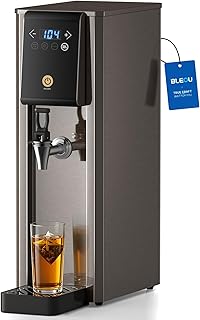
Bleou 1800W Commercial Countertop Hot Water Dispenser
Built for a service line, this 304 stainless unit pushes 20 liters per hour with adjustable output from 104°F to 212°F — enough range to cover cold-brew dilution and boba prep from the same tap. The all-metal body cleans down easily and shrugs off the knocks a busy prep station delivers.
NutriChef 8L Water Boiler and Hot Water Dispenser
The best value for events, church kitchens, and workshop break rooms where you need volume without a commercial budget. A safety lock lid, non-drip tap, and dedicated warm function make it easy to fill once and let it sit through a long shift.
AIRHOP 3L Instant Hot Water Dispenser
Three-second heat-up, five temperature presets, three volume settings, and a removable BPA-free tank that lifts out for refilling at the sink. The child lock and compact footprint make it my go-to recommendation for dorm rooms, home offices, and anywhere counter space is measured in inches.
Frequently Asked Questions
How often do these need descaling?
With hard water, every four to six weeks; with filtered or soft water, every three months is usually enough. A 50/50 white vinegar and water soak followed by two rinse cycles handles most buildup without specialty products.
Can I install an under-sink dispenser myself?
Yes, if you’re comfortable shutting off a supply line and drilling a 1-1/4 inch hole in your sink deck or countertop. Stainless is manageable with a step bit; granite and quartz need a diamond bit and patience, or a pro.
Are countertop dispensers expensive to run?
Insulated models with timers cost pennies a day since they only reheat intermittently. Uninsulated commercial units running 24/7 draw noticeably more, so switch them off outside service hours.
Is dispenser water safe for baby formula?
Water heated to a true boil and cooled to the recommended temperature is fine, but check your model actually reaches 212°F rather than topping out near 200°F. Always follow your pediatrician’s guidance on preparation.
Final Thoughts
For most homes, the Zojirushi CD-LFC30 is the one I’d buy and keep for a decade — precise, insulated, and quietly efficient. If you want hot water without a countertop appliance, the InSinkErator HOT150 is a satisfying weekend install with a real payoff, and for high-volume service the Bleou 1800W handles a full shift without flinching.