The usual mistake is assuming more teeth always means a better cut in hardwood. An 80-tooth blade ripping a 1-1/2 inch oak board will burn, bog the motor, and leave a glazed brown edge that no amount of sanding hides, because the tiny gullets between teeth cannot clear the chips. The opposite error is using a 24-tooth framing blade to crosscut cherry for a picture frame and wondering why the ends look chewed. Tooth count has to match the cut direction, the wood thickness, and the saw’s power. Get those three right and even a $20 blade makes clean cuts in maple.
Decide These 3 Things First
Rip, crosscut, or both. Ripping along the grain wants fewer teeth with big gullets; crosscutting across the grain wants more teeth to shear fibers cleanly. If you change blades rarely, a combination blade splits the difference.
Our top picks



As an Amazon Associate we earn from qualifying purchases at no extra cost to you.
Blade diameter and saw type. Most table saws take 10 inch blades, most sliding miter saws 10 or 12 inch, and circular saws 7-1/4 inch. Tooth count scales with diameter: 40 teeth on a 10 inch blade spaces like 48 on a 12 inch.
Your saw’s power. A 1.75 hp contractor saw or a 15 amp jobsite saw struggles with high tooth counts in thick hardwood. A 3 hp cabinet saw does not care.
Tooth Count by Cut Type
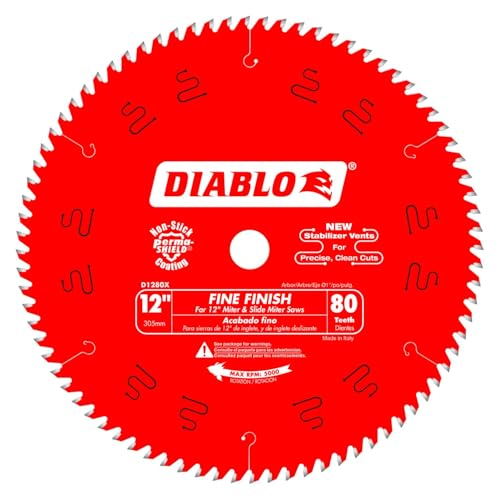
For a 10 inch blade in hardwood: 24 to 30 teeth for ripping stock thicker than 1 inch; 40 to 50 teeth for general purpose and combination work up to about 1-1/2 inches; 60 to 80 teeth for crosscutting, miters, and plywood or veneered panels where tear-out matters. The Diablo 50-tooth combination blade at about $41.25 with a .098 inch kerf is the classic one-blade solution for a table saw, while an 80-tooth blade like the WEN BL1080 at about $19.99 is a finish crosscut blade for a miter saw or a table saw sled. For 12 inch miter saws, 60 teeth is general purpose and 80 to 96 is fine finish; the Diablo 12 x 80 Hi-ATB at about $59.97 sits at the fine end. Do not confuse these with reciprocating or pruning blades measured in teeth per inch; a 6 TPI arc-edge blade is for green branches, not furniture.
Tooth Geometry and Grind
Tooth count matters less than grind for finish quality. ATB (alternate top bevel) teeth angle left and right in turn and shear cleanly for crosscuts. Hi-ATB increases that bevel to 30 to 40 degrees for near-zero tear-out in veneers and melamine, at the cost of faster dulling. FTG (flat top grind) teeth are chisels that hog out material fast for ripping. ATBR combination blades group four ATB teeth with one FTG raker and a large gullet, which is why 50-tooth combo blades rip better than 50-tooth crosscut blades. Hook angle matters too: 15 to 20 degrees positive for aggressive table saw ripping, 5 to 10 degrees for general work, and 0 to negative 5 degrees on miter saws to stop the blade from climbing the workpiece.
Kerf and Plate Thickness
Full kerf blades cut a 1/8 inch (0.125 in) slot from a plate about 0.087 inch thick; thin kerf blades cut about 3/32 inch (0.091 to 0.098 in) from a 0.070 inch plate. Thin kerf removes roughly 25 percent less wood, which lets underpowered saws rip hardwood without stalling and saves material on expensive boards. The trade-off is that the thinner plate can deflect in thick, dense stock, leaving a slightly wavy cut. If your saw is under 2 hp, buy thin kerf; if it is a 3 hp cabinet saw, buy full kerf for the stiffness. Laser-cut expansion slots and anti-vibration cuts in the plate reduce noise and wobble on either type.
Carbide Quality and Tooth Size
Look for C3 or C4 micro-grain carbide tips at least 0.100 inch thick on premium blades and 0.070 inch on budget blades; thicker carbide allows more resharpenings, typically 5 to 8 on a good blade versus 2 or 3 on a cheap one. Tips should be brazed with visible silver joints, not glued. Titanium or PTFE coatings on the plate reduce pitch buildup, which is the main reason a blade seems to dull after a few sessions in resinous hardwoods like cherry.
Price Tiers
Budget, $15 to $30: adequate carbide, thinner tips, often thin kerf. Fine for a miter saw that cuts trim or a table saw used a few weekends a year. Mid, $40 to $70: thicker C4 carbide, laser-cut plates, anti-vibration slots, coatings. The right tier for anyone building furniture. Premium, $80 to $150: precision-ground plates flat to 0.001 inch, largest carbide, and glue-line rip quality straight off the saw. Worth it only if you rip a lot of hardwood and want to skip the jointer step. Sharpening a mid or premium blade costs $15 to $30 and restores it fully, which is why the higher tiers are cheaper per cut over time.
Arbor Size and Fit
Check the arbor hole: 5/8 inch is standard on 10 inch table saw and miter saw blades, 1 inch on most 12 inch blades, and 5/8 inch or diamond knockout on 7-1/4 inch circular saw blades. Never use a reducer bushing on a table saw blade; the blade runs off center and vibrates. Also verify maximum rpm printed on the blade meets or exceeds your saw’s speed, typically 3,450 to 5,000 rpm for 10 inch saws.
Spec Checklist
| Spec | Budget | Mid | Premium |
|---|---|---|---|
| Rip blade (10 in) | 24T FTG, thin kerf | 24-30T FTG, full or thin kerf | 24T FTG glue-line, full kerf |
| Combination (10 in) | 40T ATB | 50T ATBR | 40-50T ATBR, precision plate |
| Crosscut (10 in) | 60T ATB | 80T ATB or Hi-ATB | 80T Hi-ATB, 0.001 in flatness |
| Miter saw (12 in) | 60T ATB, negative hook | 80T ATB, negative hook | 96T Hi-ATB, negative hook |
| Carbide tip thickness | 0.060-0.080 in | 0.100 in | 0.120 in or more |
| Kerf | 3/32 in thin | 3/32 or 1/8 in | 1/8 in full |
| Resharpenings | 2-3 | 5-6 | 8 or more |
| Price | $15-$30 | $40-$70 | $80-$150 |
Red Flags
Blades sold by tooth count alone with no grind, hook angle, or kerf listed. “Titanium” blades that are steel with a coating and no carbide at all. Tooth counts over 100 on a 10 inch blade, which are for plastics and aluminum, not wood. No maximum rpm marking. Prices under $10 for a 10 inch carbide blade, which means paper-thin tips that chip on the first knot. Combination blades marketed for miter saws with a positive hook angle above 10 degrees, which invites the blade to grab and lift the board.
FAQ
What tooth count is best for ripping oak or maple?
Twenty-four to 30 teeth with a flat top grind on a 10 inch blade. For boards under 1 inch thick on a powerful saw, a 40 to 50 tooth combination blade rips acceptably and saves a blade change.
Why does my 80-tooth blade burn hardwood?
The small gullets cannot clear chips on thick or long rip cuts, so the teeth rub instead of cut. Use it for crosscuts and thin stock only, and check that the fence is parallel to the blade.
Can one blade handle everything in a small shop?
A 40 or 50 tooth ATBR combination blade in thin kerf is the closest thing to a do-everything blade for a table saw. Add a 60 to 80 tooth blade for the miter saw and you are covered for most furniture work in 2026.
How do I know when a blade is dull rather than dirty?
Clean it first. Pitch buildup mimics dullness and comes off with a blade cleaner in ten minutes. If the blade still burns and requires noticeably more feed pressure after cleaning, or you can see rounded or chipped carbide under a magnifier, send it for sharpening.