Key takeaways
- Buying SAE only. Modern cars use metric fasteners almost exclusively. An SAE-only kit will fit a few sizes by coincidence and round off the rest.
- Judging a set by piece count. A 230-piece kit may have 40 hex keys and 50 screwdriver bits. Count the sockets in 8 to 22 mm, deep and shallow, across drive sizes; that is the real measure.
- Skipping deep sockets. Strut nuts, exhaust bolts, and battery hold-downs sit on long studs that shallow sockets cannot reach.
- Using 12-point sockets on stuck fasteners. Six-point sockets grip the flats and are far less likely to round a rusted bolt. Most good sets are 6-point; check before buying.
- Trying to break lug nuts with a 3/8-inch ratchet. Lug nuts at 100 ft-lb, often rusted tighter, will strip a 3/8-inch ratchet mechanism. Use a 1/2-inch breaker bar.
- Missing the spark plug socket. Standard deep sockets are too thin-walled or lack the retention insert; plugs need their own socket in the right hex size.
- Overspending on a first set. A $100 to $130 three-drive mechanics set with 200-plus pieces covers a home mechanic for years. Prices in 2026 for that class have been stable; spend the savings on a torque wrench and a breaker bar instead of a bigger case.
The Short Answer
For basic car maintenance, oil changes, brakes, battery terminals, spark plugs, filters, and the occasional sensor, you need a 3/8-inch drive socket set with metric sockets from 8 to 19 mm in both shallow and deep lengths, a 6-inch extension, a spark plug socket (5/8 inch or 16 mm for most cars, 14 mm for many newer ones), and a good ratchet. Add a 1/2-inch drive breaker bar with 17, 19, and 21 mm sockets for lug nuts and axle bolts, and a small 1/4-inch set for trim, interior panels, and battery hold-downs. That is roughly 60 to 100 useful pieces. A 200-piece kit is not wrong, but most of the extra pieces are duplicate bits and SAE sockets you will not touch on a modern vehicle.
Standard Sizes
Socket sets are organized by drive size, the square hole that fits the ratchet. Each drive size has a range of fastener sizes and torque it handles well.
Our top picks



As an Amazon Associate we earn from qualifying purchases at no extra cost to you.
| Drive size | Socket range | Comfortable torque | Ratchet length | Common car jobs |
|---|---|---|---|---|
| 1/4 in (6.35 mm) | 4 to 14 mm; 5/32 to 9/16 in | Up to about 40 ft-lb (54 Nm) | 5 to 6 in (13 to 15 cm) | Interior trim, battery terminals (10 mm), engine covers, sensors, hose clamps, license plates |
| 3/8 in (9.5 mm) | 8 to 22 mm; 5/16 to 7/8 in | Up to about 100 ft-lb (135 Nm) | 8 to 10 in (20 to 25 cm) | Oil drain plugs (14 to 17 mm), brake caliper bolts (12 to 14 mm), spark plugs, thermostat housings, valve covers, most under-hood work |
| 1/2 in (12.7 mm) | 10 to 32 mm; 7/16 to 1-1/4 in | Up to 250 ft-lb (340 Nm) and beyond with a breaker bar | 10 to 15 in (25 to 38 cm) | Lug nuts (17, 19, 21, 22 mm), caliper bracket bolts, suspension bolts, axle nuts (30 to 36 mm), crank bolts |
Socket depth matters as much as size. Shallow sockets are about 1 inch (25 mm) long and fit in tight spots; deep sockets are 2 to 2.5 inches (50 to 64 mm) and reach nuts on long studs, such as strut mounts, exhaust flanges, and battery hold-downs. A set with both in the 8 to 19 mm range covers most cars.
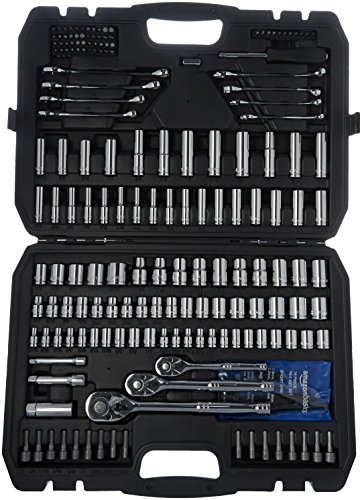
Retail sets map onto these needs at different scales. A 46-piece 1/4-inch drive set, such as the Egofine at about $15, is a good glove-box or interior kit but has no 3/8- or 1/2-inch capability and will not touch a drain plug. The DEWALT 108-piece set with 1/4- and 3/8-inch drives (about $80) covers most under-hood work but is SAE only in that version, which is a poor match for any car built in the last 30 years. The Amazon Basics 201-piece set in SAE and metric (about $109) and the CRAFTSMAN 230-piece set with 1/4-, 3/8-, and 1/2-inch drives in SAE and metric (about $129) are the full three-drive kits; roughly 80 to 100 of those pieces are what you will actually use on a car, and the rest are hex keys, bits, and SAE sockets.
How to Measure Your Space
- Look up your car’s common fastener sizes. Check the owner’s manual or a service manual for the lug nut size (usually 17, 19, or 21 mm), oil drain plug (often 14, 15, or 17 mm), and spark plug (14 or 16 mm hex). Those three numbers tell you the minimum set.
- Measure the lug nut torque. Passenger cars specify 80 to 100 ft-lb; trucks and SUVs 100 to 150. That confirms you need a 1/2-inch drive breaker bar or torque wrench, not just a 3/8-inch ratchet.
- Decide between metric and SAE. Every car sold in the United States since about the mid-1990s is metric. Domestic trucks from before then and some aftermarket parts still use SAE. If your fleet is post-2000, a metric-only set is fine.
- Check clearance in the engine bay. Compact engine bays reward a 1/4-inch drive set and a stubby 3/8-inch ratchet under 6 inches long. Trucks and older cars have room for a 10-inch ratchet.
- Measure your storage. A 200-piece blow-mold case is roughly 19 by 13 by 4 inches (48 by 33 by 10 cm) and weighs 15 to 20 pounds. A 46-piece case is about 10 by 6 by 2 inches. Make sure you have a shelf or drawer of that size.
- Count the accessories you actually need. Two extensions (3 and 6 inch), a universal joint, a spark plug socket with a rubber insert, and a 1/2-to-3/8 adapter. If a set lacks these, budget $20 to $40 to add them.
By Room or Use Case
Oil changes and filters only
A 3/8-inch drive metric set from 10 to 19 mm with a 6-inch extension and a ratchet handles the drain plug and most filter housings. Add a cap-style oil filter socket for your specific filter, around $10. A 40- to 60-piece 3/8-inch set at $40 to $70 is plenty.
Brakes and rotors
You need both 3/8-inch (caliper slide pins, 12 to 14 mm) and 1/2-inch (caliper bracket bolts, 17 to 21 mm at 80 to 130 ft-lb) drives, plus a breaker bar. This is the job that justifies stepping up to a two- or three-drive mechanics set in the $80 to $130 range.
Spark plugs and ignition
A 3/8-inch drive spark plug socket in the correct hex (5/8 inch, 14 mm, or 16 mm), a 6- and a 10-inch extension, and a universal joint for plugs tucked behind the intake. A magnetic or rubber-insert plug socket prevents dropping the plug into the well.
Tire rotation and roadside
A 1/2-inch drive breaker bar of 18 to 24 inches with a 6-point deep socket in your lug size, plus a 1/2-inch torque wrench in the 20 to 150 ft-lb range for reinstallation. Keep this trio in the trunk; it is not part of a general set but is the most-used car tooling in most households.
Interior, trim, and electrical
The 1/4-inch drive set earns its keep here: 7, 8, and 10 mm sockets for trim, dash panels, and battery terminals, plus a bit driver for Torx and Phillips screws. A $15 to $25 1/4-inch set with a bit assortment covers it.
Motorcycles, bikes, and small engines
Mostly 1/4- and 3/8-inch drive metric from 8 to 17 mm, with hex and Torx bits. Lawn equipment adds a few SAE sizes (3/8, 7/16, 1/2 inch) on domestic engines.
Common Sizing Mistakes
- Buying SAE only. Modern cars use metric fasteners almost exclusively. An SAE-only kit will fit a few sizes by coincidence and round off the rest.
- Judging a set by piece count. A 230-piece kit may have 40 hex keys and 50 screwdriver bits. Count the sockets in 8 to 22 mm, deep and shallow, across drive sizes; that is the real measure.
- Skipping deep sockets. Strut nuts, exhaust bolts, and battery hold-downs sit on long studs that shallow sockets cannot reach.
- Using 12-point sockets on stuck fasteners. Six-point sockets grip the flats and are far less likely to round a rusted bolt. Most good sets are 6-point; check before buying.
- Trying to break lug nuts with a 3/8-inch ratchet. Lug nuts at 100 ft-lb, often rusted tighter, will strip a 3/8-inch ratchet mechanism. Use a 1/2-inch breaker bar.
- Missing the spark plug socket. Standard deep sockets are too thin-walled or lack the retention insert; plugs need their own socket in the right hex size.
- Overspending on a first set. A $100 to $130 three-drive mechanics set with 200-plus pieces covers a home mechanic for years. Prices in 2026 for that class have been stable; spend the savings on a torque wrench and a breaker bar instead of a bigger case.
FAQ
Is a 3/8-inch or 1/2-inch drive socket set better for cars?
3/8 inch is the workhorse for most under-hood and brake work because the sockets are compact and the ratchet fits in tight spaces. 1/2 inch is essential for lug nuts, suspension, and any fastener above about 100 ft-lb. A complete home set has both, with 3/8 as the larger collection.
Do I need SAE sockets for a modern car?
Not for the car itself; vehicles sold in the United States since the mid-1990s are metric. SAE sizes are useful for older domestic trucks, trailers, lawn mowers, and household hardware. If you buy a combined set, expect the SAE half to see little use on the car.
What socket sizes are used most on cars?
10 mm (battery terminals, brackets, covers), 12 and 14 mm (caliper bolts, engine accessories), 17 and 19 mm (drain plugs, caliper brackets, lug nuts), and 21 mm (lug nuts on many trucks and SUVs). A set with deep and shallow sockets from 8 to 22 mm covers all of them.
Is a 46-piece 1/4-inch socket set enough for car maintenance?
No, on its own. A 1/4-inch set handles trim, sensors, and battery terminals, but it cannot deliver the torque for drain plugs, calipers, or lug nuts and tops out around 14 mm. Treat it as a companion kit to a 3/8- and 1/2-inch drive set, not a replacement.