Key takeaways
- Manufacturer states 0.5-second readouts with a thermocouple probe.
- The 4.31-inch stem can reach the center of thicker roasts.
- Temperature hold and calibration adjustment support repeat checks.
Checking the center of a chicken breast or the narrowest part of a steak calls for an instant read thermometer that settles quickly, has a fine probe tip, and shows the temperature without forcing your hand over the heat. The important differences are not just brand names. Published response times range from under a second to several seconds in these six models, while washability, display orientation, and power systems affect everyday use.
Quick Verdict: For most home cooks, the TempPro TempSwift ELITE TP620 offers the most practical balance: a maker-rated 0.5-second response, accuracy within 0.9°F, a folding thermocouple probe, and a $39.99 listed price. Choose the ChefsTemp Finaltouch X10 if IP67 protection and slightly tighter specified accuracy matter more. These are editorial selections from manufacturer documentation as of October 2026, not in-house tests. Check the current listing and the precise variant before buying.
As an Amazon Associate we earn from qualifying purchases.
By DIY Ideas 4 Home Editorial Team
6 Best Instant-Read Thermometers Reviewed
We selected six currently listed US models with specific product pages and compared manufacturers’ published accuracy, response time, probe layout, protection rating, and maintenance needs. Prices on official brand pages in October 2026 span $18.99 to $69.99 for this set; promotional prices can expire. The response figures are maker specifications rather than side-by-side independent measurements. Every unit here is a spot-check tool, not a leave-in oven probe. USDA FSIS, in its Food Thermometers guidance, advises checking the center of food and avoiding bone or fat when inserting the tip.
| Product | Best For | Key Spec | Listed Price (as of October 2026) | Watch Out For |
|---|---|---|---|---|
| TempPro TempSwift ELITE TP620 | Best Overall | 0.5-second stated read; accuracy within 0.9°F | $39.99 | IP65 splash resistance, not immersion protection |
| ChefsTemp Finaltouch X10 | Best for Frequent Rinsing | 0.5 to 1 second; accuracy within 0.7°F in stated range | $69.99 | Higher purchase price; 1-year warranty |
| ThermoWorks ThermoPop 2, 4.5-inch | Best for Pocket Storage | 2 to 3 seconds; accuracy within 1°F from 14 to 208°F | $24.00 sale; $39.00 regular | Separate probe sheath to store and handle |
| Lavatools Javelin PRO Classic | Best for Readability | 2 to 3 seconds; accuracy within 0.9°F in stated range | $49.99 | IP65 rather than IP67 |
| TempPro TempSwift PLUS TP19H | Best Budget | 1-second current listing claim; accuracy within 0.9°F | $18.99 | Legacy TP19H support sheet quotes slower response |
| INKBIRD IHT-1P | Best for USB Charging | 3 to 5 seconds; accuracy within 2°F | $23.99 sale; $29.99 regular | Less exact reading specification than top choices |
TempPro TP620: Best Overall
Best For: Home cooks who take several quick readings across steaks, chicken pieces, and holiday roasts.
The TP620 combines a relatively modest asking price with a maker-stated response quick enough to check multiple spots before the grill lid must close again. Its thermocouple sensor and folding stem distinguish it from the rechargeable INKBIRD option, which has a slower published settling time and broader accuracy tolerance. A temperature-lock function also lets you withdraw the stem before reading when the food sits deep inside a roasting pan.
TempPro’s TempSwift ELITE TP620 product page specifies a 0.5-second response, accuracy within 0.9°F, and a range from -58 to 572°F. The company listed the TP620 at $39.99 rather than its $49.99 crossed-out price in October 2026. It uses a 4.31-inch stainless-steel thermocouple probe, an automatically rotating backlit screen, and an IP65 protection claim. Those are manufacturer specifications, not a promise that every food texture will stabilize in exactly half a second.
The folded unit measures 6.25 inches long, 1.75 inches wide, and 0.81 inch high, according to the TP620 product specifications. Its replaceable AAA cell avoids a charging cable, while the hinged joint and screen are the main components to protect from drops. TempPro describes a calibration adjustment and a hold function, useful if an ice-water check starts to drift. IP65 means resistance to water jets under rated conditions; it does not authorize soaking the thermometer in a sink.
Pros:
- Manufacturer states 0.5-second readouts with a thermocouple probe.
- The 4.31-inch stem can reach the center of thicker roasts.
- Temperature hold and calibration adjustment support repeat checks.
Cons:
- IP65 is less protective against immersion than ChefsTemp’s IP67 specification.
- Its folding joint will need more care than a straight-body pen.
Who Should Buy It: Choose the TP620 when speed and cost both matter; pay more for the ChefsTemp Finaltouch X10 if rinse exposure and tighter stated accuracy outweigh the savings.
ChefsTemp Finaltouch X10: Best for Frequent Rinsing
Best For: Busy family kitchens where the probe gets cleaned between several raw and cooked ingredients.
ChefsTemp’s X10 suits the cook who values a generous folding angle, bright display, and protection from repeated splashes more than the lowest ticket price. Compared with the Lavatools Javelin PRO Classic, it carries a higher IP67 enclosure rating and a tighter published accuracy figure over its principal measuring range. The 270-degree probe rotation can also make it easier to approach a large pot from a position where your wrist is not hovering directly above steam.
The manufacturer’s Finaltouch X10 product page lists $69.99 as its current price, a response of 0.5 to 1 second, and accuracy within 0.7°F from -22 to 392°F. Its specifications identify a 4-inch Type K thermocouple tip, a backlit auto-rotating screen, and IP67 dust and water resistance. ChefsTemp also states a one-year warranty. The feature headline elsewhere on that page calls out tighter accuracy, but the detailed specification is the figure used here.
The case is stated to measure 6.69 by 1.57 by 0.94 inches and to weigh 0.27 lb, making it substantial enough to locate in a crowded drawer. Two AAA batteries are listed as included; the owner does not have to commit to a proprietary charging connector. However, a waterproof rating covers the enclosure under defined conditions, not rough treatment of the pivot joint. ChefsTemp’s user manual should guide cleaning, storage, and any service requests rather than treating IP67 as permission to put it in a dishwasher.
Pros:
- IP67 body offers a higher published sealing grade than IP65 options.
- Its 270-degree pivot helps approach deep pots from more angles.
- The 4-inch thermocouple tip supports quick checks in thick food.
Cons:
- The $69.99 manufacturer price exceeds that of the TP620.
- A one-year warranty is shorter than Lavatools’ stated coverage.
Who Should Buy It: Buy the X10 for its sealing and angled access; choose the TempPro TP620 instead if everyday grill readings matter more than additional water protection.
ThermoWorks ThermoPop 2: Best for Pocket Storage
Best For: Cooks wanting a slim, sheath-protected thermometer that can live in an apron or utensil drawer.
The ThermoPop 2 is not another folding instrument. Its straight, narrow probe and separate protective sheath make it approachable for cooks who want an uncomplicated tool without a hinge. That shape also helps when sampling the center of a loaf or inserting the tip sideways into a thin burger. Compared with the larger ChefsTemp X10, the ThermoPop’s simpler pen-like format demands less countertop space, although its reported reading time is longer.
ThermoWorks’ ThermoPop 2 product page lists the 4.5-inch version at $24.00 on sale from $39.00 as of October 2026. The 4.5-inch model has a published 2 to 3 second response and accuracy within 1°F between 14 and 208°F, covering common food-safety checkpoints. It also features an IP67 casing, a rotating backlit display, a replaceable CR2032 cell, and a two-year warranty. ThermoWorks publishes a separate response time for its 8-inch variant, so do not treat both versions as interchangeable.
For the specific 4.5-inch SKU, the company’s spec sheet gives an overall length of 7 inches, a width of 1.8 inches, and a depth of 0.7 inch. That elongated body should fit an apron pocket but may catch in a very shallow utensil insert. The exposed point must be returned to its sheath after each wash; a fixed-stem tool trades off a little convenience during storage for having no folding pivot to wear. The manufacturer includes operating instructions for this probe length.
Pros:
- A 4.5-inch probe is practical for testing loaves and chicken.
- IP67 construction pairs with a pocketable 0.7-inch-deep body.
- ThermoWorks includes a two-year warranty and calibration certificate.
Cons:
- A 2 to 3 second stated reading is slower than TP620.
- Separate sheath handling can be awkward with messy hands.
Who Should Buy It: Choose ThermoPop 2 for compact straight-probe storage; choose the Lavatools Javelin PRO Classic for an enlarged screen and one-piece folding storage.
Lavatools Javelin PRO Classic: Best for Readability
Best For: Grillers who need big digits while looking down at food from awkward angles.
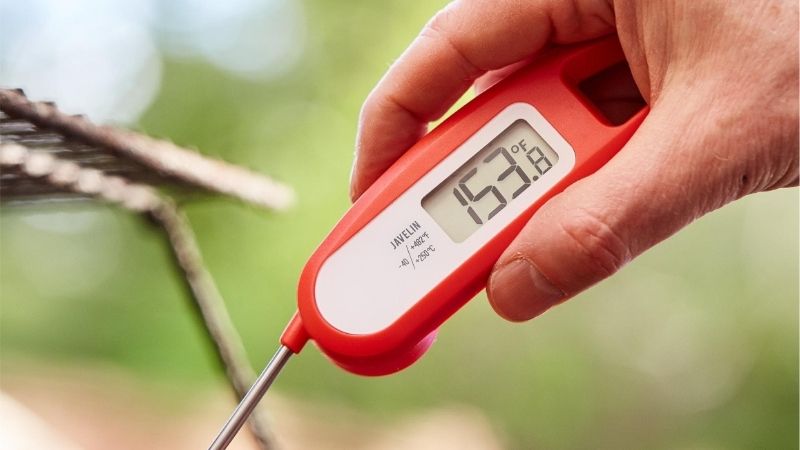
Not everyone needs the fastest stated response. The Javelin PRO Classic’s larger display may be more useful when glare, smoke, or oven mitts make a small readout frustrating. It automatically turns the view when held upside down and provides a stabilization hold for moving the thermometer away from hot cookware. The distinctive selling point against the slimmer ThermoPop 2 is the approximately 2-inch antifog display, not a claim of superior temperature accuracy.
Its product page for the Javelin PRO Classic shows a $49.99 price, typical 2 to 3 second readings, and accuracy within 0.9°F from -4 to 302°F. It lists an IP65 splash-resistant enclosure, magnetic storage, a replaceable CR2032 battery, and a three-year limited warranty. The same technical page identifies the display as backlit with automatic rotation, although it sometimes uses the older PRO Duo name in descriptive copy. Buyers should match the product heading and current listing photographs to the actual Classic unit.
Its published 4.5-inch probe length is important for reaching the middle of a thick pork shoulder without burying the user’s fingers at the surface. Lavatools’ product page describes a narrow tapered sensing tip and a carrying-free magnetic attachment for a fridge or metal utensil panel. A pocket of grease on the screen can still interfere with the touch or motion controls; wiping the device according to the Javelin PRO Classic manual is preferable to leaving it immersed. The CR2032 can eventually need replacing despite the maker’s long-life claim.
Pros:
- Two-inch antifog readout favors cooks who read from above.
- Temperature HOLD lets the display be read away from burners.
- Published three-year warranty exceeds the X10’s one-year coverage.
Cons:
- Published 2 to 3 second response trails the TP620.
- Touch and motion features add controls compared with a simple pen.
Who Should Buy It: Buy the Javelin PRO Classic if screen visibility is your first concern; the ThermoWorks ThermoPop 2 offers a slimmer body for carrying and storage.
TempPro TP19H: Best Budget
Best For: Occasional cooks who want folding storage and automatic screen rotation at a low entry price.
The TP19H puts everyday convenience features within reach of shoppers who might otherwise settle for a slow, non-backlit kitchen thermometer. It has a rotating display, a magnetic back, and a hold control, while the next TempPro model in this roundup costs more for its thermocouple sensor. This is a reasonable trade for a family that takes a few readings each week rather than monitoring a crowded barbecue grill where every second of lid-open time matters.
TempPro’s current TempSwift PLUS TP19H product page lists $18.99, a 1-second response claim, and accuracy within 0.9°F in its main food temperature range. The product description specifies an NTC sensing element, a 4-inch stainless probe, and IP65 water resistance. There is an important document difference: the company’s older TP-19H Specifications and Details support article quotes 3 to 4 seconds and different outer dimensions. Treat the newly branded PLUS page as the source for this pick, and check the version printed on the retail packaging.
The present TP19H listing specifies a case 6.18 inches long, 1.625 inches wide, and 0.81 inch high. One AAA battery powers its motion sensing and backlight, rather than using a rechargeable cell. The fold-out stem and magnet are convenient near a stove, but do not place the plastic case on a hot surface or leave it attached to a heated oven door. TempPro’s current product page also describes user calibration, which can help troubleshoot an unexpected reading before deciding to replace the tool.
Pros:
- $18.99 official sale price keeps initial outlay low.
- One AAA cell supports convenient battery replacement between holidays.
- Built-in magnet stores the folded tool away from crowded drawers.
Cons:
- Older TP19H literature states a slower response than current marketing.
- NTC sensor does not provide the TP620’s thermocouple design.
Who Should Buy It: Pick the TP19H for occasional dinners on a tight budget; choose the TempPro TP620 if you want a better-defined thermocouple response specification.
INKBIRD IHT-1P: Best for USB Charging
Best For: Cooks who prefer recharging a thermometer rather than keeping coin cells or AAA replacements on hand.
INKBIRD takes a different approach to power. Its built-in lithium battery, charging cable, and magnetic back suit a cooking station where USB charging is already routine. That avoids stocking spare batteries, but it introduces the inconvenience of waiting when the unit has been left uncharged before a large meal. The IHT-1P also accepts a slower, less exact measurement specification than TempPro’s TP620, so this is a convenience choice rather than a performance winner.
INKBIRD’s official IHT-1P product page lists $23.99 on sale from $29.99, a response described as 3 to 5 seconds, and accuracy within 2°F. The manufacturer’s specifications also show a measurement range from -58 to 572°F, IPX5 protection, a temperature hold, and a 250 mAh rechargeable battery. INKBIRD advertises up to 30 hours of use without the backlight, or around 10 hours with it on. The page’s 0.5-second measuring-rate entry is not a full stabilized-response claim and should not be compared to another thermometer’s reading time.
The instrument weighs about 0.17 lb (2.7 oz), based on INKBIRD’s published net weight, light enough to clip into a grill tool bag without noticeably adding bulk. Its manufacturer page gives dimensional values but appears to repeat a length measurement in a way that is difficult to interpret; confirm the folded shape from the actual product photos before ordering a fitted drawer organizer. INKBIRD’s IHT-1P manual is the relevant reference for cable charging and cleaning. IPX5 protects against water spray but does not justify immersing the charging port.
Pros:
- Integrated 250 mAh cell removes the recurring battery purchase.
- Magnetic storage keeps the lightweight 2.7 oz tool accessible.
- Temperature hold permits reading after withdrawing the probe from food.
Cons:
- Accuracy within 2°F is looser than ThermoWorks’ food-range specification.
- Flat battery before dinner requires charging instead of a quick swap.
Who Should Buy It: Choose the INKBIRD IHT-1P if USB power is a priority; the TempPro TP19H makes more sense when immediate battery replacement is important.
How to Choose an Instant-Read Thermometer
A thermometer is only as useful as the place you can put its sensing tip. Food safety depends on temperature at the center of the food, not on a bright display or a fast number taken against bone. The USDA FSIS Safe Minimum Internal Temperature Chart specifies 165°F for all poultry, 160°F for ground meats, and 145°F with a three-minute rest for whole cuts of beef, pork, veal, and lamb. Start with the use case, then compare how the manufacturer’s specification is measured.
Compare Settled Readings, Not Screen Refresh
A manufacturer’s response time describes how quickly its sensor approaches a temperature under particular conditions. It is not necessarily how fast numbers change on the LCD. The INKBIRD IHT-1P demonstrates the distinction clearly: its specifications include a 0.5-second measuring rate, while the product overview advertises 3 to 5 seconds for the reading. Comparing those as if they were identical would reward the wrong feature.
On the current official listings, TempPro gives the TP620 a 0.5-second response and ThermoWorks gives the 4.5-inch ThermoPop 2 a 2 to 3 second response. Both can be suitable for home cooking if the tip is correctly centered and allowed to stabilize. For a holiday roast, take readings in several locations rather than assuming the first number represents the entire bird. A modest difference in theoretical speed matters less when a cold pocket goes unchecked.
Read Accuracy With Its Temperature Range
Accuracy is generally quoted as a tolerance over a specified interval, not as one universal number for every extreme the device can display. ThermoWorks specifies ThermoPop 2 to within 1°F between 14 and 208°F; ChefsTemp describes the X10 to within 0.7°F across a broader central band. Near the edges of a thermometer’s operating limits, published tolerances can be wider. A display showing tenths of a degree does not by itself prove measurements are accurate to a tenth.
Check the owner’s manual for instructions on an ice-water accuracy check and whether the product supports recalibration. TempPro publishes a calibration function for both TP620 and the current TP19H, whereas Lavatools emphasizes its preconfigured sensor. When a result is borderline at a food safety threshold, reinsert the probe correctly and confirm it has settled before making a cooking decision. Do not use a repeated doubtful number as a substitute for the USDA’s safe temperature requirements.
Choose a Probe Shape That Fits the Food
A long probe can reach inside a turkey breast without burning your fingers, but a slender tip is more helpful for thin burgers or small fish fillets. The ThermoPop 2’s 4.5-inch straight probe can be inserted sideways for a thin cut; TempPro’s folding TP620 works well for different hand positions over a barbecue. A long stem does not mean the sensor measures along the entire shaft. Find the sensing zone from the specific product instructions before using it for very thin food.
USDA FSIS Food Thermometers guidance recommends inserting a thermometer in the thickest part of meat away from bone, fat, and gristle. For whole poultry, measure the innermost thigh, innermost wing, and thickest breast area. After a raw chicken check, wash the probe according to the maker’s directions before it touches cooked food or another ingredient. Keep the protective sheath clean as well, since sliding a dirty stem into storage can undermine careful food handling.
Consider Cleaning, Batteries, and Warranty
IP67 and IP65 are enclosure specifications that tell you something about water exposure; neither one turns a handheld thermometer into a leave-in oven instrument. ChefsTemp X10 and ThermoPop 2 state IP67, while TempPro TP620 and Javelin PRO Classic carry IP65 claims. USDA FSIS specifically cautions that most kitchen thermometers should not be immersed. Follow the device manual for rinsing, opening its battery compartment, and drying it after cleaning.
Power choice affects how the tool is kept ready. TempPro’s TP620 uses an ordinary AAA cell, ThermoPop 2 uses a CR2032, and INKBIRD IHT-1P recharges by cable. Their cover mechanisms and seals also differ, so compare a battery door with a charge port in the way you actually store and wash tools. For a household that buys one thermometer for many holiday seasons, manufacturer warranty length may matter more than a small temporary sale discount.
Frequently Asked Questions
Most purchase mistakes happen after choosing the sensor: the tool is used in the wrong location, left beside an oven burner, or stored with food residue on the stem. These four questions cover practical handling decisions that are easy to miss when comparing spec sheets.
Can I Leave an Instant-Read Probe Inside the Oven?
No. The six handheld instruments in this roundup are designed for brief temperature checks, not for staying inside a heated oven or closed grill. Their measurement ranges describe what the metal sensor can detect during a check; they do not establish an allowable ambient temperature for the plastic body or screen. USDA FSIS Food Thermometers guidance specifically distinguishes leave-in cooking thermometers from tools that are used to check food and removed.
For long cooks where you want live readings without opening the door, use a probe model explicitly designed for oven use, with the manufacturer-approved cable or wireless arrangement. That is a different product category and should not be inferred from a folding handheld thermometer’s peak measurement range.
Can I Use a Meat Thermometer for Bread or Candy?
Yes, when the intended temperature falls within the exact thermometer’s published measurement range and the maker allows that application. An instant-read probe is helpful for the center of a loaf or for spot-checking a pot of syrup. A slow-moving liquid may create temperature gradients, so stir only when the recipe and cooking technique permit, then check the center without touching the metal pan.
For candy making, do not assume a tool that reads up to 572°F can remain clipped to the saucepan. If you need constant feedback while syrup boils, choose a purpose-designed clip-on instrument with the right support and temperature rating. The grip and display of a handheld probe must stay out of the liquid and away from burner heat.
How Do I Check an Unexpected Temperature Reading?
Start with a correctly prepared ice-water bath and the procedure in the instrument’s manual. Insert only the specified sensing portion, wait for stabilization, and compare with the manufacturer’s acceptance range. The boiling-point method needs extra care because altitude and local air pressure shift the reference value, so it is less convenient for a quick kitchen check.
If the result still looks wrong, try a fresh battery where the model has one and inspect the probe for bends or contamination. Only use the calibration controls when the product instructions permit it. A damaged thermocouple joint or unreliable readout is a reason to stop using that device for food-safety decisions.
Is a 165°F Turkey Reading Enough by Itself?
No. USDA FSIS Turkey Basics: Safe Cooking advises checking the innermost portion of the thigh and wing and the thickest breast section, all reaching at least 165°F. A single reading from the breast does not prove that a thicker region near a joint is also safe. If the turkey is stuffed, the center of the stuffing must reach 165°F as well.
Probe location matters especially in a large bird where dark meat and white meat can heat at different rates. Avoid contact with bone, wait for the display to settle at each spot, and clean the sensing stem according to its instructions after handling raw poultry. Cooking time charts are planning estimates, not substitutes for checking several locations.
Final Thoughts
The TempPro TempSwift ELITE TP620 remains the Best Overall instant read thermometer here because its published 0.5-second response, folding thermocouple design, and $39.99 manufacturer price give frequent home cooks a useful combination. The ChefsTemp Finaltouch X10 is a more appropriate purchase when an IP67 housing and its stated tighter accuracy are worth the added expense, while the ThermoPop 2 makes more sense for straightforward apron-pocket storage. Before ordering, confirm which model revision is actually being shipped, especially for TP19H listings that use older product material, and check the current price and stated temperature-accuracy range on that exact listing.