Key takeaways
- 17-gallon daily manufacturer rating fits many professionally sized central systems.
- Model 60 digital control includes an outdoor temperature sensor.
- Model 35 water panel has a published replacement part number.
Dry winter air can affect several rooms at once, but a whole house humidifier is not always an appliance that plugs in beside the sofa. Duct-mounted systems feed moisture into forced-air heating, while freestanding console units depend on air circulation between rooms. The right purchase starts with that distinction, followed by the amount of moisture the house loses and the work you are willing to do each season. Too much moisture is also a problem: the U.S. Environmental Protection Agency advises against indoor humidity above 50 percent.
Quick Verdict: For a home with compatible forced-air ducts, the AprilAire 600 is our Best Overall pick, offering a manufacturer-rated 17 gallons per day and automatic digital humidity control. Without ductwork, choose the AIRCARE MA1201 instead. These are editorial selections from published product and installation documents as of October 2026, not detailed research. Check current prices and confirm HVAC compatibility before ordering.
As an Amazon Associate we earn from qualifying purchases.
By DIY Ideas 4 Home Editorial Team
6 Best Whole-House Humidifiers Reviewed
We compared model-specific manufacturer documents, installation requirements, humidistats, water-panel maintenance and published prices in October 2026. AIRCARE lists its two freestanding models at $187.99 and $189.99; the four duct-mounted models are sold through installers or dealers without an official posted list price. Those prices cannot be compared with a complete furnace-mounted installation quote. A daily output rating measures evaporation or steam delivery, not reservoir size, and advertised coverage depends on the home’s construction and airflow.
| Product | Best For | Key Spec | Listed Price (as of October 2026) | Watch Out For |
|---|---|---|---|---|
| AprilAire 600 | Best Overall | 17 gal/day; bypass HVAC mount | No official list price | Needs a bypass duct and water connection |
| AprilAire 700 | Best for No Bypass Duct | 18 gal/day; powered fan | No official list price | Fan and duct fit require planning |
| AprilAire 800 | Best for High-Demand Steam | Up to 34.6 gal/day at 240 V, 16 A | No official list price | Dedicated electrical work and annual canister |
| GeneralAire 1042LH | Best for Manual Controls | 17 gal/day at 120 F plenum | No official list price | Manual humidistat and plenum clearance |
| AIRCARE MA1201 | Best for No HVAC Work | 3.6-gal tank; four fan speeds | $187.99 | Refilling and fan noise at higher speeds |
| AIRCARE 831000 | Best for Fewer Refills | 6-gal tank; up to 70 hours per fill | $189.99 | Floor placement and periodic wick changes |
AprilAire 600: Best Overall
Best For: Owners of a central forced-air system with room for a bypass connection and a desire for automatic control.
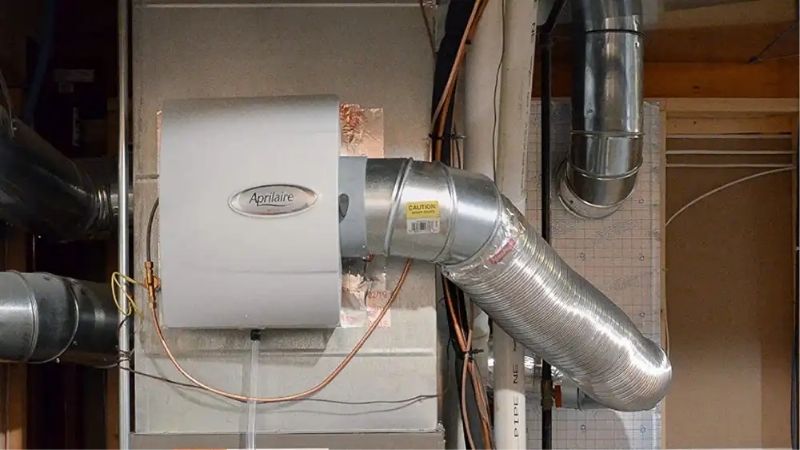
The 600 makes sense when the house already has supply and return ducts suitable for an evaporative bypass installation. It avoids the electrical demands of the AprilAire 800 steam unit, and its digital humidistat adds adjustment that the GeneralAire 1042LH’s included manual control lacks. The choice depends on a contractor verifying enough airflow across its wetted panel; a well-insulated house with no practical bypass route may favor the 700.
AprilAire’s product page for the Model 600 rates it at 17 gallons per day and quotes coverage up to 5,000 square feet for tightly constructed homes. The included Model 60 automatic controller, outdoor temperature sensor and Model 35 water panel are named in the product contents. AprilAire does not post an official list price for the 600 in October 2026, so request a total installed quote rather than comparing it with a freestanding appliance’s shelf price.
The cabinet measures 15.75 inches high, 10.25 inches wide and 15.375 inches deep. That footprint is only part of the installation: an installer also needs a suitable plenum opening, room for panel access, a water supply and a drain. AprilAire’s product support materials call for changing the water panel as required, often during the heating season; its genuine Model 35 replacement started at $16.99 in the manufacturer’s store in October 2026. Discuss the bypass damper’s seasonal position during commissioning.
Pros:
- 17-gallon daily manufacturer rating fits many professionally sized central systems.
- Model 60 digital control includes an outdoor temperature sensor.
- Model 35 water panel has a published replacement part number.
Cons:
- A bypass route is essential; an obstructed return path defeats the design.
- Installed cost depends on the home’s duct modifications and plumbing access.
Who Should Buy It: Choose the 600 for a compatible central system; choose AprilAire 700 when bypass ductwork is impractical.
AprilAire 700: Best for No Bypass Duct
Best For: Forced-air homeowners who can accommodate a powered duct insert but cannot easily run a separate bypass tube.
The 700 resolves a specific installation obstacle rather than merely adding one gallon to a published capacity figure. Its built-in fan moves duct air through the evaporation panel, unlike the 600’s passive bypass route. That feature can simplify routing in a crowded mechanical closet, but it does not erase the need to confirm duct dimensions, water connections and motor power. An HVAC contractor should evaluate available space before the homeowner pays for the unit.
AprilAire’s product page for the Model 700 states 18 gallons per day and a claimed range of up to 5,300 square feet in a tightly constructed residence. It specifies a Model 60 automatic humidistat, Model 35 evaporative panel and 24-volt transformer in the box. Its official site directs purchasers to AprilAire professionals rather than publishing a list price, meaning the correct comparison is an itemized installed bid.
At 18 inches high, 11.35 inches wide and 15.91 inches deep, the powered cabinet needs a somewhat different cutout and service envelope from the 600. The installer needs room to remove the front cover and service the fan as well as replace the wetted panel. If a motor becomes noisy or the airflow path collects deposits, a simple water-panel swap may not solve the problem. Model 35 panels are shared with the 600, useful when comparing replacement availability and recurring supply purchases.
Pros:
- Integrated fan avoids a separate bypass return duct connection.
- Manufacturer quotes an 18-gallon daily evaporation capacity for this configuration.
- Included digital controller can respond to the outdoor temperature sensor.
Cons:
- The powered assembly introduces a fan motor absent from bypass-only models.
- A suitable plenum opening and electrical provision remain necessary.
Who Should Buy It: Favor the 700 when duct routing rules out AprilAire 600; compare the AIRCARE MA1201 if no HVAC alteration is allowed.
AprilAire 800: Best for High-Demand Steam
Best For: Owners facing substantial winter moisture loss who have professional electrical and HVAC installation available.
A steam unit is not automatically the logical upgrade for a mildly dry home. The 800 is compelling where an evaporative panel cannot supply the calculated load, especially when the HVAC system does not provide sustained warm airflow. Its electrode canister makes steam independently of a hot furnace plenum. This is a more involved purchase than a $187.99 console and a more demanding installation than the 600, so output requirements must justify the added electrical and maintenance obligations.
AprilAire’s installation manual for Model 800 lists 11.5 gallons per day at 120 volts and 11.5 amps, rising to 34.6 gallons at 240 volts and 16 amps. These are configuration-specific ratings, not a blanket daily guarantee. The Model 800 product page includes a Model 62 digital controller, Model 80 steam canister and dispersion equipment. AprilAire offers professional purchasing but no official list price in October 2026; electrical labor and any required circuit work belong in the same quote.
The metal enclosure measures 20.88 inches high, 7.13 inches wide and 10.13 inches deep, while the installation guide reports approximately 23 pounds operating weight before mineral buildup. Steam piping, service access and safe drain routing also need space. AprilAire directs owners to replace the canister annually and have a licensed contractor renew electrode wires every three years. Because the available output changes markedly with voltage and amperage, licensed electrical work and the correct circuit protection are central to a safe installation.
Pros:
- Maximum published output reaches 34.6 gallons daily with 240-volt power.
- Steam production does not require a continuously hot furnace plenum.
- Product kit includes the Model 80 canister and steam dispersion tube.
Cons:
- Electrical configuration determines actual maximum output and installation expense.
- Annual steam-canister replacement adds a recurring component cost.
Who Should Buy It: Consider the 800 when a contractor confirms unusual moisture demand; choose GeneralAire 1042LH for a simpler bypass retrofit.
GeneralAire 1042LH: Best for Manual Controls
Best For: Households that prefer a simple dial-style duct control over automatic outdoor-temperature adjustment.
The 1042LH offers a credible alternative to digitally controlled AprilAire bypass models, but it makes the most sense for someone comfortable adjusting the humidistat when weather changes. Its included MHX3C control simplifies the feature set, not the duct installation. GeneralAire’s own sizing recommendation is more conservative in square footage than AprilAire’s 600 claim, which underlines why a contractor should estimate moisture loss rather than buying from an area number alone.
GeneralAire’s spec sheet for Model 1042LH records 17 gallons per day based on a 120 F supply-plenum temperature, with intended use up to 2,800 square feet. It states 24-volt operation and a five-year manufacturer warranty, plus the manual MHX3C duct-mounted humidistat. The company sells the 1042LH via approved wholesalers and installers and does not post an official retail list price. Its 990-13 Vapor Pad was shown at $37.54 on the same manufacturer’s parts listing in October 2026.
This cabinet measures 14 inches high, 15.125 inches wide and 9 inches deep and weighs 13 pounds. The specified 6-inch bypass opening, accessible service panel and seasonal shutoff damper affect installation in tight furnace rooms. GeneralAire says to replace the 990-13 pad once or twice per season depending on conditions; hard water may increase attention to deposits. The output number also assumes a warm plenum, so a heat-pump system with cooler supply air requires particular care in capacity discussions.
Pros:
- 17-gallon rating explicitly references 120 F plenum conditions.
- Included MHX3C control avoids dependence on an automatic outdoor sensor.
- Five-year manufacturer warranty is published for the 1042LH.
Cons:
- Homeowners must manually moderate settings during cold weather shifts.
- A warm-air bypass and seasonal Vapor Pad changes remain necessary.
Who Should Buy It: Pick the 1042LH for straightforward manual control; AprilAire 600 suits owners wanting automatic outdoor compensation.
AIRCARE MA1201: Best for No HVAC Work
Best For: Renters and homeowners who need extensive-room moisture control without cutting ducts or arranging plumbing.
The MA1201 is the clearest option here for someone unwilling or unable to alter a forced-air system. Its automatic fan setting changes speed as the selected humidity level is approached, while its evaporative wick transfers moisture without projecting visible droplets into a room. It cannot promise the uniform room-to-room distribution of a properly sized central unit, though. Open doorways, a central location and a working air-return path influence where the added moisture actually travels.
AIRCARE’s product page for the MA1201 lists a $187.99 price as of October 2026, a 3.6-gallon water capacity, four fan speeds and a maximum 36-hour run time per fill. The claimed coverage is up to 3,600 square feet under favorable conditions, not a measured output rating for every house. The current manufacturer listing does not disclose daily gallons of evaporation, so its 3.6-gallon tank should not be matched directly against the 17-gallon-per-day AprilAire 600 specification. A MAF1 SuperWick replacement is listed at $26.99.
Its 20.5-inch height, 21.5-inch width and 14.5-inch depth demand a clear floor spot rather than a shelf. The MA1201 owner’s manual recommends a central room, at least two inches from the wall for the cord-mounted sensor, and possible placement near a cold-air return. Owners carry water to the removable bottle, rinse deposits and inspect the wick. A refill alert and automatic empty shutoff reduce guesswork, but the manual warns that higher fan speeds are noticeably louder.
Pros:
- Four fan speeds include automatic adjustment to the chosen humidity.
- Removable water bottle holds 3.6 gallons across the complete unit.
- Original MAF1 wick is supplied with the $187.99 console.
Cons:
- Higher fan settings may be distracting in occupied living areas.
- Daily moisture output is not published on the current product page.
Who Should Buy It: Buy the MA1201 to avoid building work; AIRCARE 831000 fits users prioritizing a larger reservoir over removable-bottle handling.
AIRCARE 831000: Best for Fewer Refills
Best For: Homes where carrying water frequently is inconvenient and a freestanding cabinet can stay on the floor.
The 831000 trades the MA1201’s removable bottle for a larger pour-in reservoir. That is useful if lifting a filled container to a sink or faucet is the biggest barrier to using a humidifier consistently. Its three-speed fan provides fewer settings than the Console’s four, but the large reservoir and fill-through-front-grille design reduce trips. Like other standalone evaporative machines, this unit should be judged by the rooms it actually reaches, not only the manufacturer’s advertised house-area estimate.
AIRCARE’s 831000 product page displays $189.99 in October 2026 and states a 6-gallon reservoir, three fan speeds and up to 70 hours of maximum run time. Its claimed coverage reaches 2,700 square feet. The model uses the included 1043 SuperWick and a digital adjustable humidistat with refill and filter indicators. AIRCARE prices the 1043 wick separately at $31.99. That filter is a predictable replacement purchase; actual change frequency depends on water hardness and conditions, not a fixed one-size calendar.
The cabinet stands 22.5 inches high, measures 12.5 inches wide and extends 17.5 inches deep. AIRCARE’s 831000 owner’s manual directs users to pour water only through the designated lower opening, never through the motor area. Keep the cabinet on a level surface with an unobstructed air path; casters permit repositioning before filling. Wicks accumulate dissolved minerals as water evaporates, so a full tank does not eliminate cleaning. The manufacturer’s two-year limited warranty covers the appliance under its stated conditions, not endless wick supplies.
Pros:
- Six-gallon reservoir supports manufacturer-claimed operation up to 70 hours.
- Front-grille filling avoids removing a separate water bottle for refills.
- Digital display includes both low-water and wick-service indicators.
Cons:
- Claimed coverage of 2,700 square feet trails the MA1201’s figure.
- Pour-in filling requires care to keep water away from controls.
Who Should Buy It: Choose the 831000 for accessible floor-level filling; GeneralAire 1042LH eliminates routine tank filling in a ducted home.
How to Choose a Whole-House Humidifier
A typical buying mistake is matching a gallon figure to a floor-area claim without checking what each figure means. A 6-gallon reservoir is stored water; a 17-gallon-per-day rating describes possible moisture delivery under stated conditions. Before paying for either system, measure humidity with a separate hygrometer and identify where the house becomes too dry. In its 2022 humidifier guidance, the EPA recommends keeping indoor relative humidity below 50 percent and lowering output if condensation appears.
Choose Ducted or Freestanding First
For homes with one central forced-air system, a duct-mounted evaporative humidifier can distribute water vapor through supply registers while the HVAC blower runs. The AprilAire 600 and GeneralAire 1042LH need a bypass connection; the AprilAire 700 adds its own fan to avoid that separate route. The AprilAire 800 injects steam and requires different electrical and steam-dispersion planning. A quote should state exactly which ducts, water lines and drains are being altered and whether the equipment can operate with the heating system’s controls.
Freestanding consoles need no furnace attachment, which can make them the practical answer for rentals, older radiator-heated houses and properties with separate room units. The AIRCARE MA1201’s 3.6-gallon reservoir is easier to move around a room than a fixed duct component, but humidified air still needs to circulate. A 2,700-square-foot advertisement does not mean every closed upstairs room in a two-story house will receive the same humidity. Position a console where air can circulate and test the actual rooms rather than trusting a single central sensor.
Compare Daily Output Against Moisture Loss
Heating and ventilation remove moisture faster in some houses than others. Drafts, cold outdoor air, ceiling height, open fireplaces and frequent exhaust-fan use all change the humidification load. GeneralAire explicitly rates the 1042LH at 17 gallons per day using a 120 F plenum temperature, while the AprilAire 800 requires 240-volt, 16-amp configuration for its maximum 34.6-gallon-per-day claim. Those numbers are conditional, not equal-performance measurements in the same house. Ask an installer to calculate the home’s winter moisture load using its actual tightness and heating setup.
Capacity also affects how you live with a console. AIRCARE’s MA1201 lists a 36-hour maximum run time for a 3.6-gallon tank; the 831000 lists up to 70 hours from six gallons. Those long-run figures reflect favorable operation rather than how long the equipment will last at maximum humidity demand. A unit working hard in very dry weather can need water sooner. If emptying and refilling will be skipped, an appropriately installed water-fed system may be more useful than a large portable cabinet, even where the latter costs less upfront.
Match Controls to the Heating System
Automatic and manual controls affect how often someone must adjust the setting. The AprilAire 600 and 700 ship with the Model 60 digital humidistat and an outdoor-temperature sensor; the GeneralAire 1042LH includes the MHX3C manual control. Outside-temperature compensation is useful in cold climates because a fixed high humidity setting can create condensation on cold windows. Even an automatic system should be checked against actual room readings, especially where multiple HVAC zones or unheated rooms are present.
Both AIRCARE units include adjustable digital humidistats, but their fan controls are not identical. The MA1201 can change fan speed automatically, whereas the 831000 offers three selectable speeds with empty-tank shutoff. These features help control the machine, not solve moisture transfer through closed doors. If different floors consistently show different readings, the answer may be better airflow, another unit or an HVAC review rather than setting one humidistat ever higher.
Budget for Maintenance and Installation
Seasonal consumables deserve a line in the budget. In October 2026, AIRCARE posted $26.99 for the MAF1 wick and $31.99 for the 1043; AprilAire’s Model 35 water panel began at $16.99, while GeneralAire listed the 1042LH’s 990-13 Vapor Pad at $37.54. One household may use more than one wick or panel in a heating season because mineral content and running hours differ. Look up the exact replacement part, not a similar-looking pad that happens to fit the opening.
Water-fed systems still require upkeep. The AprilAire 800 uses a steam canister that the manufacturer calls for replacing each year, and it includes separate professional electrode-wire service. Bypass panels need drain checks, correct damper operation and periodic cleaning. EPA’s humidifier care guidance says to follow the maker’s instructions for console and central models, prevent stagnant water and stop overhumidifying. For wiring at the furnace, especially steam equipment on a higher-voltage circuit, hire qualified electrical and HVAC professionals rather than altering connections while the system is energized.
Frequently Asked Questions
These practical questions come up after the size and product type have been narrowed down. They matter because an otherwise suitable humidifier can disappoint when the home’s plumbing, heating layout or operating habits do not match its design.
Do I Need Two Humidifiers for Two Furnaces?
Often, yes, if the furnaces serve independent duct systems. AprilAire’s Model 800 installation guide notes that homes with multiple furnaces or air handlers may require one humidifier for each system. A single appliance attached to downstairs ducts cannot deliver a controlled amount of moisture through an entirely separate upstairs network. Ask the installer to draw the duct zones and estimate the moisture requirements separately before buying equipment.
Can I Use Distilled Water in a Whole-Home Unit?
It depends on the operating mechanism and the exact manual. The EPA recommends low-mineral water for ultrasonic or impeller portable humidifiers to reduce airborne mineral dust. By contrast, electrode-based steam units rely on the electrical properties of water and have specific conductivity requirements. Do not replace the AprilAire 800’s specified supply with distilled or treated water without checking its installation instructions. For evaporative consoles, follow AIRCARE’s water and wick directions instead of adding oils or unapproved chemicals.
Why Is There No Visible Mist From My Console?
That can be normal for an evaporative unit. AIRCARE’s MA1201 and 831000 pull air across a wetted paper wick, where moisture evaporates and leaves the outlet without a visible cloud. A clean machine with the correct fan setting may still appear to be doing nothing. Confirm the reservoir is draining gradually, the fan is running and a separate hygrometer shows an appropriate trend over time. A clogged wick or a humidistat that has already reached its setpoint can prevent additional output.
Can a Whole-Home Humidifier Increase My Electric Bill?
Yes, but the effect varies substantially with the design. A fan-powered evaporative model uses electricity for its fan and controls, while a bypass model mainly depends on the heating system’s existing airflow. An electrode-steam system such as the AprilAire 800 uses electrical energy to boil water and can require a much larger power connection. The correct comparison is the complete heating-season operating cost at the humidity setting you actually need, including water and replaceable parts, not the humidifier’s purchase price alone.
Final Thoughts
The AprilAire 600 remains our Best Overall whole house humidifier for an appropriate ducted home because its 17-gallon daily manufacturer rating, automatic Model 60 control and replaceable water panel provide a practical starting point without steam-level electrical work. An AIRCARE MA1201 is the purchase to investigate instead when a lease or house layout rules out HVAC changes. Before committing, have a contractor check the bypass space or place a hygrometer in the driest bedroom as well as the room containing a portable unit; the gap between those readings can change the decision. Check the latest price, replacement-part availability and installation requirements on the exact model listing before buying.