Key takeaways
- One wireless SmartSensor included
- Power extender kit for no-C-wire homes
- Supports up to 32 remote sensors
A wireless room thermostat lets a remote sensor read the temperature in the room you actually use, so the furnace stops chasing a hallway reading, but sensor compatibility, not Wi-Fi alone, decides which system fits your home.
Quick Verdict: For most homes, the ecobee Smart Thermostat Premium is the pick because it ships with one wireless SmartSensor and an integrated power extender for homes without a C-wire. If you live in the Google ecosystem, the Nest Learning Thermostat includes a sensor too. This is an editorial pick based on published specifications as of October 2026, not in-house testing. Check the current price and confirm your 24 volt HVAC compatibility on the listing before you buy.
As an Amazon Associate we earn from qualifying purchases.
By DIY Ideas 4 Home Editorial Team
The Best Wireless Room Thermostats Reviewed
We selected these five based on published specifications and manufacturer documentation rather than in-house testing, as of October 2026, from ecobee, Google and Copeland. Complete systems here, thermostat plus any required sensor, run from roughly $139.99 to about $280. A remote sensor matters because a thermostat that only reads its own hallway location will overheat or underheat the bedroom or office you care about, and the fix is a sensor in that room reporting back to the wall head.
| Product | Best For | Key Spec | Listed Price (as of October 2026) | Watch Out For |
|---|---|---|---|---|
| ecobee Smart Thermostat Premium | Best overall, sensor included | SmartSensor in box, PEK | $259.99 | Needs 24 V HVAC |
| Google Nest Learning Thermostat | Google ecosystem | 2nd-gen sensor included | $279.99 | Priced above ecobee Premium |
| Copeland Sensi Touch 2 ST76 | Add-on sensors, privacy | RS01-SG sold separately | $209.99 | C-wire required |
| ecobee Smart Thermostat Enhanced | Later multiroom expansion | SmartSensor optional, PEK | $199.99 | No sensor in box |
| ecobee Smart Thermostat Essential | Lowest entry price | Next-gen SmartSensor only | $139.99 | Sensor sold separately |
ecobee Smart Thermostat Premium: Best For an Included Sensor
Best For: A homeowner who wants a remote room sensor in the box and a C-wire workaround built in.
Against the add-on sensor models here, the Premium removes two decisions at once by including a SmartSensor and a power extender, so most 24 volt homes can install it without buying extras. That bundle is why it reads as the default choice for a first smart-thermostat upgrade rather than a model that sends you back to the store for a sensor.
ecobee’s product page lists one SmartSensor in the box, an integrated power extender kit and support for up to 32 remote sensors, priced at $259.99 as of October 2026.
The wall head measures 4.09 by 4.09 inches and 1.02 inches deep with a 4 inch touchscreen, and it needs a nominal 24 volt control circuit rather than line voltage. The power extender wires in behind the thermostat, so a home missing a common wire does not need a new cable run to the furnace board.
Pros:
- One wireless SmartSensor included
- Power extender kit for no-C-wire homes
- Supports up to 32 remote sensors
Cons:
- Costs more than the Enhanced or Essential
- Needs 24 volt HVAC, not line voltage
Who Should Buy It: Buy this for an included sensor and C-wire fix; Google households should take the Nest Learning Thermostat, and a privacy-first add-on route is the Copeland Sensi Touch 2 ST76.
Google Nest Learning Thermostat: Best For Nest Homes
Best For: Households already using Google Home that want a temperature sensor bundled in.
Where the ecobee units live in the ecobee app, this one keeps everything in Google Home and, like the Premium, includes a remote sensor rather than selling it separately. For a household that already runs lights or speakers through Google Home, that single-app control is often worth more than a spec-by-spec edge.
Google’s product page lists a second-generation Nest Temperature Sensor in the box and compatibility with most 24 volt systems, priced at $279.99 as of October 2026.
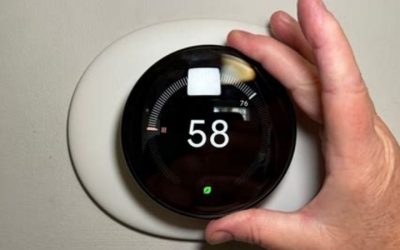
The thermostat measures 3.9 inches in diameter and 1.1 inches deep and weighs 5.7 ounces, and Google’s online checker confirms whether your wiring is supported. The round dial sits proud of the wall rather than flush, so it reads as a design piece more than the square ecobee heads do.
Pros:
- Second-gen Nest sensor included
- Works with most 24 volt systems
- Single Google Home app
Cons:
- Costs more than the ecobee Premium
- Older 2020 Nest sensor rules differ
Who Should Buy It: Choose this inside the Google ecosystem; an included ecobee SmartSensor comes with the ecobee Smart Thermostat Premium, and a wired add-on path is the Copeland Sensi Touch 2 ST76.
Copeland Sensi Touch 2 ST76: Best For Add-On Sensors
Best For: A buyer who wants to add room sensors only where needed and skip a camera or occupancy tracking.
Unlike the bundled-sensor ecobee and Nest picks, this one sells the room sensor separately, which keeps the entry price lower if you only need the thermostat at first. It also appeals to buyers who would rather not put a camera or motion sensor on the wall at all.
Copeland’s product documentation lists support for the Sensi Room Sensor RS01-SG at $39.99 each, with the ST76 thermostat at $209.99 at Home Depot as of October 2026, about $249.98 for the thermostat and one sensor.
The thermostat measures 4.72 inches tall, 6.26 inches wide and 1.77 inches deep and weighs 0.72 pound, and it requires a common C-wire rather than a power extender, so confirm you have that fifth wire before ordering. The larger landscape face also covers more of an older thermostat’s wall footprint without a trim plate.
Pros:
- Adds RS01-SG room sensors as needed
- Transparent $249.98 thermostat-and-sensor cost
- No camera or occupancy tracking
Cons:
- Requires a C-wire, no power extender
- Room sensor not included
Who Should Buy It: Pick this to add sensors room by room; a sensor in the box comes with the ecobee Smart Thermostat Premium, and Google users should look at the Nest Learning Thermostat.
ecobee Smart Thermostat Enhanced: Best For Later Expansion
Best For: A homeowner who wants ecobee multiroom sensing but does not need a sensor on day one.
It sits a step below the Premium, keeping SmartSensor compatibility and the included power extender while dropping the in-box sensor to lower the entry price. It is the pick for someone who wants the ecobee platform now and plans to add room sensors one at a time.
ecobee’s spec sheet lists optional SmartSensor support, an included power extender kit and trim plate, with the thermostat at $199.99 as of October 2026 and sensors sold separately.
The wall head measures 4.09 by 4.09 inches and 0.94 inch deep, slightly slimmer than the Premium, and it also runs on a nominal 24 volt control circuit. The included power extender means most homes avoid a separate C-wire purchase, matching the Premium on installation but not on the bundled sensor.
Pros:
- Adds optional room SmartSensors
- Lower $199.99 thermostat price
- Included power extender kit
Cons:
- No remote sensor in the box
- Add sensor cost for a fair comparison
Who Should Buy It: Buy this to expand ecobee sensing later; a bundled sensor is on the Nest Learning Thermostat, and a wired add-on system is the Copeland Sensi Touch 2 ST76.
ecobee Smart Thermostat Essential: Best Budget Pick
Best For: A cost-conscious buyer who may add one next-gen SmartSensor later rather than now.
It is the lowest-priced way into the ecobee app here, and it supports the current second-generation SmartSensor, though not the discontinued first-generation Room Sensor, a distinction worth checking if you already own older ecobee sensors.
ecobee’s product documentation lists compatibility with the next-gen SmartSensor and a separately sold power extender at $24.99, with the thermostat at $139.99 as of October 2026.
The thermostat measures 3.62 by 3.62 inches and 0.91 inch deep, the most compact wall head in this group, and its C-wire or power-extender needs differ by system, so price the extender in before you compare it with the Enhanced. Its smaller face suits a cramped wall or a hallway where the larger heads look bulky.
Pros:
- Lowest thermostat price at $139.99
- Supports next-gen SmartSensor
- Most compact wall head here
Cons:
- No first-gen Room Sensor support
- Sensor and power extender sold separately
Who Should Buy It: Pick this for the lowest entry price; a sensor in the box is the ecobee Smart Thermostat Premium, and Google users should choose the Google Nest Learning Thermostat.
How to Choose a Wireless Room Thermostat
Start with sensor compatibility, then confirm your wiring, your HVAC staging and the full system price.
Confirm Remote Sensor Compatibility First
Wi-Fi alone does not mean remote room sensing, so check which sensor a thermostat accepts before anything else. The Premium and Nest include a sensor, the Essential takes only the next-gen SmartSensor, and the Copeland ST76 uses the separate RS01-SG. Buying the wrong sensor generation is the most common and most avoidable mistake here, so read the current compatibility page rather than an older forum post.
Check Your 24 Volt Wiring and C-Wire
Before buying, turn off HVAC power at the breaker and verify a nominal 24 volt control circuit, a C-wire or a power extender option, and whether your equipment uses proprietary communication. Do not attach a 120 or 240 volt line-voltage circuit to a 24 volt smart thermostat, and send complex heat-pump, dual-fuel or zoning work to a qualified HVAC technician.
Match Supported HVAC Staging
A thermostat has to support your system’s heating and cooling stages, not just its sensors. ecobee and Nest cover most common 24 volt systems, but confirm multi-stage or heat-pump staging against the maker compatibility checker rather than assuming support. A dual-fuel or multi-stage heat pump is exactly the setup where a mismatch shows up as short cycling or a stuck auxiliary heater.
Add Up the Complete System Price
Compare full system cost, not the thermostat sticker. The Premium at $259.99 includes a sensor, while the Copeland ST76 at $209.99 with a $39.99 RS01-SG reaches about $249.98, and the Essential at $139.99 still needs a sensor and perhaps a power extender. Added up that way, the cheapest thermostat is not always the cheapest finished system, which is the figure that actually hits your card.
Frequently Asked Questions
These answers clear up the wiring and sensor questions that trip up first-time buyers.
Is a wireless room thermostat actually wireless?
Only the sensor is. The thermostat wall head still connects to low-voltage HVAC wiring in almost every case; the wireless part is the remote room sensor that reports temperature back to the thermostat.
Does adding sensors create separate room zones?
No. Remote sensors let the thermostat average or prioritize readings from occupied rooms, but they do not create independently controlled zones. True zoning needs motorized dampers in the ductwork and a separate zoning panel, which is a larger and more expensive project than adding a sensor.
Will any Nest sensor work with any Nest thermostat?
No. Sensor compatibility is tied to specific generations. The fourth-gen Nest ships with the second-gen Temperature Sensor, and you should not assume an older 2020 Nest thermostat follows the same rules.
Do I need a C-wire for these thermostats?
It depends. The Premium and Enhanced include a power extender that substitutes for a C-wire, while the Copeland ST76 requires a common wire and the Essential may need a separately sold extender.
Final Thoughts
The ecobee Smart Thermostat Premium stays the pick because it bundles a SmartSensor and a power extender that most 24 volt homes can install without extras, though Google households are better served by the Nest Learning Thermostat and sensor-by-sensor buyers by the Copeland Sensi Touch 2 ST76; before ordering, shut off the HVAC breaker, confirm your 24 volt wiring and compare the complete system price.