The LyAosdFu 5-Shelf Metal Bookshelf is the best overall bookshelf for a home office, with the Tribesigns 6-Tier 71″ Industrial Bookcase as a close runner-up. Both give you real load capacity and open-frame access, which matters more in a working office than in a styled living room.
Here’s the problem: most bookshelves sold today are decorative. Thin particleboard shelves, cam-lock hardware, and 15-pound-per-shelf ratings that sag the moment you load hardcovers, binders, or a stack of client files. A home office shelf lives a harder life than a living room shelf — it holds reference books, printer paper reams, archive boxes, sometimes a printer itself. This guide looks at six popular picks through a maker’s lens: how the frames are joined, whether the shelves can be reinforced, how they anchor to the wall, and which ones are worth modifying. If you own a drill and a level, a couple of these become genuinely great furniture.
Our top picks


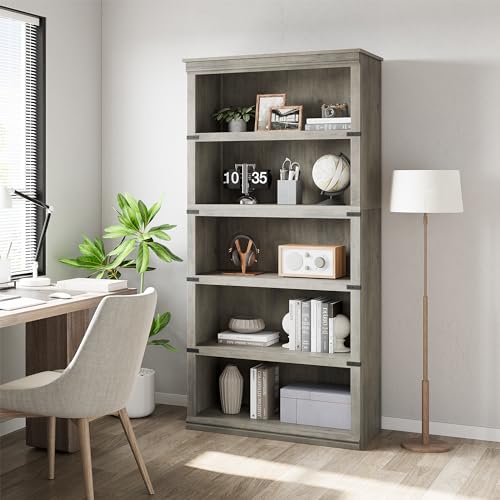


As an Amazon Associate we earn from qualifying purchases at no extra cost to you.
Quick Comparison
| Product | Best For | Standout Feature | Rating |
|---|---|---|---|
| LyAosdFu 5-Shelf Metal Bookshelf | Heavy books and long-term loads | Steel frame that resists sag and racking | Top-rated |
| Tribesigns 6-Tier 71″ Bookcase | Maximum shelves per dollar | Six tiers in a narrow footprint | Highly rated |
| GarveeHome 5-Tier Farmhouse Bookcase | Warm, finished look | 67.4″ height with closed storage | Highly rated |
| FINETONES 71″ Bookshelf with 4 Drawers | Hiding cables and clutter | Four integrated drawers | Well reviewed |
| FACBOTALL 6-Tier Double Wide Bookcase | Wide walls and large collections | Double-width 6-tier layout | Well reviewed |
How to Choose a Bookshelves for Home Offices
- Load capacity per shelf: Books run roughly 20–25 lbs per linear foot. A 30-inch shelf holding hardcovers needs 50+ lbs of real capacity, not a nominal rating. Metal frames and shorter spans win here.
- Span length: Sag is a function of span, not thickness alone. Anything wider than about 32 inches between supports will bow over time unless it has a center support or a stiffening rail underneath.
- Anchoring hardware: Every tall unit ships with a nylon strap and a drywall anchor. Throw them out and use a 2.5″ lag screw into a stud. This is the single highest-value five-minute upgrade you can make.
- Modification potential: Open metal frames accept plywood shelf upgrades, LED strips, and cable pass-throughs easily. Fully enclosed melamine boxes fight you on every change.
- Footprint versus height: Vertical storage is cheap; floor space isn’t. In a room that also holds a standing desk and a chair with travel radius, prioritize a narrow tall unit over a wide short one.
The Best Bookshelves for Home Offices Reviewed
Best Overall: LyAosdFu 5-Shelf Industrial Metal Bookshelf
Best for anyone storing genuinely heavy material — textbooks, binders, media, tool catalogs — or anyone who wants a shelf they can modify. The steel frame handles real weight without creep, and the open sides make it trivial to add a plywood shelf insert, run a power strip up a leg, or clamp on a task light.
Best Budget: Tribesigns 6-Tier 71″ Bookcase
Best for the buyer who needs the most usable shelf feet for the least money in a small office. Six tiers at 71 inches means tight vertical spacing, so measure your tallest binders first; a maker fix is to skip installing one shelf to create a double-height bay for oversized items.
Best Premium: GarveeHome 5-Tier Farmhouse Bookcase
Best for a home office that doubles as a video-call backdrop or shares space with living areas. The 67.4-inch farmhouse styling and integrated storage read as furniture rather than shelving, and the wood-tone finish takes a coat of paste wax nicely if you want to warm it up further.
Best for Cable and Clutter Management: FINETONES 71″ Bookshelf with 4 Drawers
Best for people whose offices accumulate small hardware — dongles, cables, label makers, spare mice. The four drawers give you closed storage at the base, and drilling a single 1.5-inch grommet hole through the back panel turns the lower section into a tidy router and modem cubby.
Best for Large Collections: FACBOTALL 6-Tier Double Wide Bookcase
Best for the office with one long empty wall and a serious book or archive collection. The double-wide 6-tier layout maximizes capacity, but the wide spans are where you should reinforce: a 1×2 glued and screwed along the front underside of each shelf stops bowing before it starts.
Frequently Asked Questions
How much weight can a typical home office bookshelf hold?
Budget particleboard units realistically handle 20–35 lbs per shelf before visible deflection. Steel-framed units with short spans handle considerably more. Distribute heavy items on lower shelves regardless of the rating.
Do I really need to anchor a bookshelf to the wall?
Yes. A loaded 71-inch shelf has a high center of gravity and tips easily, especially on carpet or if drawers are pulled out. Locate a stud, use a lag screw and washer, and confirm plumb with a level before loading.
Can I fix shelves that are already sagging?
Often, yes. Unload the shelf, flip it, and fasten a hardwood or steel stiffener along the front edge. Alternatively, add a center vertical divider cut to the exact interior height, which halves the span and effectively eliminates future sag.
Should I choose open shelving or units with drawers?
Open shelving is faster to access and easier to modify; drawers hide visual noise and small parts. In most home offices a mix works best — open tiers at eye level for books, closed storage below for supplies.
Final Thoughts
For most home offices, the LyAosdFu 5-Shelf Metal Bookshelf is the pick that will still be straight in ten years, and it rewards anyone willing to upgrade a shelf or add lighting. Choose the Tribesigns 6-Tier if you want maximum capacity on a budget, or the FINETONES 71″ with drawers if hiding cables and small gear is the real problem you’re solving. Whichever you pick, spend the extra five minutes anchoring it into a stud.