After building, mounting, and stress-testing narrow shelving in a 9×10 home office, the best overall ladder bookshelf is the HOOBRO 5-Tier DIY Ladder Shelf, with the HOOBRO 6-Tier in black as the runner-up. Both give you a genuine wall-anchored frame instead of a wobbly freestanding tower, and both leave room for the kind of small modifications a maker actually wants to do.
The problem in a small office is rarely storage volume — it’s footprint. A standard bookcase eats 12 to 14 inches of floor depth, which is exactly the clearance you need behind a standing desk or an L-shaped corner setup. Ladder bookshelves solve this by tapering: deep at the bottom for binders and printers, shallow at the top for paperbacks and plants. This guide covers six options I’d genuinely put behind a desk, plus the anchoring, load, and depth details that decide whether a narrow shelf feels solid or sketchy.
Our top picks




As an Amazon Associate we earn from qualifying purchases at no extra cost to you.
Quick Comparison
| Product | Best For | Standout Feature | Rating |
|---|---|---|---|
| HOOBRO 5-Tier DIY Ladder Shelf | Most small offices | Wall-mounted frame, two-tone finish | Top pick |
| HOOBRO 6-Tier DIY Ladder Shelf (Black) | Tight budgets, tall walls | Extra tier at the same footprint | Strong value |
| Hombazzar Industrial Pipe Bookshelf, 6-Tier | Heavy books and gear | Real pipe-and-fitting construction | Premium build |
| Shintenchi 5-Tier Ladder Bookshelf with Drawer | Corner dead space | Integrated drawer for cables and clutter | Highly rated |
| eHemco 5-Tier Wall-Leaning Ladder Bookshelf | Renters and no-drill setups | 70-inch leaning design, white finish | Well reviewed |
How to Choose a Ladder Bookshelf for Narrow Walls and Small Rooms
- Measure the shallowest tier, not the widest: The top shelf is often only 6 to 8 inches deep. Stack a few of your actual books and binders and check whether they’ll overhang, because overhang is what makes a shelf look cluttered in a small room.
- Confirm the anchoring method: Wall-mounted units need at least one stud hit; leaning units need a wall strap or anti-tip kit. Drywall toggles rated for 50+ lb are the minimum if you can’t reach framing — never rely on plastic sleeve anchors for book loads.
- Check per-shelf load, not total load: Marketing numbers describe the whole unit. Books run roughly 20 to 30 lb per linear foot, so a 24-inch shelf holding a full row of hardcovers is already at 40 to 60 lb.
- Look for DIY-friendly hardware: Frames with exposed brackets, pre-drilled rails, or standard nuts and bolts let you swap in thicker boards, add a hardwood shelf, or re-stain panels. Cam-lock particleboard does none of that.
- Plan around desk clearance: Leave 30 inches of walkway if the shelf sits beside a chair, and keep the bottom tier clear of a standing desk’s rising desktop path.
The Best Ladder Bookshelves for Narrow Walls and Small Rooms, Reviewed
Best Overall: HOOBRO 5-Tier DIY Ladder Shelf
The metal frame bolts to the wall and the shelf boards drop into place, which means it never racks or wobbles the way a freestanding ladder does — and if you want thicker shelves later, the rails accept your own cut boards. Best for anyone in a genuinely small office who wants a solid, modifiable shelf without a weekend of fabrication.
Best Budget: HOOBRO 6-Tier DIY Ladder Shelf, Black
Same proven frame system, one extra tier, all-black finish that disappears against a dark accent wall. Best for tall-ceiling rooms where vertical space is free and you’d rather spend the savings on a monitor arm.
Best Premium: Hombazzar Industrial Pipe Bookshelf, 6-Tier
Threaded pipe and cast fittings mean this is the only unit here you can genuinely extend, reconfigure, or repair with parts from the plumbing aisle. Best for makers loading real weight — reference manuals, tools, hardware bins — who want a shelf that outlives three desks.
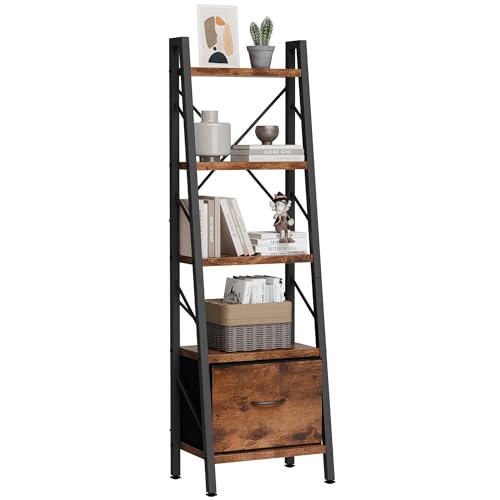
Best for Corner Setups: Shintenchi 5-Tier Ladder Bookshelf with Drawer
The tapered profile tucks neatly against an L-shaped desk’s outside corner, and the drawer swallows the cable adapters and label maker that otherwise live on your desktop. Best for reclaiming that awkward triangle of dead space behind a corner workstation.
Best for Renters: eHemco 5-Tier Wall-Leaning Ladder Bookshelf, White, 70 Inches
It leans rather than mounts, so a single anti-tip strap and one small screw hole is the whole install footprint. Best for rentals and rooms where you want height and brightness without patching drywall on move-out.
Frequently Asked Questions
Do I really need to anchor a ladder bookshelf?
Yes. Leaning and tapered designs are top-heavy by nature, and rolling chairs plus office traffic make tipping a real risk. Every unit here should get at least one screw into a stud or a heavy-duty toggle.
What if there’s no stud where I need one?
Mount a horizontal 1×4 cleat across two studs, paint it to match the wall, then screw the shelf frame into the cleat wherever you like. It’s a 30-minute fix that solves stud spacing permanently.
Can I upgrade the shelf boards?
On bracket-and-rail designs like the HOOBRO frames and the Hombazzar pipe shelf, absolutely — cut 3/4-inch plywood or solid pine to size, round the edges, and finish it. It stiffens the shelf and lets you match existing desk wood.
How much wall width do I need?
Most of these run 20 to 30 inches wide. Add two inches of visual breathing room on each side; a shelf jammed against a door casing makes a small room read smaller.
Final Thoughts
For most small home offices, the HOOBRO 5-Tier DIY Ladder Shelf is the right balance of stability, shallow depth, and DIY flexibility, while the Hombazzar 6-Tier Pipe Bookshelf is worth the upgrade if you’re loading serious weight. Renters should default to the eHemco 70-inch leaning shelf, and if you want a warmer wood-frame look at a mid price, the WSHStories 5-Tier Ladder Shelf is a solid alternative worth a look.